Quick answer: Cytochrome P450 (CYP) is a superfamily of heme-containing monooxygenases, found mainly in the smooth endoplasmic reticulum of liver cells, that carry out phase 1 metabolism, mostly hydroxylation, of drugs and other xenobiotics using NADPH and oxygen. Most CYPs are inducible. Induction lowers drug effect, inhibition raises drug levels, and genetic variation explains differences between patients.
Where does CYP fit in drug metabolism?
A xenobiotic is a foreign compound. The main ones of medical relevance are drugs, chemical carcinogens, natural compounds in plant foods and environmental compounds such as pesticides. Most are metabolised in the liver. Metabolism is usually detoxification, but sometimes a harmless compound becomes active. That can be wanted, as when a prodrug is activated, or unwanted, as when an inert compound becomes a carcinogen or mutagen.
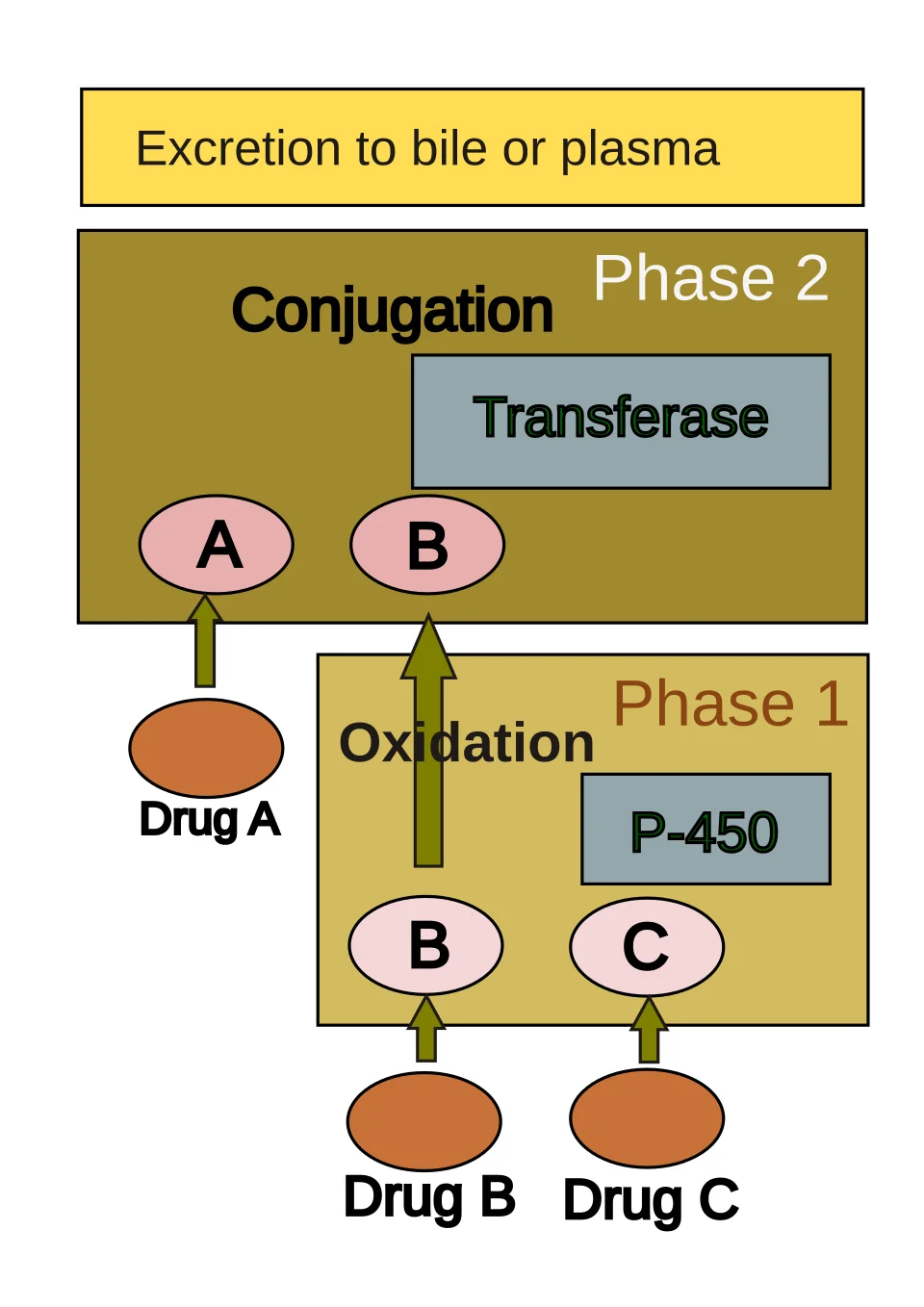
Metabolism of xenobiotics occurs in two phases:
- Phase 1: the major reaction is hydroxylation, catalysed by monooxygenases, also called cytochromes P450. Phase 1 makes a compound more reactive by introducing groups that can be conjugated or excreted. Some phase 1 reactions, such as hydrolysis by esterases, do not involve P450.
- Phase 2: conjugation. Glucuronyltransferases, sulfotransferases and glutathione S-transferases use UDP-glucuronic acid, PAPS (active sulfate) and glutathione as donors. Phase 2 converts active products of phase 1 into inactive compounds.
The rate at which CYPs detoxify a drug often decides how long it acts. Examples of compounds hydroxylated this way are benzpyrene, aminopyrine, aniline, morphine and benzphetamine, which become more soluble and easier to excrete.
Salient features of cytochrome P450
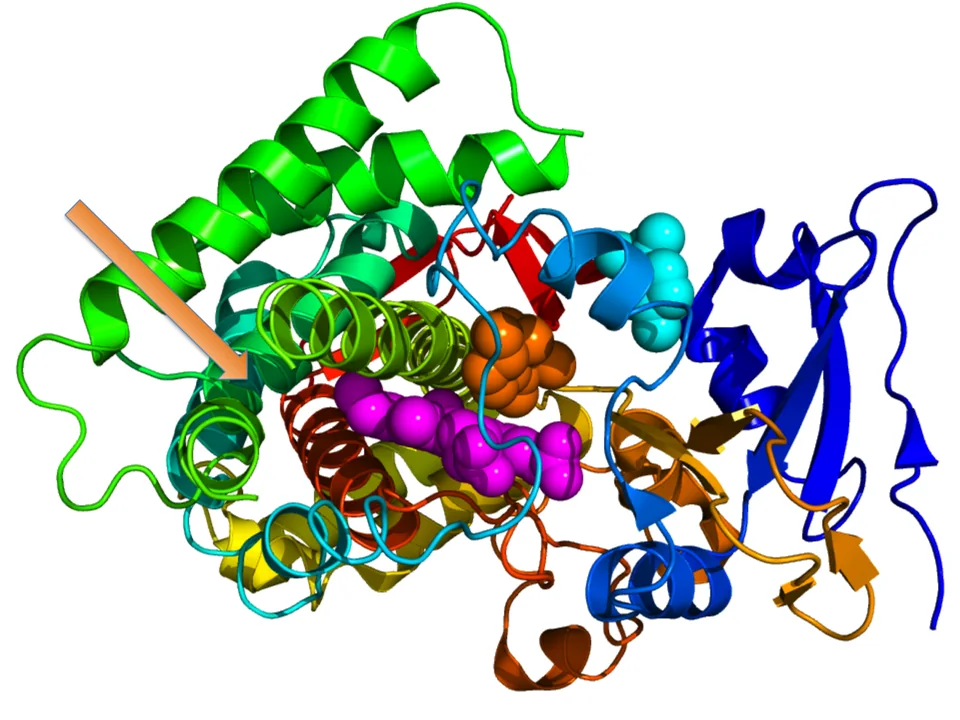
- All are hemoproteins with heme as the prosthetic group.
- They show a peak absorption at 450 nm when complexed with carbon monoxide, which gives the name.
- Highest concentration is in the smooth endoplasmic reticulum (microsomes) of the liver, so P450 is also called the liver microsomal oxidase system. In hepatic microsomes they can be as much as 20% of total protein. They are also found in enterocytes and virtually all tissues.
- In the adrenal gland they are present in mitochondria as well as the endoplasmic reticulum, where they take part in cholesterol and steroid hormone synthesis.
- The reaction depends on NADPH, and the phospholipid phosphatidylcholine is needed for the enzyme to act.
- Multiple forms exist. Most are inducible.
- A distinct form, cytochrome P448, has an absorption peak at 448 nm. It is specific for polycyclic aromatic hydrocarbons and is also called aromatic hydrocarbon hydroxylase.
- Besides drugs, CYPs act on steroid hormones, carcinogens and pollutants, and take part in the synthesis of steroid hormones and the conversion of vitamin D to its active form, calcitriol.
The reaction
CYPs add a hydroxyl group to aliphatic or aromatic compounds. The steps:
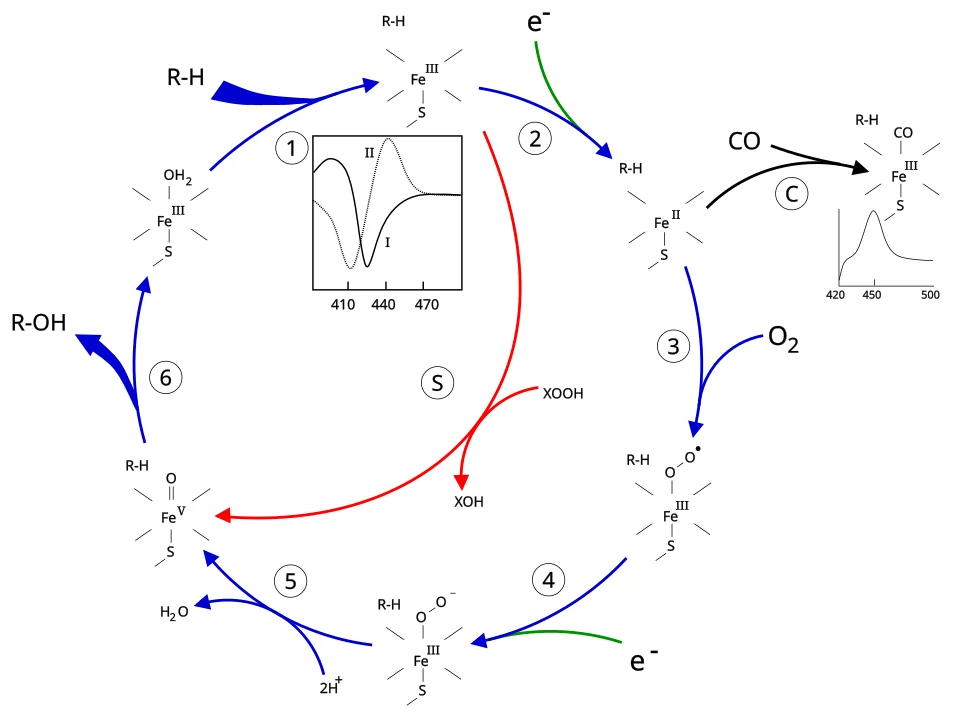
- NADPH-cytochrome P450 reductase, a flavoprotein, passes electrons from NADPH to cytochrome P450. Cytochrome b5, another hemoprotein in smooth ER membranes, may donate electrons in some cases.
- Reduced cytochrome P450 activates molecular oxygen.
- One oxygen atom becomes the hydroxyl group on the substrate, and the other is reduced to water.
Because one oxygen atom goes into the substrate, CYPs are called monooxygenases. Besides hydroxylation they catalyse deamination, dehalogenation, desulfuration, epoxidation, peroxygenation, dealkylation, ester cleavage and reduction.
Nomenclature
CYP names are built from the amino acid sequence similarity:
- CYP: the root, meaning cytochrome P450
- A number: the family (40% or more amino acid identity)
- A capital letter: the subfamily (more than 55% identity)
- A number: the individual enzyme in the subfamily
So CYP3A4 is family 3, subfamily A, enzyme 4. The gene name is written the same way in italics.
At least 57 functional CYP genes are found in humans. About 15 CYPs in families 1, 2 and 3 do most xenobiotic metabolism. Twelve are particularly important: CYP1A1, 1A2, 1B1, 2A6, 2B6, 2C8, 2C9, 2C19, 2D6, 2E1, 3A4 and 3A5. The liver has the most, which ensures efficient first-pass metabolism. The enzymes have overlapping substrate specificities, so a single CYP can metabolise many different compounds, and the same compound can be handled by more than one CYP.
Major isoforms and their drugs
| Enzyme | Substrates (examples) | Inhibitors | Inducers |
|---|---|---|---|
| CYP1A2 | Caffeine, clozapine, theophylline | Cimetidine, fluvoxamine, ciprofloxacin | Omeprazole, tobacco smoke |
| CYP2C9 | Warfarin, phenytoin, diclofenac, ibuprofen, tolbutamide, losartan, celecoxib | Fluconazole, fluvastatin, amiodarone, zafirlukast | Rifampin |
| CYP2C19 | Omeprazole, lansoprazole, pantoprazole, diazepam, voriconazole | Cimetidine, fluvoxamine | Rifampin |
| CYP2D6 | Amitriptyline, imipramine, haloperidol, risperidone, paroxetine | Fluoxetine, paroxetine | Not listed here |
| CYP3A4 | Calcium channel blockers such as diltiazem | Erythromycin and ketoconazole are among the strongest | Barbiturates, carbamazepine, phenytoin |
Key points on individual enzymes:
- CYP3A4: two of its strongest inhibitors are erythromycin (a macrolide) and ketoconazole (an azole antifungal). In each of these drug groups alternatives exist that barely inhibit the enzyme.
- CYP2C8/9: important for more than 15 common drugs including phenytoin, carbamazepine and warfarin, which have a narrow safety margin.
- CYP2C19: metabolises more than 12 common drugs including omeprazole, lansoprazole, phenytoin and diazepam.
- CYP1A1/2: handles only a few drugs (theophylline, caffeine, paracetamol, carbamazepine) but is more important for activating procarcinogens. Polycyclic hydrocarbons, cigarette smoke and charbroiled meat are potent inducers.
- CYP2E1: oxidises alcohol and halothane, and forms the minor, hepatotoxic metabolite N-acetyl benzoquinoneimine (NAPQI) from paracetamol. Chronic alcoholism induces it.
- CYP2D6: shows genetic polymorphism. An ultrarapid metaboliser genotype has also been identified.
Enzyme induction
Most CYP isoforms are inducible. Giving phenobarbital or similar drugs causes hypertrophy of the smooth endoplasmic reticulum and a three- to fourfold increase in the amount of cytochrome P450 within a few days. In most cases this is increased transcription to mRNA. In some cases induction involves stabilising the mRNA or the enzyme protein, or increased translation of existing mRNA.
In general, induction decreases therapeutic effect.
- Warfarin: metabolised by CYP2C9, which is induced by phenobarbital. Induction increases metabolism, so warfarin efficacy falls and the dose must be increased.
- Ethanol: induces CYP2E1, which metabolises some widely used solvents and compounds in tobacco smoke, many of them procarcinogens. This raises the risk of carcinogenicity.
- Smoking and charbroiled food: potent inducers of CYP1A.
- Phenobarbital and rifampin are classic inducers.
Enzyme inhibition
An inhibitor slows the metabolism of another drug (the substrate). Think of a shared road (the CYP isoform) where the inhibitor blocks the traffic. Interactions with inhibitors have three features:
- They are immediate.
- Substrate drug levels rise.
- The result is drug toxicity.
In terms of kinetics, inhibition increases the area under the curve (AUC), decreases clearance, raises plasma level and increases the chance of adverse reactions.
Risk is highest for narrow therapeutic index drugs such as methotrexate, cyclosporine and warfarin. A narrow therapeutic index means the toxic and effective doses are close together. Drugs that depend on only one metabolic pathway are at greater risk than those with several, because with several pathways the backed-up traffic can be diverted to another CYP or a phase 2 enzyme.
Drug-drug interactions are among the leading causes of adverse drug reactions.
Foods can also inhibit CYP. Grapefruit contains furanocoumarins, which inhibit cytochrome P450 and so alter the metabolism of many drugs. For drugs that need CYP to be activated, grapefruit reduces their activity.
| Feature | Induction | Inhibition |
|---|---|---|
| Effect on CYP | More enzyme made | Enzyme activity blocked |
| Onset | Takes days (new protein synthesis) | Immediate |
| Substrate level | Falls | Rises (higher AUC, lower clearance) |
| Main clinical result | Loss of efficacy | Toxicity |
| Example | Phenobarbital and warfarin (CYP2C9) | Erythromycin or ketoconazole and CYP3A4 substrates |
Direction check: inducer means substrate level falls and the drug fails. Inhibitor means substrate level rises and the drug is toxic. Prodrugs behave the other way round, because they need CYP to become active.
Clinical examples
- Doxepin with paroxetine or fluoxetine: if doxepin is needed in a patient on one of these CYP2D6 inhibitors, watch closely for sedation, consider checking a drug level, and dose very conservatively.
- Drug withdrawals: several drugs were removed from the market after life-threatening interactions. In each case a known CYP3A4 inhibitor was commonly co-prescribed with a CYP3A substrate of narrow therapeutic index. Official warning letters did not change prescribing enough.
- Liver injury patterns: CYPs convert some compounds, such as acetaminophen and carbon tetrachloride, to reactive metabolites. This helps explain the zonal pattern of liver lesions they cause.
Genetic and other variation
The hepatic expression of each CYP is genetically determined. This explains much of the fourfold or greater difference in rates of drug metabolism among healthy people. Some CYPs are polymorphic, and some people lack the protein.
- Intermediate metabolisers (IM): relatively frequent, heterozygous for the normal gene.
- Poor metabolisers (PM): uncommon, homozygous for the mutation, with low or absent activity.
- Ultrarapid metabolisers: identified for CYP2D6.
CYP2D6 metabolises debrisoquine and perhexiline. Poor metabolisers lack CYP2D6 and accumulate perhexiline at usual doses. Lack of CYP2D6 is the critical factor in serious adverse effects of perhexiline, including chronic hepatitis and cirrhosis.
Reduced drug metabolism is linked to polymorphism at these alleles:
| Gene | Reduced metabolism |
|---|---|
| CYP2C9 | 6 to 8% of Caucasians |
| CYP2C19 | 3 to 5% of Caucasians and 12 to 23% of Asians |
| CYP2D6 | 6 to 10% of Caucasians, 2 to 5% of African Americans, 1% of Asians |
Other factors matter less. Expression of some CYPs declines slightly with age (by up to 10%), which is minor compared with genetics, environment and liver disease. Gender differences in CYP3A4 and CYP2E1 may explain slightly faster metabolism of certain drugs (erythromycin, chlordiazepoxide, midazolam) in women. Some CYPs are also developmentally regulated.
Mnemonics
Naming CYP3A4: CYP, then 3 (family), A (subfamily), 4 (the enzyme). Families share 40% or more identity, subfamilies more than 55%.
Practice MCQs
Cytochrome P450 enzymes are located mainly in the:
- A. Mitochondria of hepatocytes
- B. Cytosol of renal tubular cells
- C. Smooth endoplasmic reticulum of liver cells
- D. Lysosomes of macrophages
Show answer
Answer: C. CYPs are heme-containing monooxygenases found mainly in the smooth endoplasmic reticulum (microsomes) of hepatocytes.
In the cytochrome P450 reaction, molecular oxygen is used so that:
- A. Both atoms are incorporated into the substrate
- B. One atom enters the substrate as a hydroxyl group and the other becomes water
- C. Oxygen is converted to hydrogen peroxide
- D. Oxygen oxidises NADPH directly
Show answer
Answer: B. One atom of molecular oxygen becomes the hydroxyl group on the substrate and the other is reduced to water, using electrons from NADPH. That makes P450 a monooxygenase.
A patient on stable warfarin is started on phenobarbital. The expected effect is:
- A. Reduced anticoagulant effect of warfarin
- B. Increased anticoagulant effect of warfarin
- C. No change, as warfarin is not a CYP substrate
- D. Immediate warfarin toxicity
Show answer
Answer: A. Phenobarbital induces CYP2C9, which metabolises warfarin. Faster metabolism lowers warfarin levels and efficacy, so the dose must be increased.
Which pair are strong inhibitors of CYP3A4?
- A. Rifampin and phenobarbital
- B. Omeprazole and tobacco
- C. Phenytoin and carbamazepine
- D. Erythromycin and ketoconazole
Show answer
Answer: D. Erythromycin and ketoconazole are among the strongest CYP3A4 inhibitors, so they raise levels of CYP3A4 substrates and can cause toxicity.
In the name CYP2D6, the letter D denotes the:
- A. Family
- B. Individual enzyme
- C. Subfamily
- D. Gene mutation
Show answer
Answer: C. The root CYP is followed by the family number, then the subfamily letter, then the individual enzyme number. CYP2D6 is family 2, subfamily D, enzyme 6.
Toxicity from enzyme inhibition is most likely with a drug that:
- A. Has a wide therapeutic index and many metabolic pathways
- B. Has a narrow therapeutic index and a single metabolic pathway
- C. Is a prodrug activated by the inhibited enzyme
- D. Is excreted unchanged by the kidney
Show answer
Answer: B. Narrow therapeutic index drugs such as methotrexate, cyclosporine and warfarin carry the greatest risk of toxicity when a CYP inhibitor raises their levels. Single-pathway drugs are also at greater risk.
Viva questions
What is cytochrome P450?
A superfamily of heme-containing monooxygenases, found mainly in the smooth endoplasmic reticulum of the liver, that catalyse phase 1 metabolism of drugs and other xenobiotics, mainly by hydroxylation.
Why is it called P450?
Because it is a pigment (P) containing heme, and when complexed with carbon monoxide it shows a peak absorption at 450 nm.
Describe the reaction catalysed by cytochrome P450.
NADPH-cytochrome P450 reductase passes electrons from NADPH to P450. Reduced P450 activates molecular oxygen. One oxygen atom goes into the substrate as a hydroxyl group and the other is reduced to water.
How are CYP enzymes named?
CYP, then a number for the family (40% or more identity), a letter for the subfamily (more than 55% identity), and a number for the individual enzyme. CYP3A4 is family 3, subfamily A, enzyme 4.
What is enzyme induction? Give an example.
Increased synthesis of CYP, for example by phenobarbital, causing smooth ER hypertrophy and a three- to fourfold rise in enzyme within days. It speeds drug metabolism and lowers effect, as with warfarin and phenobarbital via CYP2C9.
What happens with enzyme inhibition?
Metabolism of the substrate slows at once, its levels rise and toxicity can follow, especially for narrow therapeutic index drugs like methotrexate, cyclosporine and warfarin. Erythromycin and ketoconazole inhibit CYP3A4.
What is the clinical importance of CYP polymorphism?
CYP expression is genetically determined, so metabolism can differ fourfold or more between people. Poor metabolisers, for example CYP2D6 deficiency with perhexiline, accumulate drug at usual doses and may have serious adverse effects.
Flashcards
Still mixing up induction and inhibition? Ask the GalenAI tutor and practise cytochrome P450 MCQs.