Quick answer: A culture medium is a mixture of chemicals that supports the growth of microorganisms and must supply a source of carbon and energy. Media are solid (set with agar) or liquid. By purpose they are simple, enriched, enrichment, selective, indicator, differential, sugar, transport or anaerobic. Blood agar, chocolate agar and MacConkey agar are the routine plates in diagnostic bacteriology.
What is a culture medium?
To identify a clinically important bacterium, it first has to be isolated from the sample sent to the laboratory. The sample is inoculated on a medium that gives the bacteria what they need to multiply. They then form colonies on a solid medium or a suspension in a liquid medium. This is the starting point for identification and for antibiotic susceptibility testing.
A culture medium is a mixture of chemicals that can support the growth of microorganisms. It should contain a source of carbon and energy.
In general a medium has to provide these groups of nutrients:
- Hydrogen donors and acceptors
- A carbon source
- A nitrogen source
- Minerals such as sulfur and phosphorus, plus trace elements
- Growth factors such as amino acids, purines, pyrimidines and vitamins
For studies of microbial metabolism a completely synthetic medium is prepared, in which the exact concentration of every ingredient is known. For routine work it is much cheaper and simpler to use natural materials such as yeast extract or protein digest. Most free-living microbes grow well on yeast extract. Parasitic forms may need special substances found only in blood or in animal tissue extracts. Some parasitic microbes cannot be grown on artificial media at all: Treponema pallidum cannot be grown in vitro, and Chlamydia trachomatis grows only inside eukaryotic cells.
Common ingredients
- Agar (agar-agar) is the solidifying agent. It is obtained from a type of seaweed. It has virtually no nutritive value and is not affected by the growth of bacteria. It melts at 98 degrees C and usually sets at 42 degrees C, depending on concentration. About 2% agar is used for solid media. Occasionally heated serum or egg is used to make a solid medium instead.
- Peptone is a complex mixture of partly digested proteins. It contains proteoses, peptones, polypeptides and amino acids, a variety of inorganic salts including phosphates, potassium and magnesium, and accessory growth factors such as riboflavin.
- Blood, serum and yeast extract are other common ingredients.
Solid and liquid media
Media are classified first by physical state.
| Feature | Solid media | Liquid media (broth) |
|---|---|---|
| How made | A gel formed by adding agar | No gelling agent |
| Growth looks like | Discrete colonies, each a clone of cells from a single bacterial cell, when inoculated in suitable dilution | Diffuse turbidity |
| Main use | Isolation of pure colonies and study of colony characteristics, pigment and haemolysis | Large volumes (blood or water), bulk cultures of antigens or vaccines, back-up cultures |
Liquid media are used to obtain bacterial growth from blood or water when large volumes have to be tested, and for preparing bulk cultures of antigens or vaccines. Bacteria grow diffusely in liquids and produce uniform turbidity. Fluid enrichment media are first incubated at 37 degrees C and then subcultured on a solid medium to get individual isolated colonies.
Broth cultures in highly enriched media are also important as back-up cultures of biopsy tissue and body fluids such as CSF. A broth may be positive when there is no growth on solid media, because the inoculum contained only a small number of bacteria.
Solid media let bacteria show their own colony morphology and characteristic features such as pigmentation or haemolysis, which makes identification easier. When studying colonies on a solid medium, note:
- Shape: circular, irregular or rhizoid
- Size in millimetres
- Elevation: effuse, elevated, convex, concave, umbonate or umbilicate
- Margin: bevelled or otherwise
- Surface: smooth, wavy, rough, granular, papillate or glistening
- Edge: entire, undulate, crenated, fimbriate or curled
- Colour: white, buff, pink and so on
- Structure: opaque, translucent or transparent
- Consistency: membranous, friable, butyrous or viscid
- Emulsifiability
Microorganisms exist as mixed populations in clinical material and as resident flora. They must be grown in pure culture so that their properties can be demonstrated and they can be identified for their clinical significance.
Classification by purpose
Culture media can be categorised as simple (basal), complex, enriched, enrichment, selective, indicator, differential, sugar, transport or anaerobic media.
| Type | Idea | Examples |
|---|---|---|
| Simple (basal) | Basic nutrients only | Nutrient broth, nutrient agar |
| Complex | Extra ingredients for special purposes or special nutrients | Blood agar |
| Enriched | For bacteria with exacting nutritional needs | Brain-heart infusion broth, blood agar, chocolate agar |
| Enrichment | Liquid medium that stimulates the wanted bacteria or inhibits those to be suppressed | Tetrathionate broth, selenite F broth |
| Selective | Solid medium with an inhibiting substance added | Thayer-Martin medium, desoxycholate citrate agar (DCA), TCBS agar |
| Indicator | Changes colour when a bacterium grows in it | Wilson-Blair medium, MacConkey agar (in some descriptions) |
| Differential | Helps to tell apart characteristics of bacteria | MacConkey agar, mannitol salt agar |
| Transport | Carries samples containing delicate organisms | Stuart's medium, buffered glycerol saline |
| Anaerobic | Grows anaerobes using reducing substances or absence of oxygen | Robertson's cooked meat medium, thioglycollate medium |
Be careful with one point. In some descriptions MacConkey agar is listed as an indicator medium, because it separates lactose fermenters from non-lactose fermenters. In others it is the standard example of a differential medium. Both uses refer to the same property, so check which term your department prefers.
Simple (basal) media
Nutrient broth contains peptone, meat extract, sodium chloride and water. Nutrient agar is made by adding 2% agar to nutrient broth. It is the simplest and most common medium in routine diagnostic laboratories.
Complex and enriched media
Complex media have added ingredients for special purposes, to bring out certain characteristics, or to provide the special nutrients needed by the bacterium under study.
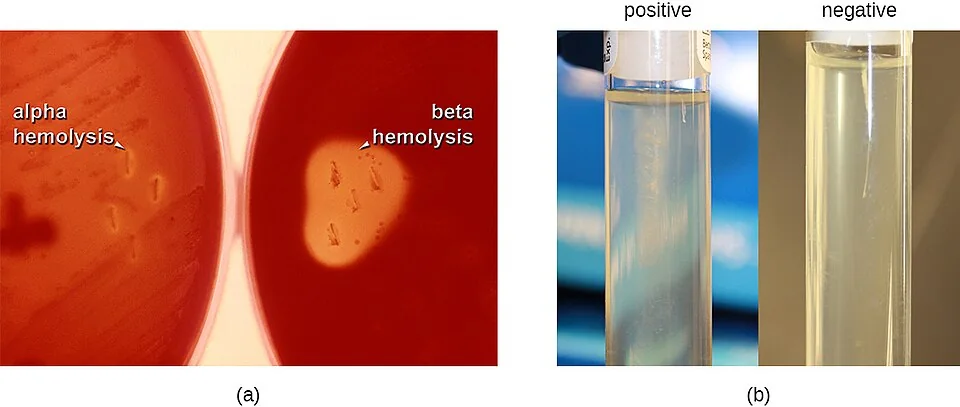
Blood agar is a solid medium made of agar and blood. The blood is usually from sheep. For routine specimens it is made with 5% sheep blood and is the standard medium, because most aerobic and facultatively anaerobic organisms grow on it. Supplementing it with cysteine and hemin enhances the growth of anaerobic bacteria. Blood agar also shows the degree of haemolysis caused by bacterial haemolysin, and this is used to separate Gram-positive cocci. For example, viridans streptococci produce alpha haemolysis on blood agar.
Chocolate agar contains heated blood, with or without supplements. It is the second routine medium. Some organisms that do not grow on blood agar, including the pathogenic Neisseria and Haemophilus, grow on chocolate agar. Colonies on blood agar or other hemin-containing media can look dark brown because they absorb the hemin pigment.
Enrichment media
An enrichment medium is liquid. A substance is added that stimulates the bacterium you want or inhibits the ones you want to suppress. Tetrathionate broth and selenite F broth are the usual examples. Do not confuse these with enriched media: enriched media supply extra nutrients to fussy organisms, while enrichment media tilt the competition in favour of the target organism.
Selective media
A selective medium is a solid medium with an inhibiting substance, so that the wanted bacteria form colonies more readily than the others. Examples:
- Thayer-Martin medium, a selective medium for the pathogenic Neisseria
- Desoxycholate citrate agar (DCA) for faecal samples
- Thiosulphate citrate bile sucrose agar (TCBS) for Vibrio species
- Salmonella Shigella agar, which isolates Salmonella and Shigella from faecal samples
- Potassium tellurite agar, on which Corynebacterium diphtheriae forms black colonies
Indicator and differential media
An indicator medium changes colour when a bacterium grows in it. A differential medium helps to tell characteristics of bacteria apart.
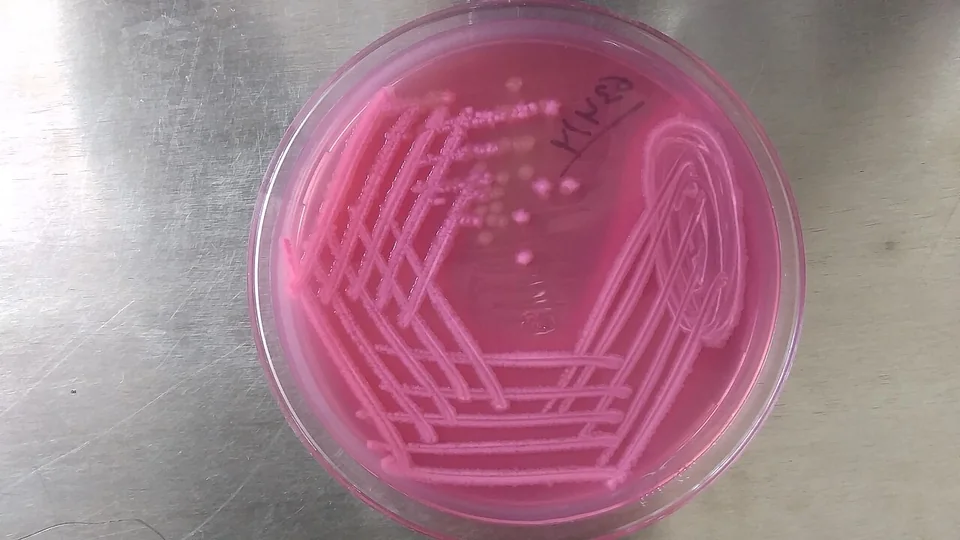
- MacConkey agar separates lactose fermenters from non-lactose fermenters. It is selective for enteric Gram-negative rods and contains an indicator. Escherichia coli forms flat, smooth, pink colonies. Klebsiella pneumoniae forms large, mucoid colonies. Non-lactose fermenters give colourless colonies. Eosin-methylene blue (EMB) agar is an alternative used for the same purpose.
- Mannitol salt agar helps to tell Staphylococcus aureus from Staphylococcus epidermidis.
Routine plate set: blood agar (5% sheep blood) for most organisms, chocolate agar for Neisseria and Haemophilus, and MacConkey or EMB for enteric Gram-negative rods. Anaerobes need their own anaerobic medium.
Transport media
Transport media are special media devised for carrying specimens that may contain fastidious or delicate organisms. Stuart's medium is a non-nutrient soft agar gel. It contains a reducing agent to prevent oxidation and charcoal to neutralise certain bacterial inhibitors. It is used to transport specimens for isolation of gonococci, and it is also used for throat and genital swabs. Buffered glycerol saline is used for enteric bacilli.
Anaerobic media
Anaerobic media grow anaerobic organisms in the presence of reducing substances or in the absence of oxygen.
- Robertson's cooked meat medium
- Thioglycollate medium: supports organisms with varied oxygen requirements, namely anaerobes, aerobes and facultative anaerobes. An oxygen indicator turns the top of the medium pink or blue. The medium is boiled before use to drive out oxygen, because oxygen is less soluble at high temperature. Obligate aerobes grow only at the top of the tube, microaerophiles in the middle, and anaerobes only at the bottom.
- Brucella agar: a highly supplemented medium containing hemin and vitamin K. Specimens for obligate anaerobes must be plated on anaerobic media, or on a selective medium that inhibits enteric Gram-negative rods and facultatively anaerobic or anaerobic Gram-positive cocci.
Anaerobic conditions for plates can also be created with the McIntosh-Fildes anaerobic jar, Gaspak, the pre-reduced anaerobic system (PRAS) or an anaerobic chamber (glove box).
Special-purpose media in diagnostic work
- Chromogenic agars incorporate antibiotics and chromogenic enzyme substrates that give colour to specific organisms, such as methicillin-resistant Staphylococcus aureus (MRSA) and various Candida species. They are more expensive, but they raise sensitivity by suppressing background flora and making the pathogen easier to recognise. They are typically used for surveillance cultures and urine cultures. CHROM agar is used to speciate Candida from the colour produced by each species.
- Screen agars select out MRSA and vancomycin resistance in staphylococci.
- Media with beta-lactamase detection enzymes help detect antibiotic resistance.
- Cation-adjusted Mueller-Hinton agar is the medium for antibiotic susceptibility testing.
Media for fungi
All fungi are basically aerobic. Culture is usually more sensitive than direct examination, so part of the material collected for microscopy should also be cultured.
- Sabouraud dextrose agar (SDA) is the traditional mycological medium. It contains glucose and modified peptone, supports the growth of fungi and restricts the growth of bacteria. The morphological features used to identify fungi were described on SDA.
- Inhibitory mold agar (IMA) and brain-heart infusion agar, with or without antibiotics, enhance recovery from clinical specimens and have largely replaced the traditional use of SDA in some laboratories.
- Other media used in mycology include Czapek-Dox medium, bird seed agar and corn meal agar. Media made from plant and vegetable materials also grow many fungi, because these are their natural habitats.
- Potato dextrose agar stimulates the production of conidia once a culture has been obtained.
- Many yeasts also grow well on blood agar. Non-specific media such as blood agar or brain-heart infusion can be made selective for fungi by adding antibacterials.
For nonsterile specimens, antibacterial antibiotics such as gentamicin and chloramphenicol are added to inhibit bacteria, and cycloheximide is added to inhibit saprobic (contaminant) moulds.
Fungal cultures are commonly set up in paired sets, one incubated at 25 to 30 degrees C and the other at 35 to 37 degrees C. Identification rests largely on the morphology of the fungus and its colony: rapidity of growth, colour and form of the colony on the surface, and pigmentation on the reverse.
Why media matter in the clinic
- The choice of media depends on the clinical diagnosis and the organisms under consideration. Several types are needed for routine culture, particularly when aerobic, facultatively anaerobic and obligately anaerobic bacteria are all possible.
- Colony appearance, pigment, haemolysis and reactions on indicator media give the first clues to identity.
- The same colonies that are picked from solid media go on to biochemical tests and susceptibility testing.
Mnemonics
Enriched versus enrichment: Enriched media add nutrients for fussy bacteria (blood agar, chocolate agar). Enrichment media are liquids that favour one organism over others (selenite F, tetrathionate).
Practice MCQs
The role of agar in a culture medium is to:
- A. Supply carbon and energy
- B. Supply amino acids
- C. Act as a solidifying agent without nutritive value
- D. Act as an indicator of acid production
Show answer
Answer: C. Agar is obtained from seaweed and has virtually no nutritive value. It only gives a gel, and it is not affected by bacterial growth.
A swab is suspected to contain Haemophilus. Which routine medium is the better choice than plain blood agar?
- A. MacConkey agar
- B. Chocolate agar
- C. Thioglycollate broth
- D. Potassium tellurite agar
Show answer
Answer: B. Some organisms that fail to grow on blood agar, including pathogenic Neisseria and Haemophilus, grow on chocolate agar, which contains heated blood.
Which of the following is an enrichment medium?
- A. Selenite F broth
- B. Blood agar
- C. Nutrient agar
- D. Thayer-Martin medium
Show answer
Answer: A. Enrichment media are liquid media that stimulate the wanted bacteria or inhibit others. Selenite F broth is a standard example.
Pink colonies on MacConkey agar indicate an organism that:
- A. Cannot grow in the presence of bile
- B. Is an obligate anaerobe
- C. Produces alpha haemolysis
- D. Ferments lactose
Show answer
Answer: D. MacConkey agar contains indicators that separate lactose fermenters from non-lactose fermenters, so E. coli gives pink colonies and non-lactose fermenters give colourless ones.
In a tube of thioglycollate medium, obligate anaerobes grow:
- A. Only at the top
- B. In the middle
- C. Only at the bottom
- D. Evenly throughout
Show answer
Answer: C. In thioglycollate medium obligate aerobes grow only near the top where oxygen is present, microaerophiles in the middle, and anaerobes only at the bottom.
Cycloheximide is added to fungal culture media to:
- A. Stimulate production of conidia
- B. Inhibit contaminant moulds
- C. Inhibit bacterial growth
- D. Act as an oxygen indicator
Show answer
Answer: B. Cycloheximide inhibits saprobic (contaminant) moulds, while antibacterials such as gentamicin and chloramphenicol inhibit bacteria. Together they let the pathogenic fungus grow from nonsterile specimens.
Viva questions
Define a culture medium.
A mixture of chemicals that can support the growth of microorganisms. It must contain a source of carbon and energy.
Why is agar used in solid media?
Agar comes from seaweed and forms a gel. It has virtually no nutritive value and is not affected by bacterial growth. It melts at 98 degrees C and sets at about 42 degrees C, and about 2% is used.
Which media are used routinely for a diagnostic specimen?
Blood agar (usually 5% sheep blood) as the standard, chocolate agar as the second medium, and MacConkey or EMB agar for enteric Gram-negative rods. Anaerobic media are added when anaerobes are possible.
What is the difference between enriched and enrichment media?
Enriched media supply extra nutrients for bacteria with exacting needs, for example blood agar and chocolate agar. Enrichment media are liquids that stimulate the wanted bacteria or inhibit others, for example tetrathionate and selenite F broth.
What is a transport medium? Give an example.
A medium used to carry samples containing delicate organisms. Stuart's medium is a non-nutrient soft agar with a reducing agent and charcoal, used for gonococci and swabs.
How does MacConkey agar work?
It is selective for enteric Gram-negative rods and contains an indicator, so lactose fermenters (pink colonies, such as E. coli) can be told apart from non-lactose fermenters (colourless colonies).
Which medium is used for fungi, and how are bacteria and contaminant moulds suppressed?
Sabouraud dextrose agar, which contains glucose and modified peptone, or inhibitory mold agar. Antibacterials such as gentamicin and chloramphenicol inhibit bacteria, and cycloheximide inhibits contaminant moulds.
Flashcards
Still mixing up enriched and enrichment media? Ask the GalenAI tutor and practise culture media MCQs.