Quick answer: An antigen-antibody reaction is the specific, reversible combination of an antigen with its homologous antibody. In the body it underlies antibody-mediated immunity and some tissue injury. In the laboratory (a serological reaction) it detects and measures antigen or antibody. Main types are precipitation, agglutination, complement fixation, neutralisation and labelled methods such as ELISA.
What are antigen-antibody reactions?
Antigens and antibodies, by definition, combine with each other specifically and in an observable manner. These reactions serve several purposes:
- In the body: they form the basis of antibody-mediated immunity in infectious diseases, and of tissue injury in some types of hypersensitivity and autoimmune diseases.
- In the laboratory: they help in the diagnosis of infections.
- In epidemiological surveys: they help identify infectious agents and non-infectious antigens such as enzymes, and screen the population for a particular infection.
- In general, they are used for the detection and quantitation of either antigen or antibody.
Antigen-antibody reactions carried out in vitro are called serological reactions.
General features
- The reaction is specific. An antigen combines only with its homologous antibody and the reverse. The specificity is not absolute, because cross reactions may occur due to antigenic similarity or relatedness.
- Entire molecules react, not fragments. When an antigenic determinant on a large molecule or a carrier particle reacts with its antibody, the whole molecule or particle is agglutinated.
- There is no denaturation of the antigen or the antibody during the reaction.
- The combination occurs at the surface. So it is the surface antigens that are immunologically relevant, and antibodies to the surface antigens of infectious agents are generally protective.
- The combination is firm but reversible. Its firmness depends on affinity and avidity.
- Both antigens and antibodies take part in forming agglutinates or precipitates.
- Antigens and antibodies can combine in varying proportions, unlike chemicals with fixed valencies. Both are multivalent. Antibodies are generally bivalent, though IgM molecules may have five or ten combining sites. Antigens may have valencies up to the hundreds.
The reaction also obeys the thermodynamic law of mass action. The constant Ka is called the affinity constant and measures how tightly the antibody binds the antigen.
Affinity and avidity
- Affinity is the intensity of attraction between one antigen-binding site and one epitope. It depends on how closely an epitope fits the combining region of its antibody (the paratope). Low-affinity antibodies bind antigen weakly and dissociate easily. High-affinity antibodies bind more tightly and stay bound longer.
- Avidity is the overall strength of the bond after the formation of the antigen-antibody complexes. It is a better measure of binding capacity in biological systems, for example the reaction of an antibody with many determinants on a virus or a bacterial cell, than the affinity of single binding sites.
Secreted pentameric IgM often has lower affinity than IgG, but its high avidity, from its higher valence, lets it bind antigens effectively.
Affinity versus avidity: affinity is one site binding one epitope. Avidity is the combined strength of all the sites together. IgM is the classic example of low affinity but high avidity.
Three stages of the reaction
| Stage | What happens |
|---|---|
| Primary | The initial interaction of antigen and antibody with no visible effect. It is rapid, occurs even at low temperatures, and obeys the laws of physical chemistry. It is reversible, held by weak intermolecular forces (van der Waals forces, ionic bonds and hydrogen bonds) rather than firm covalent bonds. It can be studied by separating free and bound antigen or antibody using markers such as radioactive isotopes, fluorescent dyes or ferritin. |
| Secondary | In most, but not all, instances the primary reaction is followed by a secondary stage. |
| Tertiary | Some reactions in the body start chain reactions that neutralise or destroy injurious antigens, or cause tissue damage. These include humoral immunity against infections, clinical allergy and other immunological diseases. |
Sensitivity and specificity of a test
In a highly specific test, false positive reactions are absent or minimal. In general, the sensitivity and specificity of a test are in inverse proportion.
Reagents for serological tests were originally prepared by individual laboratories. That led to batch variation and poor reproducibility and comparability. Readymade standardised commercial kits have simplified test procedures, improved quality and greatly enlarged the scope and use of these tests.
Which immunoglobulin class works best in which test?
| Reaction | IgG | IgM | IgA |
|---|---|---|---|
| Precipitation | Strong | Weak | Variable |
| Agglutination | Weak | Strong | Moderate |
| Complement fixation | Strong | Weak | Negative |
| Lysis | Weak | Strong | Negative |
A single antibody can cause precipitation, agglutination and most other serological reactions. An antigen can stimulate different classes of immunoglobulin, which differ in their reaction capacities as well as in other properties. IgM, with its many binding sites, is especially effective in agglutination and lysis.
Precipitation
Precipitation: a soluble antigen combines with its antibody in the presence of electrolytes (NaCl) at a suitable temperature and pH. The antigen-antibody complex forms an insoluble precipitate.
Flocculation: when the precipitate stays suspended as floccules instead of sedimenting. Precipitation can take place in liquid media or in gels such as agar, agarose or polyacrylamide.
Zones of precipitation and the prozone phenomenon
The amount of precipitate depends on the relative proportions of antigen and antibody. If increasing amounts of antigen are added to the same amount of antiserum in different tubes, precipitation is most rapid and abundant in one of the middle tubes, where antigen and antibody are in optimal (equivalent) proportions. In the earlier tubes antibody is in excess, and in the later tubes antigen is in excess. In both, precipitation is weak or even absent. For a given antigen-antibody system the optimal ratio is constant, whatever the quantity of reactants.
A graph of the precipitate in different tubes has three phases:
- Prozone (antibody excess): the high concentration of antibodies prevents lattice formation, so precipitation is weak or absent.
- Zone of equivalence: antigen and antibody are in optimal proportions and a lattice forms.
- Post-zone (antigen excess): precipitation is again weak or absent.
The zone phenomenon can also affect agglutination.
Applications of precipitation tests
Precipitation is sensitive for the detection of antigens, and it is relatively less sensitive for detecting antibodies. Applications include:
- Forensic identification of blood and seminal stains
- Testing for food adulterants
- Grouping of streptococci by the Lancefield technique
- The VDRL test for syphilis
- Standardising toxins and toxoids
- Testing toxigenicity in diphtheria bacilli
Types of precipitation and flocculation tests
- Ring test: the simplest type. The antigen solution is layered over a column of antiserum in a narrow tube, and a precipitate forms at the junction of the two liquids. It has few clinical uses now. Examples are Ascoli's thermoprecipitin test and Lancefield grouping of streptococci.
- Slide test: a drop each of antigen and antiserum is placed on a slide and mixed by shaking, and floccules appear. The VDRL test for syphilis is an example of slide flocculation.
- Tube test: a tube flocculation test is also used for syphilis serology.
- Gel diffusion: precipitation in gel can be arranged as single or double diffusion, in one or two dimensions. The Ouchterlony double immunodiffusion technique is one example.
Agglutination
In agglutination, a particulate antigen clumps with its antibody. The same principles govern agglutination and precipitation. Agglutination is more sensitive than precipitation for detecting antibodies. It occurs best when antigen and antibody react in equivalent proportions, and the zone phenomenon appears when either is in excess.
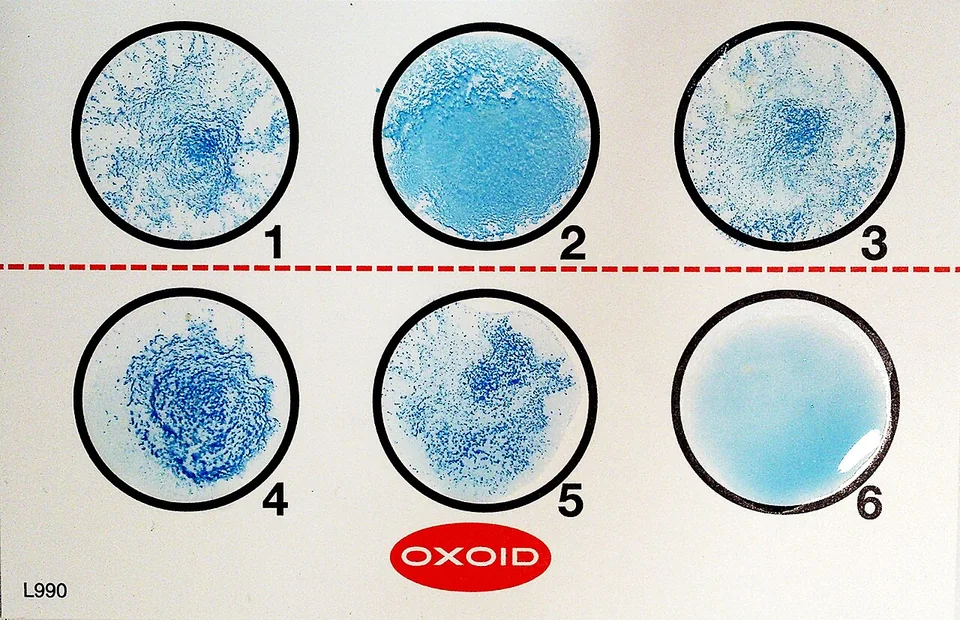
Incomplete (monovalent) antibodies combine with the antigen but do not cause agglutination. They can act as blocking antibodies, preventing agglutination by a complete antibody added afterwards.
Slide agglutination
When a drop of antiserum is added to a smooth, uniform suspension of particulate antigen in a drop of saline on a slide or tile, agglutination takes place.
- A positive result is clumping of the particles and clearing of the drop.
- Mixing with a loop or gently rocking the slide helps. Depending on the titre, agglutination may occur instantly or within seconds.
- Clumping after a minute may be due to drying and should be disregarded.
- A control on the same slide, the antigen suspension in saline without antiserum, shows whether the antigen is autoagglutinable.
- Agglutination is usually visible to the naked eye, but sometimes needs confirmation under the microscope.
Slide agglutination is a routine way of identifying many bacterial isolates from clinical specimens.
Several dilutions of serum should be tested, to avoid false negatives caused by the prozone from blocking antibodies. Blocking antibodies can be detected by doing the test in hypertonic (5%) saline or albumin saline, or more reliably by the antiglobulin (Coombs) test.
Passive agglutination
Attaching soluble antigens to the surface of carrier particles converts precipitation tests into agglutination tests, which are more convenient and more sensitive for detecting antibodies.
- Carriers: red cells, latex particles or bentonite. Human or sheep erythrocytes adsorb a variety of antigens. Polysaccharide antigens adsorb by simple mixing, while protein antigens need tanned red cells.
- Rose-Waaler test: a passive haemagglutination test for rheumatoid arthritis. The autoantibody (RA factor) acts as an antibody to gamma globulin and agglutinates red cells coated with globulin. The antigen is a suspension of sheep erythrocytes sensitised with a subagglutinating dose of rabbit anti-sheep erythrocyte antibody.
- Latex agglutination: polystyrene latex particles, 0.8 to 1.0 micrometre in diameter, adsorb several antigens. It is widely used for anti-streptolysin O (ASO), C-reactive protein (CRP), RA factor and human chorionic gonadotrophin (HCG).
Passive agglutination tests are very sensitive and give high titres, but they may give false positive results.
Heterophile agglutination
Some agglutination tests depend on antigens shared between unrelated organisms or cells:
- Weil-Felix reaction for typhus fevers: typhus rickettsiae share a common antigen with some strains of Proteus.
- Paul-Bunnell test: sheep cell agglutinins in the serum of infectious mononucleosis patients are adsorbed by ox red cells but not by guinea pig kidney extract.
- Cold agglutination test: positive in mycoplasmal (primary atypical) pneumonia. The patient's serum agglutinates human O group red cells at 4 degrees C, and the agglutination reverses at 37 degrees C.
- Streptococcus MG agglutination test for primary atypical pneumonia.
Antiglobulin (Coombs) test
The Coombs test detects incomplete anti-Rh antibodies that do not agglutinate Rh-positive red cells in saline.
Principle: when serum with incomplete anti-Rh antibodies is mixed with Rh-positive red cells, the antibody globulin coats the surface of the cells, though they do not agglutinate. The coated cells are washed free of all unattached protein and treated with a rabbit antiserum against human gamma globulin (the antiglobulin or Coombs serum), which detects the antibody on the cells.
Complement fixation test
Complement fixation uses complement as an indicator of whether antigen and antibody have reacted. Appropriate controls are needed:
- Antigen and serum controls, to show they are not anti-complementary
- Complement control, to show the desired amount of complement was added
- Cell control, to show that sensitised erythrocytes do not lyse without complement
Two variants handle sera that do not suit the standard test:
- Indirect complement fixation test: certain avian sera (duck, turkey, parrot) and mammalian sera (horse, cat) do not fix guinea pig complement. The test is set up in duplicate. After the first step, a standard antiserum known to fix complement is added to one set. If the test serum contained antibody, the antigen was used up in step one, so the standard antiserum cannot fix complement. In this indirect test, haemolysis indicates a positive result.
- Conglutinating complement absorption test: uses horse complement, which is non-haemolytic. The indicator is sensitised sheep erythrocytes mixed with bovine serum, which contains conglutinin that acts as an antibody to complement. If the complement was used up in the first step, conglutination does not occur.
Other serological methods
Other methods you will meet include neutralisation tests, immunofluorescence, enzyme-linked immunosorbent assay (ELISA), radioimmunoassay, chemiluminescence immunoassay, immunoelectrophoresis, immunoelectroblot (Western blot), immunochromatographic tests, immunoelectron microscopy and flow cytometry.
Antigen-antibody reactions in disease
- Blood transfusion: antibodies in the plasma of one blood type react with antigens on the red cells of another type. Early transfusions caused agglutination and haemolysis of red cells, often with fatal reactions. Donor and recipient blood can be tested beforehand.
- Poststreptococcal glomerulonephritis: antibodies bind streptococcal antigens and form immune complexes that deposit in the renal glomeruli and cause nephritis.
- Recent streptococcal infection: anti-streptolysin O (ASO) and anti-DNase B antibodies can serve as indicators, though the antibody responses may be depressed if antibiotics are given early.
- Antibody classes in protection: IgG is bivalent and makes up about 75% of antibodies in a normal person. IgM forms a large share of the primary response and, with 10 binding sites, is very effective against invaders. Antibodies protect by direct attack on the invader and by activating the complement system.
Mnemonics
Prozone and post-zone: pro is before the optimum, with antibody in excess. Post is after the optimum, with antigen in excess. Both give weak or no precipitation.
Practice MCQs
Maximum precipitation occurs when:
- A. Antibody is in excess
- B. Antigen is in excess
- C. Antigen and antibody are in optimal proportions
- D. Only IgM is present
Show answer
Answer: C. In the zone of equivalence antigen and antibody are in optimal proportions and a lattice forms. In the prozone antibody is in excess and in the post-zone antigen is in excess, and in both precipitation is weak.
The prozone phenomenon is caused by:
- A. Excess of antibody
- B. Excess of antigen
- C. Absence of electrolytes
- D. Denaturation of the antigen
Show answer
Answer: A. High concentrations of antibody prevent lattice formation, so there is weak or no precipitation or agglutination despite antibody being present. Testing several dilutions avoids false negatives.
Which immunoglobulin is most efficient in agglutination reactions?
- A. IgG
- B. IgA
- C. IgE
- D. IgM
Show answer
Answer: D. IgM is strong in agglutination and lysis, weak in precipitation and complement fixation. IgG is strong in precipitation and complement fixation but weak in agglutination.
The antiglobulin (Coombs) test is used to detect:
- A. Complete antibodies that agglutinate in saline
- B. Incomplete antibodies that coat red cells but do not agglutinate them
- C. Soluble antigens in a gel
- D. Complement-fixing antibodies of avian sera
Show answer
Answer: B. The Coombs (antiglobulin) test detects incomplete anti-Rh antibodies that coat Rh-positive red cells without agglutinating them in saline.
The Weil-Felix reaction depends on:
- A. A common antigen shared by typhus rickettsiae and some Proteus strains
- B. Latex particles coated with antigen
- C. Precipitation in agar gel
- D. Lysis of sheep red cells by complement
Show answer
Answer: A. Weil-Felix is a heterophile agglutination test. Typhus rickettsiae share a common antigen with some strains of Proteus.
IgM binds antigens effectively despite lower affinity because of its:
- A. Smaller size
- B. Covalent binding to antigen
- C. High avidity from its higher valence
- D. Ability to cross the placenta
Show answer
Answer: C. Affinity is the strength of binding of a single site to a single epitope. IgM has low affinity per site but many sites, so its overall avidity is high.
Viva questions
What are serological reactions?
Antigen-antibody reactions carried out in vitro. They are used to detect and quantify antigens or antibodies, for diagnosis, epidemiological surveys and screening.
State the general features of antigen-antibody reactions.
They are specific (with possible cross reactions), involve whole molecules, cause no denaturation, occur at the surface, and are firm but reversible. Both partners take part, and they combine in varying proportions because both are multivalent.
Differentiate affinity from avidity.
Affinity is the strength of binding between one antibody site and one epitope. Avidity is the overall strength of binding of the whole antibody with its multiple sites to the antigen, and it is a better measure of biological binding capacity.
Define precipitation and flocculation.
Precipitation is the formation of an insoluble antigen-antibody complex when soluble antigen meets its antibody with electrolytes at suitable temperature and pH. In flocculation the precipitate stays suspended as floccules.
What is the prozone phenomenon?
Weak or absent precipitation or agglutination when antibody is in great excess, because lattice formation is prevented. It is avoided by testing several dilutions of serum.
What is passive agglutination? Give examples.
Soluble antigen is attached to carrier particles such as red cells, latex or bentonite, converting a precipitation test into a more sensitive agglutination test. Examples are the Rose-Waaler test and latex agglutination tests for ASO, CRP and RA factor.
What is the principle of the Coombs test?
Incomplete anti-Rh antibodies coat Rh-positive red cells without agglutinating them. After washing, antiglobulin (Coombs) serum, a rabbit antiserum against human gamma globulin, is used to detect the coating antibody.
Flashcards
Still mixing up prozone and post-zone? Ask the GalenAI tutor and practise antigen-antibody reaction MCQs.