Quick answer: Sterilisation frees an article, surface or medium of all living microorganisms, in both vegetative and spore state. Disinfection destroys or removes pathogens but not necessarily spores. Physical methods use heat (dry or moist), filtration and radiation. Chemical methods use alcohols, aldehydes, halogens, phenols, dyes, surface-active agents and gases. The best method depends on the purpose and the material.
Why do we sterilise?
Microorganisms are everywhere: in the surroundings, on inanimate objects and on the surface of the human body. They cause contamination, infection and decay, so they have to be removed or destroyed. The methods used depend on the purpose, the material to be treated and the nature of the microorganisms to be removed or killed.
Key definitions
| Term | Meaning |
|---|---|
| Sterilisation | The process by which an article, surface or medium is freed of all living microorganisms, in either the vegetative or spore state. It is a validated process. |
| Disinfection | Destruction or removal of all pathogenic organisms, or organisms capable of causing infection. It destroys most recognised pathogens but not necessarily all microbial forms, for example bacterial spores. |
| Asepsis | The state of complete absence of viable pathogenic microorganisms in any environment. It also means preventing contact with microorganisms. |
| Antiseptic | An agent that can be safely applied to skin or mucous membrane to prevent infection by inhibiting the growth of bacteria. |
| Bactericidal agent (germicide) | A substance that kills bacteria. |
| Bacteriostatic agent | Prevents multiplication of bacteria, which may remain alive. A chemical that is bactericidal at one concentration may become bacteriostatic at another. |
| Decontamination | Making an article or area free of contaminants, including biological, chemical, radioactive and other hazardous materials. |
| Sterilizer | The apparatus used to sterilise medical devices, equipment or supplies by direct exposure to the sterilising agent. |
Disinfectants are applied to inanimate objects. Antiseptics are applied to living tissue.
Classification of methods
- Physical: heat (dry heat and moist heat), filtration and radiation.
- Chemical: alcohols, aldehydes, dyes, halogens, phenols, surface-active agents, metallic salts and gases.
The factors that decide the type of process include time, temperature, the stage of growth of the organism, the nature of the medium in which the organism lies, and the number of organisms present.
Heat
Heat is the simplest means of sterilising materials, as long as the material itself can resist heat damage. Moist heat is more lethal than dry heat. Under moist conditions most vegetative mesophilic bacteria have a thermal death point between 50 and 65 degrees C, and most spores between 100 and 120 degrees C. The thermal death point is the lowest temperature that kills a bacterium under standard conditions in a given time.
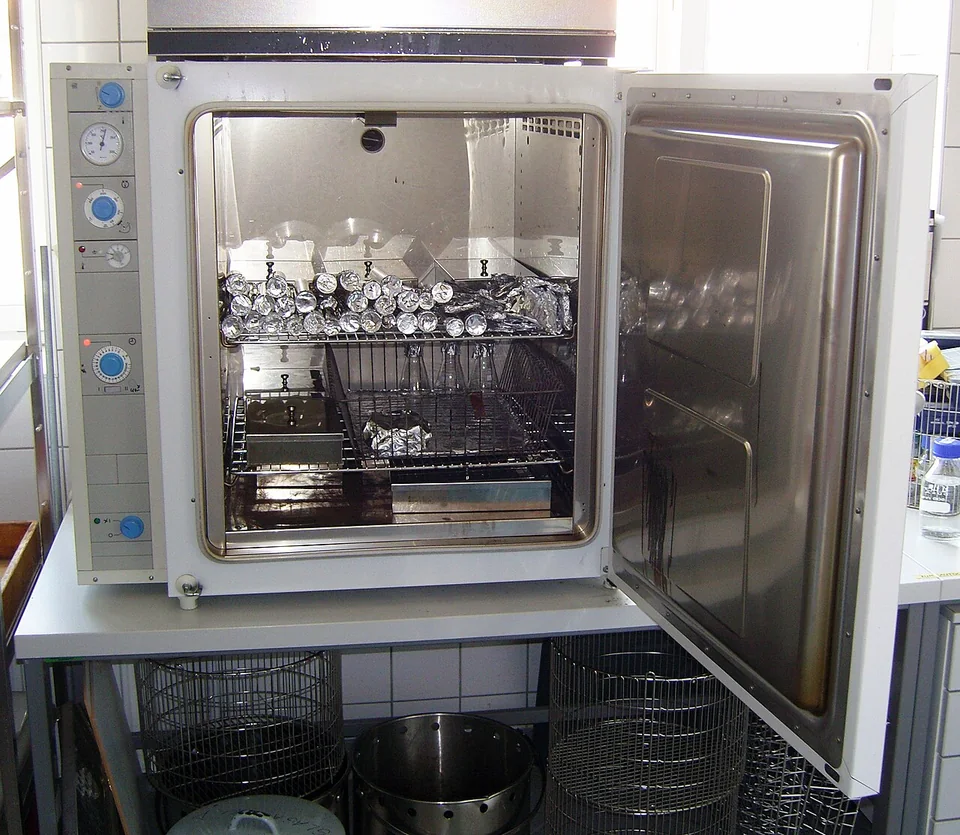
Dry heat
Dry heat includes flaming, incineration and hot air. Inoculating loops are sterilised by heating in a flame until red hot and then cooling before use.
The hot air oven circulates hot air in an electric oven and is used for materials that must stay dry. Because heat is less effective on dry material, the customary exposure is 160 to 170 degrees C for 1 hour or more. Under these conditions heat acts by denaturing cell proteins and nucleic acids and disrupting cell membranes. Done properly, this is sporicidal.
Moist heat
Moist heat includes boiling, steam at atmospheric pressure, and steam above atmospheric pressure.
- A temperature of 100 degrees C kills all but spore forms of eubacteria within 2 to 3 minutes in laboratory-scale cultures.
- 121 degrees C for 15 minutes is used to kill spores.
- Steam is generally used because bacteria die faster when moist, and because steam carries heat to all parts of the sterilising vessel.
- At sea level the steam must be kept at 15 lb per square inch (psi) above atmospheric pressure to reach 121 degrees C. Autoclaves or pressure cookers do this. At higher altitudes a pressure above 15 psi is needed to reach the same temperature.
| Feature | Hot air oven (dry heat) | Autoclave (steam under pressure) |
|---|---|---|
| Usual setting | 160 to 170 degrees C for 1 hour or more | 121 degrees C for 15 minutes at 15 psi above atmospheric pressure |
| Best for | Materials that must stay dry | Most heat-resistant materials; kills spores |
| Why it works | Denatures proteins and nucleic acids, disrupts membranes | Moist heat kills faster; steam spreads heat everywhere |
Filtration
Bacteria can be removed by mechanical devices. Filters such as the Berkefeld, Pasteur-Chamberland and Seitz filters are examples, as are candles, asbestos pads and membranes. Coagulants such as alum also remove bacteria from water.
Radiation
- Ionising radiation (gamma rays): a safe and effective method, increasingly used for bandages, syringes, needles, catheters and other medical equipment. The material is packed in plastic containers and exposed to gamma rays, which are highly penetrating.
- Ultraviolet light: a nonchemical means of disinfection with proven efficacy, along with irradiation and heat.
Sterilising heat-sensitive articles
Ethylene oxide
Heat-sensitive articles may be sterilised at 55 to 60 degrees C by ethylene oxide, which kills bacteria, spores (for example tetanus spores) and viruses. Ethylene oxide is explosive, so it is mixed with carbon dioxide (12 per cent). Water vapour is also often added (relative humidity 33 per cent) because it increases the efficiency of the gas.
Plasma sterilisation
Plasma is the fourth state of matter and consists of ions, electrons or neutral particles. Radio frequency energy creates an electromagnetic field. Hydrogen peroxide vapour is introduced into it, which produces a plasma containing free radicals of hydrogen and oxygen. These denature all microorganisms and render the articles sterile. Arthroscopes and urethroscopes are sterilised in this way.
Liquid chemical sterilants
Of the FDA-approved sterilants, glutaraldehyde at 2.4% or more and hydrogen peroxide at 6% or more are both effective, but exposure times as long as 10 hours may be needed. Concentrated glutaraldehyde and hydrogen peroxide are corrosive, so check with the manufacturer before using them on instruments such as endoscopes.
Chemical disinfectants and antiseptics
| Group | Examples | Uses |
|---|---|---|
| Alcohols | Ethyl alcohol, isopropyl alcohol, trichlorobutanol | Skin antisepsis (70 to 80% alcohol). Alcohols are inflammable and evaporate rapidly. |
| Aldehydes | Formaldehyde, glutaraldehyde, orthophthalaldehyde | Disinfection and sterilisation |
| Halogens | Iodine, chlorine, hypochlorites | Iodine: skin disinfectant. Chlorine: water supply and swimming pools. Hypochlorites: widely used in hospitals. |
| Dyes | Aniline dyes (brilliant green, malachite green, crystal violet); acridine dyes (acriflavine, proflavine) | Skin, and in some culture media such as Lowenstein-Jensen medium; acridine dyes as skin antiseptics |
| Surface-active agents | Cetrimide, benzalkonium chloride | Disinfection, antisepsis, preservation |
| Others | Phenols, peracetic acid, hydrogen peroxide, hypochlorous acid, metallic salts | Various disinfectant uses |
Other useful points:
- Alcoholic solutions of chlorhexidine and of iodine are used as antiseptics.
- Lime is the cheapest of all disinfectants. A 10 to 20 per cent aqueous suspension of lime, left for 2 hours, can disinfect faeces and urine.
Levels of disinfection
Medical items are grouped by how closely they contact the patient, using Spaulding's classification, and each group needs a suitable level of disinfection.
- Intermediate-level disinfectant: a chemical that kills all microbial pathogens including mycobacteria and non-enveloped viruses, but not spores. Examples: alcohol, phenolic compounds and iodophores.
- Low-level disinfectant: a chemical that kills only vegetative bacteria, fungi and lipid-enveloped viruses. Example: quaternary ammonium compounds.
Semi-critical items such as thermometers and neonatal blood pressure cuffs need only intermediate-level disinfection, done with alcohol, as the articles may not be compatible with stronger agents.
Spores decide the level: intermediate-level agents kill mycobacteria and non-enveloped viruses but not spores. Only true sterilisation (or long exposure to a sterilant) deals with spores.
Qualities of a good disinfectant
A good disinfectant should:
- Be active against all pathogens: bacteria, fungi, viruses and protozoa
- Act within a brief exposure time
- Spread through organic films and enter folds and crevices
- Stay active in the presence of blood, pus, exudates and excreta
- Not corrode metals or damage fabrics, and not bleach or stain
- Not be poisonous to higher animals
- Mix readily with water, stay stable, and be cheap
- Work in both acid and alkaline medium
A good antiseptic should in addition be rapid in action with sustained protection, non-irritating to tissues, not delay healing, be non-absorbable or of minimal toxicity if absorbed, be non-sensitising, and be compatible with soaps and detergents.
Concurrent disinfection
Concurrent disinfection means applying disinfective measures as soon as possible after the discharge of infectious material from the body of an infected person.
Factors affecting efficacy
- Cleaning: failure to clean instruments adequately leaves a higher bioburden, protein load and salt concentration, and these reduce sterilisation efficacy.
- Type of organism: spore-forming organisms are the most resistant. The contaminating flora on surgical instruments is mostly vegetative bacteria.
- Time, temperature, number of organisms and the medium in which they lie also matter.
Sterilisation control
Sterilisation must be checked. Bacillus species, which form heat-resistant spores, serve as sterilisation indicators (controls). Their spores are found everywhere, in soil, dust, water and air.
Biofilms
A biofilm is a group of interactive bacteria attached to a surface or to each other and enclosed in an exopolysaccharide matrix. The matrix can act as a diffusion barrier for some antimicrobials, and bacteria in a biofilm can be far more resistant than the same strain growing free in broth. This is one reason infections with biofilms are hard to treat.
Mnemonics
Autoclave numbers: 121 degrees C, 15 minutes, 15 psi. Hot air oven: 160 to 170 degrees C, 1 hour or more.
Practice MCQs
Which statement best separates sterilisation from disinfection?
- A. Sterilisation uses chemicals only
- B. Sterilisation removes all living microorganisms including spores
- C. Disinfection is applied only to living tissue
- D. Disinfection kills spores but not vegetative bacteria
Show answer
Answer: B. Sterilisation frees an article of all living microorganisms in the vegetative or spore state. Disinfection destroys pathogens but not necessarily spores.
The standard condition used in an autoclave to kill spores is:
- A. 100 degrees C for 2 to 3 minutes
- B. 160 to 170 degrees C for 1 hour
- C. 121 degrees C for 15 minutes
- D. 60 degrees C for 10 minutes
Show answer
Answer: C. Steam at 15 psi above atmospheric pressure reaches 121 degrees C, and 121 degrees C for 15 minutes is used to kill spores.
Hot air oven sterilisation is usually done at:
- A. 160 to 170 degrees C for 1 hour or more
- B. 121 degrees C for 15 minutes
- C. 100 degrees C for 30 minutes
- D. 55 to 60 degrees C for 1 hour
Show answer
Answer: A. Dry heat is less effective on dry material, so a hot air oven uses 160 to 170 degrees C for 1 hour or more.
Which method is used for sterilising arthroscopes?
- A. Autoclave
- B. Hot air oven
- C. Boiling
- D. Plasma sterilisation
Show answer
Answer: D. Plasma sterilisation using hydrogen peroxide vapour is used for heat-sensitive instruments such as arthroscopes and urethroscopes.
An intermediate-level disinfectant does NOT kill:
- A. Mycobacteria
- B. Bacterial spores
- C. Non-enveloped viruses
- D. Vegetative bacteria
Show answer
Answer: B. An intermediate-level disinfectant kills all microbial pathogens including mycobacteria and non-enveloped viruses, but not spores. Alcohol is an example.
Ethylene oxide is mixed with carbon dioxide because it is:
- A. Explosive
- B. Corrosive to plastics
- C. Inactive at low temperature
- D. A poor sporicidal agent
Show answer
Answer: A. Ethylene oxide is explosive, so it is mixed with carbon dioxide. It works at 55 to 60 degrees C and kills bacteria, spores and viruses.
Viva questions
Define sterilisation and disinfection.
Sterilisation is freeing an article, surface or medium of all living microorganisms, vegetative or spore. Disinfection is destruction or removal of pathogenic organisms, not necessarily spores.
What is the difference between bactericidal and bacteriostatic?
A bactericidal agent kills bacteria. A bacteriostatic agent prevents their multiplication but they may stay alive. The same chemical can be bactericidal at one concentration and bacteriostatic at another.
Describe the principle of an autoclave.
Steam under pressure, 15 psi above atmospheric pressure at sea level, reaches 121 degrees C. Moist heat kills faster than dry heat, and steam spreads heat to all parts of the vessel. 15 minutes at 121 degrees C kills spores.
How does a hot air oven kill microorganisms?
At 160 to 170 degrees C for 1 hour or more, heat denatures cell proteins and nucleic acids and disrupts cell membranes. It is used for materials that must stay dry.
Name methods to sterilise heat-sensitive articles.
Ethylene oxide gas at 55 to 60 degrees C, plasma sterilisation with hydrogen peroxide vapour, gamma radiation for packed items, and liquid sterilants such as glutaraldehyde.
What are the levels of disinfection?
Intermediate level kills all pathogens including mycobacteria and non-enveloped viruses but not spores (alcohol, phenolics, iodophores). Low level kills only vegetative bacteria, fungi and lipid-enveloped viruses (quaternary ammonium compounds).
What makes spores important in sterilisation?
Spore-forming organisms are the most resistant, so sterilisation efficacy is judged against spores. Bacillus spores are used as sterilisation indicators.
Flashcards
Still unsure which method suits which instrument? Ask the GalenAI tutor and practise sterilisation MCQs.