Quick answer: Pharmacokinetics is the study of what the body does to a drug. It has four processes: absorption, distribution, metabolism and excretion. Together they set the drug concentration at the site of action, and so the route, onset, duration and dosing frequency. Key parameters are bioavailability, volume of distribution, clearance and half-life.
What is pharmacokinetics?
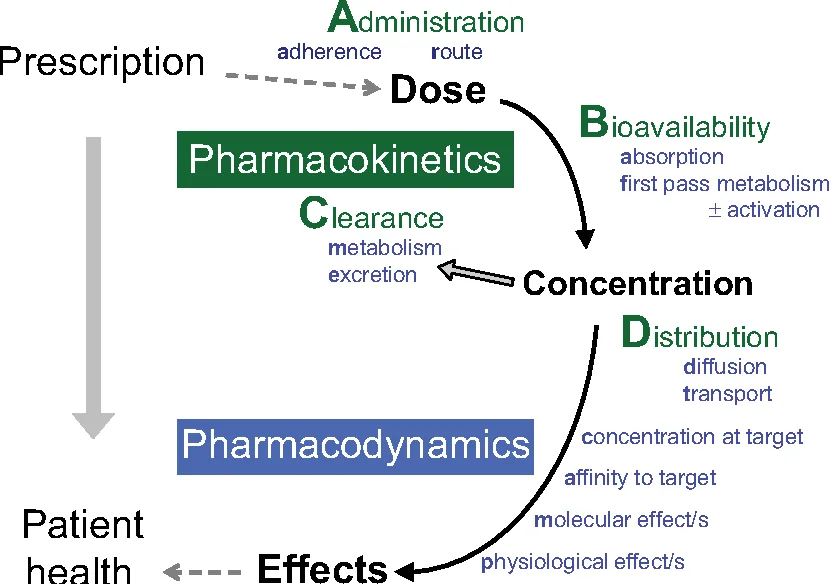
Pharmacokinetics is the quantitative study of how a drug moves into, through and out of the body. It is often summed up as "what the body does to the drug". Pharmacodynamics is the other half: "what the drug does to the body", meaning the events that follow the drug's interaction with its receptor or other primary site of action.
Pharmacokinetics has four processes:
- Absorption: the drug enters the systemic circulation from the site of administration.
- Distribution: the drug spreads through the body.
- Metabolism: the drug is chemically changed, mainly in the liver.
- Excretion: the drug leaves the body, unchanged or as metabolites.
Together these are called drug disposition. The intensity of a drug's response is related to its concentration at the site of action, and that concentration depends on its pharmacokinetic properties. For this reason pharmacokinetics decides the route of administration, the dose, how soon the drug starts to act, when it peaks, how long it lasts and how often it is given.
All these processes involve passage of the drug across biological membranes. A membrane is a bilayer of phospholipid and cholesterol molecules. This makes it relatively impermeable to most substances.
Many factors change pharmacokinetics from one patient to another: age, body weight, kidney and liver function, other drugs, other diseases, diet, smoking and alcohol. Genetic factors also play a role. This is why the dose needed varies between individuals.
Absorption and routes of administration
Absorption is mostly by passive diffusion across lipid membranes, so lipophilic (fat-soluble) drugs are absorbed better. Diazepam, for example, is more than 90% absorbed after an oral dose. Water-soluble drugs must be small enough to pass through membrane pores, so large molecules such as heparin are not absorbed orally. A drug taken by mouth must also survive gastric juice. Penicillin and insulin are examples of drugs that are destroyed in the gut. Drugs that are destroyed by gastric acid or that irritate the stomach can be given with an enteric coating, which stops them dissolving in the acid of the stomach.
A drug given by intramuscular or subcutaneous injection also has to be absorbed before it can act.
| Route | Key points | Example |
|---|---|---|
| Intravenous | 100% of the dose enters the systemic circulation, absorption is bypassed, useful in emergencies and allows dose titration. Invasive, and carries a higher risk of adverse effects. | Intravenous teicoplanin for invasive MRSA infection |
| Oral | The most common route and convenient. Subject to first-pass metabolism for some drugs. | Ramipril for hypertension |
| Intramuscular | Easier than intravenous, but absorption is less predictable. | Adrenaline (epinephrine) in anaphylaxis |
| Buccal | Rapid absorption, avoids first-pass metabolism. | Midazolam for status epilepticus |
| Inhaled | High concentration at the site of disease with limited systemic absorption. | Salbutamol for acute asthma |
| Intrathecal | Achieves high local levels. | Methotrexate in acute lymphoblastic leukaemia |
Local (topical) routes give high concentrations at an accessible site without exposing the rest of the body, so systemic side effects are minimal. Some drugs given on the skin are absorbed and act systemically, for example glyceryl trinitrate (GTN) as an ointment or patch for angina.
Bioavailability and the first-pass effect
Bioavailability is the fraction of the dose that reaches the systemic circulation. It is written as F, and 0 < F ≤ 1. By definition F is 1 for an intravenous dose. It is often given as a percentage of the oral dose.
Bioavailability is reduced by:
- Incomplete absorption from the gut or injection site
- The first-pass effect
- Uptake of the drug by the lungs
First-pass (presystemic) metabolism is the metabolism of a drug as it passes from the site of absorption into the systemic circulation. All orally administered drugs are exposed to metabolising enzymes in the intestinal wall and in the liver, which they reach through the portal vein. The drug may also be excreted into the bile or the gut lumen. The hepatic extraction ratio is the fraction of the absorbed drug that the liver prevents from reaching the systemic circulation.
As a general rule, the more lipid-soluble the drug, the greater its first-pass metabolism.
Ways to deal with extensive first-pass loss:
- Use a route that avoids it: sublingual, transdermal or parenteral. Nitroglycerin undergoes near complete presystemic clearance, so it is given sublingually or transdermally.
- Give a much higher oral dose. Verapamil is given at 1 to 5 mg intravenously but 40 to 120 mg orally.
Lidocaine, propranolol, naloxone and glyceryl trinitrate are examples of drugs whose usefulness by mouth is greatly reduced or prevented by first-pass metabolism. Absolute oral bioavailability is usually found by comparing the area under the curve (AUC) after an oral dose with that after an intravenous dose.
Bioavailability can fall even after an intravenous dose. The lecithin lipid suspension of diazepam has 30% less bioavailability than diazepam in propylene glycol, because the lipid droplets are taken up by the liver and metabolised.
Distribution
After a drug reaches the blood, highly perfused organs (brain, heart, lungs, liver and kidneys) receive most of it first. Muscle, skin and fat are slower, and equilibration there may take hours or even days. Capillaries are freely permeable in most tissues, so drugs pass quickly into the extracellular space. After that, distribution depends on the drug's properties. Highly polar, water-soluble drugs such as neuromuscular blockers stay mostly in extracellular fluid. Lipid-soluble drugs like propofol cross cell membranes easily and are distributed much more widely.
Volume of distribution
The volume of distribution (Vd) is the apparent volume in which a drug is distributed. For most drugs it is an apparent volume, not a real anatomical space. It links the total amount of drug in the body to the plasma concentration.
Worked example: 1000 mg given intravenously gives a steady plasma concentration of 50 mg/L. Vd = 1000 / 50 = 20 L.
- A drug with a low Vd stays mainly in the circulation. A drug with a high Vd has moved into peripheral tissues such as body fat.
- Low-Vd drugs can be removed by haemodialysis in overdose. High-Vd drugs cannot.
- A drug that is taken up extensively by tissues can have a Vd far larger than the actual volume of the body.
Factors that change Vd include the lipid:water partition coefficient, the pKa, plasma protein binding, tissue affinity, the fat to lean body mass ratio (which varies with age, sex and obesity) and diseases such as heart failure, uraemia and cirrhosis.
Plasma protein binding
Many drugs circulate bound to plasma proteins, usually reversibly. Albumin is the main carrier of acidic drugs. α1-acid glycoprotein binds basic drugs. Only unbound drug can cross membranes to reach the site of action, and it is the unbound concentration that drives the effect.
- Disease changes binding. Low albumin (hypoalbuminaemia) reduces binding of acidic drugs. States such as cancer, arthritis, myocardial infarction and Crohn's disease raise α1-acid glycoprotein and increase binding of basic drugs.
- Highly protein-bound drugs are not removed by haemodialysis.
- Two drugs can compete for the same binding site. The one with higher affinity displaces the other. This effect is usually transient and small, because the displaced drug is redistributed, metabolised or excreted. Two highly bound drugs do not always displace each other, because their binding sites may differ.
- Quoted plasma concentrations include both bound and free drug.
Tissue binding, the brain and redistribution
Drugs can bind to cell components in tissues and accumulate there. This forms a reservoir that prolongs drug action, but it can also cause local toxicity, for example the kidney and ear toxicity of aminoglycoside antibiotics.
The blood-brain barrier (BBB) is formed by brain capillary endothelial cells joined by continuous tight junctions, with surrounding glial cells. Drugs must therefore cross the cells, not pass between them. The more lipophilic a drug, the more likely it is to cross. Dopamine does not enter the brain but its precursor levodopa does. The BBB is deficient at the chemoreceptor trigger zone, so even lipid-insoluble drugs can cause vomiting.
Redistribution ends the action of some highly lipid-soluble drugs. The drug first goes to well-perfused organs such as the brain, then moves out to muscle and fat as plasma concentration falls. The anaesthetic action of intravenous thiopentone ends in a few minutes by redistribution. With repeated or continuous dosing the low-perfusion sites fill up and the drug becomes longer-acting.
Metabolism
Drugs are eliminated either unchanged or as metabolites. Excretory organs (except the lung) remove polar compounds more efficiently than lipid-soluble ones, so lipid-soluble drugs are not readily eliminated until they are metabolised to more polar compounds.
Metabolising enzymes are classed as phase 1 or phase 2.
| Feature | Phase 1 | Phase 2 |
|---|---|---|
| Reactions | Oxidation, reduction, hydrolysis | Conjugation, catalysed by transferase enzymes |
| What happens | Adds or exposes functional groups such as -OH, -COOH, -SH and -NH2 | The phase 1 group is conjugated with a polar substance such as glucuronic acid, sulfate or glutathione |
| Main enzymes | Cytochrome P450 (CYP) isozymes, mainly in hepatic microsomes | Transferases, for example UGT (glucuronidation) |
| Result | Changes the biological properties of the drug | Water solubility increases further. Products are usually less toxic and less active, and are readily excreted. |
| Effect of age or liver disease | Much more susceptible to inhibition | Less affected |
Further points:
- Prodrugs are inactive drugs that are metabolised to an active drug. Cyclophosphamide and clopidogrel are activated by CYP enzymes.
- Some conjugated products are excreted in bile, reactivated in the gut and reabsorbed. This is enterohepatic circulation.
- Enzyme induction greatly speeds up hepatic metabolism. It can increase the toxicity of drugs with toxic metabolites and is an important cause of drug interactions, as is enzyme inhibition. Induction starts slowly and wears off slowly after the inducing drug is stopped.
- Phenobarbitone speeds clearance of jaundice in congenital nonhaemolytic jaundice, which is due to deficient glucuronidation of bilirubin.
- Genetic variation matters. The polymorphic CYPs named as most important are 1A2, 2D6, 2C9 and 2C19. Pharmacogenomics is the study of how genetic variation affects drug response or metabolism.
Excretion
The kidney is the most important organ for excreting drugs and their metabolites. Renal excretion of unchanged drug is a major route for 25% to 30% of drugs given to humans. Other routes:
- Faeces: unabsorbed oral drug, and metabolites excreted in bile or directly into the gut and not reabsorbed.
- Breast milk: the amounts are small, but they may affect the nursing infant, who has a poor capacity to metabolise drugs.
- Lung: important mainly for anaesthetic gases.
Three renal processes
- Glomerular filtration: depends on the glomerular filtration rate and on protein binding. Only unbound drug is filtered.
- Active tubular secretion: organic anions and cations are secreted by separate transporters. The anion system handles salicylate, penicillins and cephalosporins. The cation system handles atropine, neostigmine and meperidine. Drugs using the same transporter compete.
- Passive tubular reabsorption: water reabsorption creates a gradient that drives passive reabsorption of drug. Lipophilic drugs such as propofol are almost completely reabsorbed and have virtually no renal clearance. For less lipophilic drugs, the degree of ionisation decides the extent, because only nonionised drug diffuses easily across the tubule. Oliguria can reduce renal drug clearance.
Protein binding hinders filtration but not tubular secretion. Active secretion lowers the free drug concentration and pulls the bound drug off the protein.
Ion trapping
Urine pH ranges from 4.5 to 8.0, so the ionised fraction of a weak acid or base can change a lot, especially when the pKa is close to that range. Phenobarbital, a weak acid with pKa 7.4, is mostly nonionised at urine pH 6.0 and is reabsorbed. If urine pH is raised to 8 or 9 with sodium bicarbonate, most of it becomes ionised, reabsorption falls and clearance rises. For a weak base the reverse holds: acidifying the urine promotes excretion. This is used in some cases of overdose.
Ion trapping rule: alkalinise the urine to speed excretion of a weak acid (phenobarbital). Acidify the urine to speed excretion of a weak base.
Competition at the tubule
- Probenecid inhibits secretion of penicillin, raising plasma concentration and prolonging its action. It also blocks uric acid transport, but uric acid is mainly reabsorbed, so net excretion of uric acid rises while that of penicillin falls.
- Quinidine reduces renal clearance of digoxin, probably by reducing its tubular secretion, and plasma digoxin can rise two- to fivefold.
Clearance
Clearance (CL) is the measure of the body's capacity to eliminate a drug. It is the volume of plasma (or blood) completely cleared of drug per unit time. The rate of elimination changes as concentration falls, so it is not a good single measure. Clearance is a single number that relates the rate of elimination to the concentration:
- Rate of elimination = CL × plasma concentration
- CL = dose / AUC after a single dose with complete bioavailability, where AUC is the area under the plasma concentration-time curve from zero to infinity.
Worked examples:
- Cephalexin: CL is 4.3 mL/min/kg, with 90% excreted unchanged in urine. In a 70-kg man the plasma clearance is 301 mL/min, and the kidney clears about 270 mL of plasma every minute.
- Propranolol: CL is 16 mL/min/kg, almost entirely by the liver. In a 100-kg man this is 1600 mL/min, roughly equal to total hepatic blood flow.
For a drug that is avidly secreted and not reabsorbed, renal clearance is largely set by renal blood flow. The same is true of the liver for drugs with a high hepatic extraction ratio.
First-order and zero-order kinetics
| Feature | First-order | Zero-order (saturable) |
|---|---|---|
| What is eliminated | A constant fraction per unit time | A constant amount per unit time |
| Clearance | Constant over the usual clinical range, because enzymes and transporters are not saturated | Changes with concentration, because elimination is saturated |
| Half-life | Constant | Increases as the dose increases |
| Effect of raising dose | Elimination rate rises in proportion | Drug accumulates, with risk of toxicity |
| Examples | Most drugs | Ethanol, high-dose phenytoin; also listed: aspirin, cisplatin, fluoxetine, omeprazole |
Analogy: with first-order kinetics, a bath drains fast at first and the last bit takes ages. With zero-order kinetics, water is pumped out at a constant rate.
A simple tank example shows first-order kinetics. A 4 L compartment holds 64 mg with a clearance of 1 L/min. Each minute one quarter of the compartment volume is cleared: 16 mg in the first minute, then 12 mg in the second. The fraction stays the same but the amount falls.
Drugs showing saturation kinetics are less predictable in clinical use.
Half-life and steady state
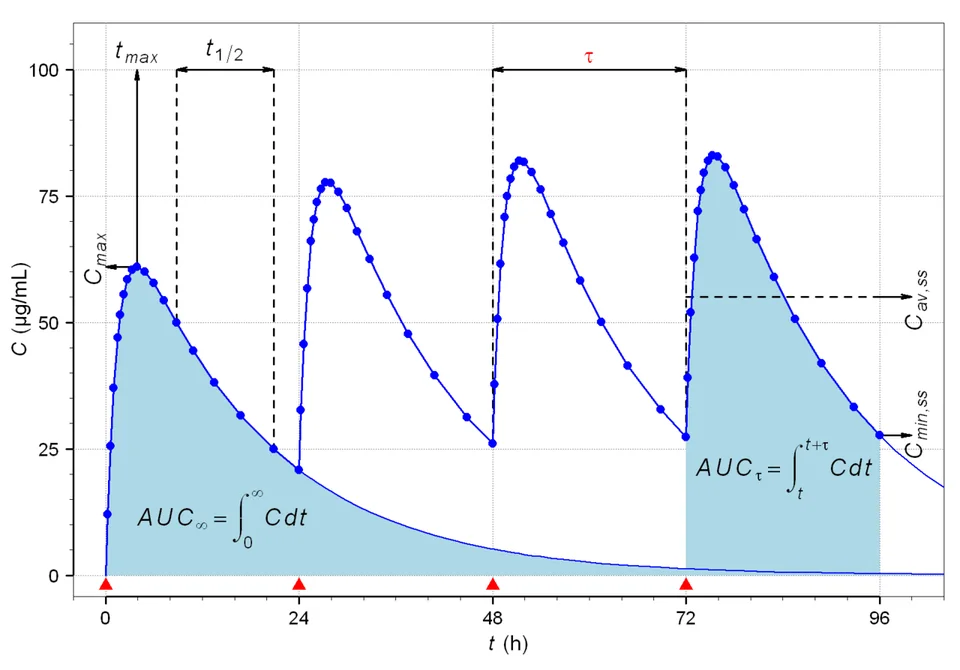
Half-life (t½) is the time for the plasma concentration to fall by half when elimination is first order. It depends on two other variables:
- t½ is directly proportional to Vd and inversely proportional to CL. A larger Vd lengthens the half-life, and greater clearance shortens it.
Half-life also governs how fast a drug accumulates and how fast it leaves:
| Number of half-lives | Percentage of steady state reached (repeated dosing) | Fraction eliminated (after stopping) |
|---|---|---|
| 1 | 50% | Half |
| 2 | 75% | 75% eliminated |
| 3 | 87.5% | 87.5% eliminated |
| 4 | 93.75% | Almost complete by four to five half-lives |
With repeated dosing or a continuous infusion, plasma concentration reaches a steady value within three to five half-lives. This does not depend on the size of the dose. If a drug has a half-life of about 24 h, steady state takes 3 to 5 days. If that is too slow clinically, a loading dose can be given to reach a therapeutic concentration quickly.
Steady state is reached when the rate of drug elimination equals the rate of drug administration:
- Css = dosing rate / CL (for complete bioavailability). With incomplete bioavailability, F × dosing rate = CL × Css.
So if the target concentration is known, clearance dictates the rate at which the drug should be given. The aim is to keep concentrations within the therapeutic window, the range with efficacy and minimal toxicity.
Half-life check: 50%, 75%, 87.5%, 93.75%. Each extra half-life closes half of the remaining gap to steady state (or to complete elimination).
Terminal half-life
With prolonged dosing, a drug may enter deep compartments that equilibrate slowly with plasma. After dosing stops, drug returns from these compartments and prolongs the apparent half-life. Gentamicin has a half-life of 2 to 3 h after a single dose but a terminal half-life of 53 h, because it accumulates in the kidney, where it can cause toxicity.
Compartment models
Pharmacokinetic models treat the body as one or more compartments.
- One-compartment model: the body is a single well-stirred compartment of volume Vd. After an intravenous bolus the concentration falls only by elimination. On a logarithmic scale the curve is a straight line, and its slope is the first-order elimination rate constant.
- Two-compartment model: after an intravenous injection there is an initial rapid distribution phase, mainly passage of drug from plasma into tissues, followed by a slower elimination phase. The volume of distribution at steady state (Vss) is the sum of the central and peripheral volumes (V1 + V2).
Whether a drug fits a two- or three-compartment model is of no clinical consequence. The best model is the one with the fewest compartments that accurately describes the measured concentrations.
AUC, Cmax and Tmax
After an oral or other extravascular dose, the plasma concentration rises while absorption is the rate-limiting step. It reaches a peak (Cmax) at time Tmax, then falls as metabolism and elimination become rate-limiting. The AUC is an integrated measure of exposure to the drug. Together with Cmax it helps predict desired and toxic effects.
Clinical uses of pharmacokinetics
- Dose selection: most drugs should be started at a low dose and titrated to the lowest effective dose, because individuals differ.
- Therapeutic drug monitoring (TDM): measuring plasma concentration is used for drugs such as ciclosporin, tacrolimus, digoxin, theophylline, lithium, phenytoin, aminoglycosides and methotrexate. It is most useful when plasma levels cannot be predicted from the dose, when clinical effects are hard to monitor, and when the therapeutic window is narrow.
- Renal disease: drugs that are mainly excreted by the kidney and cause toxicity at high levels need dose reduction. Digoxin, dofetilide and sotalol are examples. Meperidine is metabolised in the liver, but its metabolite normeperidine is excreted by the kidney and accumulates in renal failure, causing CNS excitation and seizures.
Practice MCQs
Which change in urine would increase the renal clearance of phenobarbital, a weak acid, in overdose?
- A. Acidifying the urine
- B. Reducing urine flow
- C. Alkalinising the urine with sodium bicarbonate
- D. Giving a drug that blocks glomerular filtration
Show answer
Answer: C. Phenobarbital is a weak acid. Raising urine pH makes it more ionised, ionised drug is not reabsorbed easily across the tubule, so reabsorption falls and clearance rises.
Nitroglycerin is given sublingually rather than orally mainly because:
- A. It is destroyed by enteric coating
- B. It undergoes near complete first-pass clearance after oral dosing
- C. It is too large to cross membranes
- D. It is excreted in bile
Show answer
Answer: B. Nitroglycerin undergoes near complete presystemic (first-pass) clearance when swallowed, so it is given sublingually or transdermally, which avoid the liver on first pass.
During repeated dosing at a fixed interval, approximately what proportion of steady state is reached after three half-lives?
- A. 50%
- B. 75%
- C. 87.5%
- D. 93.75%
Show answer
Answer: C. After one half-life 50% of steady state is reached, after two 75%, after three 87.5%, and after four 93.75%.
A patient's renal function falls and the clearance of a renally excreted drug halves. If the dosing rate is unchanged, the steady-state concentration will:
- A. Halve
- B. Stay the same
- C. Rise slightly
- D. Double
Show answer
Answer: D. Css equals the dosing rate divided by clearance. If clearance falls to half and the dosing rate is unchanged, Css doubles, so the dose needs to be reduced.
Probenecid prolongs the action of penicillin because it:
- A. Competes with penicillin for active tubular secretion
- B. Increases the glomerular filtration of penicillin
- C. Induces metabolism of penicillin
- D. Alkalinises the urine
Show answer
Answer: A. Probenecid competes for tubular secretion, so net excretion of penicillin falls, plasma concentration rises and its action is prolonged. Uric acid is mainly reabsorbed, so the same block increases its excretion.
Which statement about a drug with zero-order elimination, such as phenytoin at high dose, is correct?
- A. A constant fraction is eliminated per unit time
- B. A constant amount is eliminated per unit time, so raising the dose can cause accumulation
- C. Half-life is constant whatever the dose
- D. Clearance is constant at all concentrations
Show answer
Answer: B. In zero-order elimination a fixed amount of drug is removed per unit time. If the dose rises the amount eliminated does not, so the drug accumulates and the half-life increases.
Viva questions
Define pharmacokinetics and name its four processes.
Pharmacokinetics is the study of what the body does to a drug. The four processes are absorption, distribution, metabolism and excretion. Together they are called drug disposition.
What is bioavailability?
The fraction (F) of the dose that reaches the systemic circulation, where 0 < F ≤ 1. It is 1 for an intravenous dose and is lowered by incomplete absorption and the first-pass effect.
What is the first-pass effect and how can it be avoided?
Metabolism of an oral drug in the gut wall and liver before it reaches the systemic circulation. It can be avoided by sublingual, transdermal or parenteral routes, or overcome by giving a larger oral dose, as with verapamil.
Compare phase 1 and phase 2 metabolism.
Phase 1 is oxidation, reduction or hydrolysis, mainly by CYP enzymes, and it adds functional groups. Phase 2 is conjugation, for example with glucuronic acid, and it makes the product more water-soluble and usually less active and less toxic. Phase 1 is much more affected by old age and liver disease.
What is volume of distribution and why does it matter in overdose?
It is the apparent volume linking the amount of drug in the body to its plasma concentration. A low-Vd drug stays in the circulation and can be removed by haemodialysis. A high-Vd drug has moved into tissues and cannot.
How long does it take to reach steady state, and why?
About three to five half-lives, whatever the dose, because at steady state elimination equals administration. A loading dose can be used if this is too slow.
What is ion trapping and how is it used clinically?
Only nonionised drug is reabsorbed across the renal tubule. Changing urine pH changes the ionised fraction. Alkalinising the urine increases excretion of a weak acid such as phenobarbital, and acidifying it increases excretion of a weak base. It is used in some overdoses.
Flashcards
Still stuck on half-life and steady state? Ask the GalenAI tutor and practise pharmacokinetics MCQs.