Quick answer: Antibiotics are classified by chemical structure, mechanism of action, spectrum and type of action (bactericidal or bacteriostatic). Mechanism is a key basis: drugs inhibit cell wall synthesis, protein synthesis, folate metabolism, DNA gyrase, or damage the cell membrane. The β-lactams, which include penicillins and cephalosporins, are the largest class.
Why classify antibiotics?
An antibiotic is a drug that acts against bacteria. Antibiotics belong to the wider group of antimicrobial agents, which also includes antifungal, antiviral, antiprotozoal and anthelmintic drugs. No single scheme covers everything, so we use several. Each one answers a different question:
- Which organisms does the drug act on? (type of organism and spectrum)
- Does it kill or only stop growth? (type of action)
- What is its chemical family? (chemical classification)
- How does it work? (mechanism of action)
- Where does it come from? (source)
Once you know the class, you can predict much of the spectrum, the likely adverse effects and the main resistance mechanism.
1. By type of organism
Antimicrobial agents are first split by the kind of organism they are mainly active against:
- Antibacterial: penicillins, aminoglycosides, erythromycin, fluoroquinolones
- Antifungal: griseofulvin, amphotericin B, ketoconazole
- Antiviral: acyclovir, amantadine, zidovudine
- Antiprotozoal: chloroquine, pyrimethamine, metronidazole, diloxanide
- Anthelmintic: mebendazole, pyrantel, niclosamide, diethylcarbamazine
This page deals with the antibacterial drugs.
2. By spectrum of activity
Spectrum means the range of organisms a drug acts on. Drugs were traditionally called narrow-spectrum or broad-spectrum. That distinction is no longer clear-cut, because many drugs have an intermediate range, for example extended-spectrum penicillins, newer cephalosporins, aminoglycosides and fluoroquinolones. The two terms are still widely used.
3. By type of action
- Bactericidal drugs kill bacteria. Examples: penicillins, cephalosporins, aminoglycosides.
- Bacteriostatic drugs stop bacteria growing and multiplying. Examples: tetracyclines, chloramphenicol, macrolides.
The line is not fixed. Some mainly static drugs become cidal at higher concentrations, such as those reached in the urinary tract (erythromycin, nitrofurantoin). Some mainly cidal drugs (cotrimoxazole, streptomycin) may only be static in certain circumstances. Clinically the distinction matters less than it sounds, because the result also depends on how well the host deals with the weakened bacteria.
4. By chemical structure
| Chemical class | Examples |
|---|---|
| Sulfonamides | Sulfadiazine, sulfamethoxazole |
| Diaminopyrimidines | Trimethoprim, pyrimethamine |
| Quinolones | Nalidixic acid, norfloxacin, ciprofloxacin and other fluoroquinolones |
| β-Lactam antibiotics | Penicillins, cephalosporins, carbapenems, monobactams |
| Tetracyclines | Doxycycline, minocycline, tetracycline |
| Nitrobenzene derivative | Chloramphenicol |
| Aminoglycosides | Streptomycin, gentamicin, amikacin, tobramycin |
| Macrolides | Erythromycin, clarithromycin, azithromycin |
| Lincosamides | Lincomycin, clindamycin |
| Polypeptide antibiotics | Polymyxin B, colistin |
| Nitrofuran derivatives | Nitrofurantoin |
| Nitroimidazoles | Metronidazole, tinidazole |
| Nicotinic acid derivatives | Isoniazid, pyrazinamide |
| Others | Rifampin, spectinomycin |
Glycopeptides (vancomycin, teicoplanin) and oxazolidinones (linezolid) are also used, and are classed by their mechanism below.
5. By mechanism of action
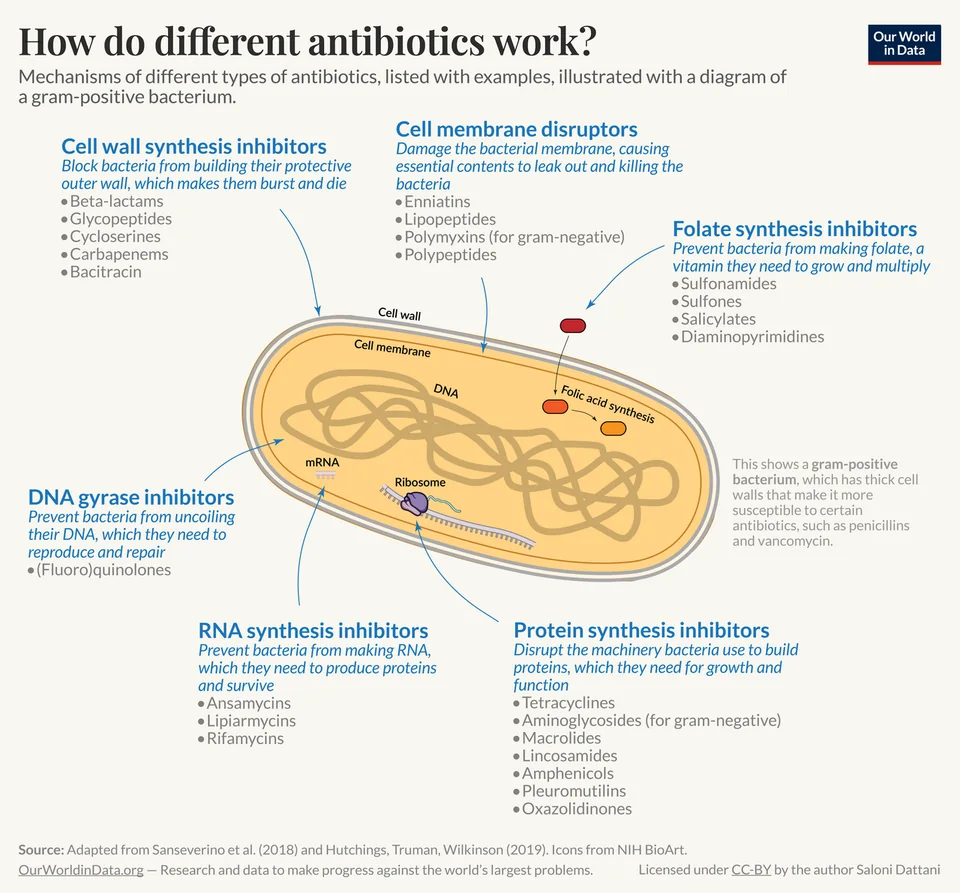
This is the most useful scheme for understanding how drugs behave. Bacterial targets that differ from human cells allow selective toxicity. For example, penicillin-binding proteins have no mammalian counterpart, and bacterial ribosomes differ from human ones.
| Target | Drug groups | Key points |
|---|---|---|
| Cell wall synthesis | Penicillins, cephalosporins, carbapenems, monobactams, vancomycin, cycloserine, bacitracin | β-Lactams bind penicillin-binding proteins (PBPs), the cross-linking enzymes of the wall. Generally bactericidal. |
| Protein synthesis | Tetracyclines, chloramphenicol, macrolides, clindamycin, linezolid, aminoglycosides | Most are bacteriostatic. Aminoglycosides are the exception and are bactericidal. |
| Folate synthesis or action (intermediary metabolism) | Sulfonamides, trimethoprim | Generally bacteriostatic |
| DNA gyrase | Fluoroquinolones such as ciprofloxacin | DNA gyrase uncoils supercoiled DNA so that transcription can occur |
| Cell membrane | Polymyxins (colistin, polymyxin B) | Cause leakage from cell membranes; act on gram-negative organisms |
Protein synthesis inhibitors in more detail
| Group | Ribosomal target | How it works |
|---|---|---|
| Aminoglycosides (amikacin, gentamicin, kanamycin, netilmicin, streptomycin, tobramycin, plazomicin) | 30S subunit | Bind irreversibly, block translocation of peptidyl tRNA and cause misreading of mRNA, so wrong amino acids enter the chain. Bactericidal. Uptake needs an electrochemical gradient across the bacterial membrane, which falls under anaerobic conditions, so uptake and activity are reduced. |
| Tetracyclines (doxycycline, minocycline, tetracycline) | 30S subunit | Bind reversibly and block aminoacyl tRNA from binding at the A site, so peptide elongation stops. |
| Macrolides (erythromycin, azithromycin, clarithromycin) | 50S subunit (23S rRNA) | Bind reversibly and block translocation. Bacteriostatic, though erythromycin may be bactericidal at high concentrations. |
| Chloramphenicol | Near the macrolide site | Inhibits transpeptidation. Bacteriostatic. |
Odd one out: aminoglycosides are the only protein synthesis inhibitors in this list that are bactericidal. Spectinomycin is a related drug that binds the same 30S subunit but does not cause misreading, so it is only bacteriostatic.
6. By source
Penicillin came from the Penicillium mould. A systematic search of soil microbes called actinomycetes then gave streptomycin, followed by tetracyclines, chloramphenicol, erythromycin and many others. Over time the emphasis moved from finding new antibiotic-producing organisms to making semisynthetic derivatives of older drugs with better properties or a different spectrum. A few novel fully synthetic drugs also exist, for example the fluoroquinolones and oxazolidinones.
The β-lactam antibiotics
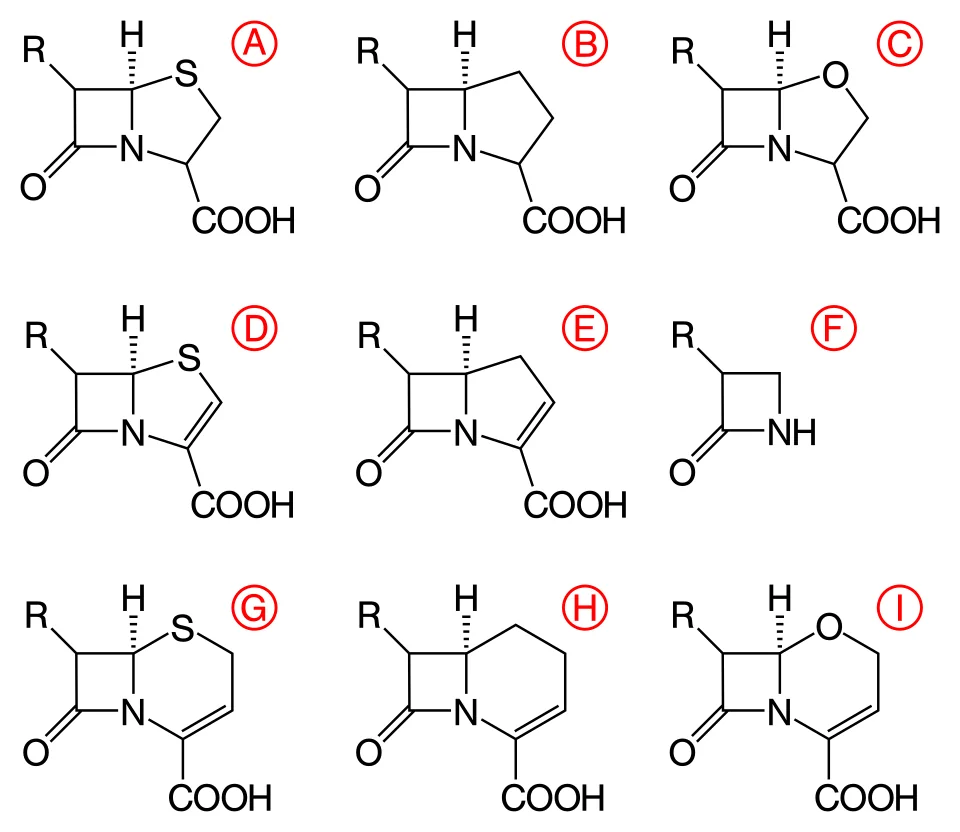
β-Lactams are the largest class of antibiotics. They have a β-lactam ring and kill bacteria by inhibiting the enzymes of cell wall synthesis (PBPs).
| Subgroup | Examples | Main activity |
|---|---|---|
| Natural penicillins | Benzylpenicillin, phenoxymethylpenicillin | Mainly gram-positive organisms |
| Penicillinase-resistant penicillins | Flucloxacillin, temocillin | Used for staphylococcal infections |
| Broad-spectrum penicillins | Amoxicillin, ampicillin | A wide range of gram-positive and gram-negative organisms |
| Antipseudomonal penicillins | Piperacillin, ticarcillin (given with β-lactamase inhibitors) | Selected gram-negative organisms, especially P. aeruginosa |
| Cephalosporins | See the next section | Grouped into generations |
| Carbapenems | Imipenem (with cilastatin), meropenem | Broad spectrum, including pseudomonas, proteus, klebsiella and anaerobes |
| Monobactam | Aztreonam | Gram-negative aerobes; no cross-reactivity with penicillins or cephalosporins |
β-Lactamase inhibitors (clavulanic acid, sulbactam, tazobactam) are given together with a β-lactam to protect it from bacterial enzymes.
Cephalosporins by generation
Cephalosporins are classified into five generations. The general rule: the first generation acts mainly on gram-positive bacteria, and each later generation adds activity against gram-negative bacteria.
| Generation | Examples | Spectrum and uses |
|---|---|---|
| First | Cefazolin, cephalexin, cefadroxil, cephradine | Mainly gram-positive organisms, with some activity against E. coli, P. mirabilis and Klebsiella pneumoniae. Used for MSSA and streptococcal infections such as skin and soft tissue infections. Cefazolin is recommended for surgical prophylaxis against skin organisms. |
| Second | Cefuroxime, cefuroxime axetil, cefprozil, cefaclor, cefamandole; cephamycins cefoxitin and cefotetan | More gram-negative activity, including H. influenzae and Moraxella catarrhalis, and more resistant to β-lactamases. Used in community-acquired pneumonia, acute otitis media and sinusitis. |
| Third | Cefotaxime, ceftriaxone, ceftazidime | Greater potency against gram-negative bacilli and reduced potency against gram-positive cocci |
| Fourth | Cefepime (parenteral) | Good activity against a broad range of gram-positive and gram-negative organisms, including P. aeruginosa |
| Fifth | Ceftaroline, ceftobiprole, ceftolozane | Ceftaroline and ceftobiprole bind PBP2a with higher affinity than other β-lactams. Ceftolozane is a ceftazidime derivative with better activity against Pseudomonas, but it is not stable against most ESBLs or carbapenemases. It is combined with tazobactam. |
Cephamycins (cefoxitin and cefotetan) are grouped with the second generation. They have a 7α-methoxy group that gives resistance to β-lactamases, and they are active against B. fragilis.
All cephalosporins lack clinically useful activity against enterococci, Listeria monocytogenes and atypical respiratory pathogens (Legionella, Mycoplasma, Chlamydophila).
Other important groups
- Aminoglycosides: bactericidal protein synthesis inhibitors (see above). Toxicity includes ototoxicity and nephrotoxicity.
- Tetracyclines and chloramphenicol: protein synthesis inhibitors with a wide range of activity.
- Macrolides: erythromycin was the first macrolide, isolated from soil bacteria. Clarithromycin and azithromycin were developed from it and, with a longer duration of action and wider spectrum, have replaced erythromycin for many uses. Erythromycin is used in diphtheria, pertussis and as a substitute in people allergic to penicillin. Ketolides (telithromycin) are modified macrolides that stay active against many macrolide-resistant gram-positive strains.
- Fluoroquinolones: inhibit DNA gyrase. Useful in urinary tract infections and prostatitis, and increasingly in mycobacterial infections.
- Glycopeptides (vancomycin, teicoplanin): act on cell wall formation, effective against gram-positive organisms only, and used against MRSA and ampicillin-resistant enterococci. Neither is absorbed orally, but oral vancomycin is used for C. difficile infection.
- Polymyxins (colistin, polymyxin B): act on the outer cell membrane of gram-negative organisms.
- Antitubercular drugs: these are divided into first line (high efficacy, low toxicity) and second line (lower efficacy or higher toxicity, used when first-line drugs cannot be used or to supplement them). Isoniazid is an essential component of antitubercular regimens. A further grouping ranks drugs from Group I to Group V by efficacy, with fluoroquinolones in Group III.
Classification by how the drug kills
Killing pattern guides dosing. Three patterns are described:
- Time-dependent killing: efficacy depends on how long the free drug concentration stays above the level needed to inhibit the organism (the MIC). Examples: β-lactams, carbapenems, aztreonam, macrolides, linezolid.
- Concentration-dependent killing: efficacy depends on how high the peak concentration is relative to the MIC. Examples: aminoglycosides, fluoroquinolones, ketolides.
- Both: efficacy depends on the area under the concentration-time curve divided by the MIC. Examples: glycopeptides such as vancomycin, daptomycin, colistin, tigecycline.
This explains once-daily aminoglycoside dosing: a high peak gives maximal killing, a low trough limits nephrotoxicity, and the post-antibiotic effect (continued activity after levels fall below the MIC) maintains the effect. Aminoglycosides and fluoroquinolones have a prolonged post-antibiotic effect against gram-negative bacilli.
How bacteria become resistant
Resistance is classed as natural (the microbe always lacks the target or process, for example gram-negative bacilli are normally unaffected by penicillin G) or acquired (a previously sensitive organism becomes resistant after exposure to the drug, a major clinical problem).
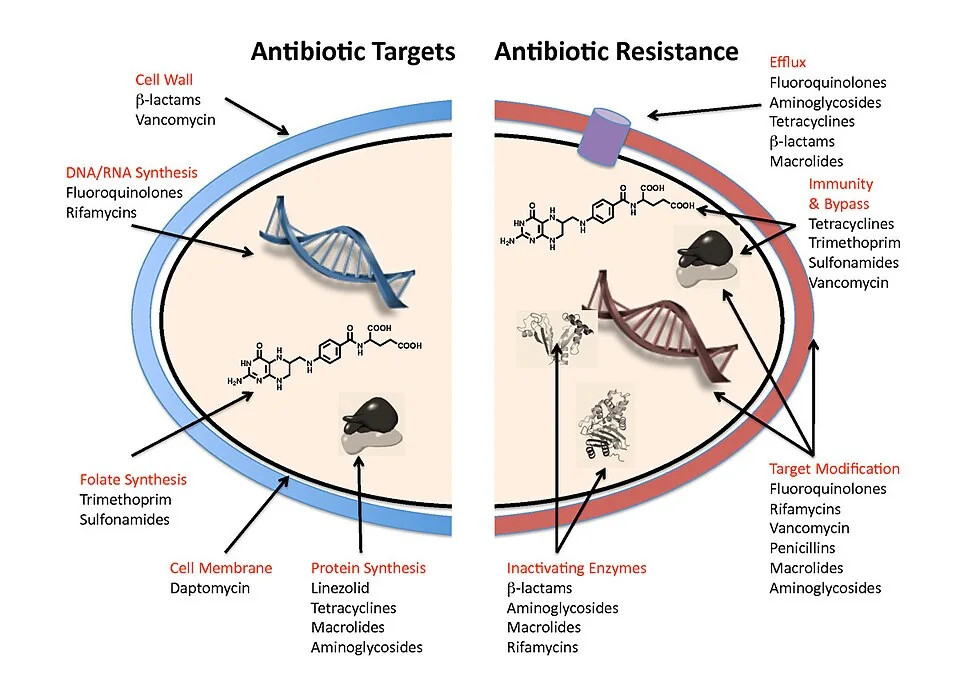
For β-lactams the main mechanisms are:
- Destruction by β-lactamases: the most common and most important mechanism. These enzymes break the β-lactam ring. Gram-positive bacteria secrete large amounts outside the cell, while gram-negative bacteria keep smaller amounts in the periplasmic space. Newer enzymes include ESBLs and carbapenemases. Organisms with carbapenem-hydrolysing enzymes may be resistant to almost all antibacterials in clinical use.
- Altered target: mutated PBPs, or a new PBP such as the one coded by mecA in MRSA.
- Less drug inside the cell: loss of porins (restricted entry) or efflux pumps.
Other classes have their own mechanisms. For macrolides, the commonest is mutation or methylation at the ribosomal binding site, coded by erm genes. For aminoglycosides, the commonest plasmid-mediated mechanism is production of enzymes that destroy the drug.
Key adverse effects by class
| Class | Important adverse effects |
|---|---|
| β-Lactams | Hypersensitivity from rash to anaphylaxis; diarrhoea; neurotoxicity (more with cefepime and imipenem, higher risk with seizure history, renal impairment and old age) |
| Aminoglycosides | Ototoxicity and nephrotoxicity; low therapeutic index |
| Tetracyclines | Dental discolouration in children; avoided in pregnancy |
| Chloramphenicol | Bone marrow suppression; "grey baby syndrome" in newborns, because liver glucuronide conjugation is not yet developed |
| Macrolides | Gastrointestinal upset, QT prolongation; erythromycin and clarithromycin are strong inhibitors of CYP3A4 (drug interactions) |
| Fluoroquinolones | Nausea, CNS effects, tendinitis and tendon rupture (especially over 60 years, with corticosteroids, in transplant recipients), QT prolongation; avoided in pregnancy and young children |
| Vancomycin | Nephrotoxicity; "red man syndrome", managed by slower infusion and an antihistamine |
All systemic antibiotics can alter bowel flora and cause Clostridioides difficile infection. Hypersensitivity can occur with almost any antimicrobial and is unpredictable and unrelated to dose. It is most often seen with penicillins, cephalosporins, sulfonamides and fluoroquinolones.
Using the classification in practice
- Empirical therapy: treatment often starts before the organism is known, based on the likely pathogen. Choice is then refined by culture and sensitivity where possible.
- Stewardship: avoid antibiotics in viral infections, give the narrowest spectrum for the shortest duration, and move from intravenous to oral as soon as possible. Restricting third- and fourth-generation drugs is part of hospital antibiotic policy.
- AWaRe classification: this scheme from the World Health Organization groups antibiotics by coverage and risk of resistance. Access drugs are used empirically and preferred where possible (for example amoxicillin, cefalexin, cefazolin, gentamicin, doxycycline). Watch drugs are used judiciously. Reserve drugs are kept for multidrug-resistant pathogens.
Practice MCQs
Which of the following protein synthesis inhibitors is bactericidal?
- A. Tetracycline
- B. Erythromycin
- C. Gentamicin
- D. Chloramphenicol
Show answer
Answer: C. Most protein synthesis inhibitors are bacteriostatic. Aminoglycosides bind the 30S subunit, cause misreading of mRNA and are bactericidal, so they are the exception.
Which of the following is a cephamycin?
- A. Cefuroxime
- B. Cefoxitin
- C. Cefazolin
- D. Ceftriaxone
Show answer
Answer: B. Cephamycins, cefoxitin and cefotetan, have a 7α-methoxy group that gives resistance to β-lactamases, and they are active against B. fragilis. Cefuroxime is a true second-generation cephalosporin.
Compared with first-generation cephalosporins, third-generation cephalosporins are:
- A. More active against gram-positive cocci and less against gram-negative bacilli
- B. Equally active against both
- C. Active against enterococci and Listeria
- D. More potent against gram-negative bacilli and less potent against gram-positive cocci
Show answer
Answer: D. Successive generations gain gram-negative activity. Third-generation drugs are more potent against gram-negative bacilli and less potent against gram-positive cocci.
The most common mechanism of resistance to β-lactam antibiotics is:
- A. Destruction of the drug by β-lactamase enzymes
- B. Increased uptake of the drug
- C. Loss of the ribosomal binding site
- D. Increased DNA gyrase activity
Show answer
Answer: A. The commonest mechanism of resistance to β-lactams, especially in gram-negative bacteria, is destruction of the drug by β-lactamases, which break the β-lactam ring.
Ciprofloxacin acts mainly by:
- A. Inhibiting cell wall synthesis
- B. Binding the 30S ribosomal subunit
- C. Inhibiting DNA gyrase
- D. Binding the 50S ribosomal subunit
Show answer
Answer: C. Fluoroquinolones such as ciprofloxacin inhibit DNA gyrase, the enzyme that uncoils supercoiled DNA for transcription. Penicillins act on the cell wall, tetracyclines on the 30S ribosome and macrolides on the 50S ribosome.
Which drug shows time-dependent killing?
- A. Gentamicin
- B. Ceftriaxone
- C. Amikacin
- D. Telithromycin
Show answer
Answer: B. β-Lactams kill in relation to how long the drug concentration stays above the level needed to inhibit the organism (time-dependent). Aminoglycosides and ketolides kill in a concentration-dependent way, which is why aminoglycosides can be given once daily.
Viva questions
On what bases can antibiotics be classified?
By type of organism, spectrum (narrow or broad), type of action (bactericidal or bacteriostatic), chemical structure, mechanism of action and source (natural, semisynthetic, synthetic).
Differentiate bactericidal from bacteriostatic drugs, with examples.
Bactericidal drugs kill bacteria (penicillins, cephalosporins, aminoglycosides). Bacteriostatic drugs stop growth and multiplication (tetracyclines, chloramphenicol, macrolides). The line is not rigid: erythromycin can be cidal at high concentrations and cotrimoxazole may be only static in some situations.
Classify cephalosporins by generation, with one example each.
First: cefazolin. Second: cefuroxime (cefoxitin and cefotetan are the cephamycins). Third: ceftriaxone or ceftazidime. Fourth: cefepime. Fifth: ceftaroline. Gram-negative activity increases with each generation after the first.
What are cephamycins?
Cefoxitin and cefotetan, grouped with the second generation. A 7α-methoxy group makes them resistant to β-lactamases, and they are active against B. fragilis.
How do β-lactams work and how do bacteria resist them?
They bind penicillin-binding proteins, the cross-linking enzymes of the cell wall, and are bactericidal. Resistance is mainly through β-lactamases that break the β-lactam ring, also through altered or new PBPs (for example mecA in MRSA), loss of porins and efflux pumps.
Name the groups that inhibit protein synthesis and their ribosomal subunits.
Aminoglycosides and tetracyclines act on the 30S subunit. Macrolides act on the 50S subunit. Chloramphenicol also inhibits protein synthesis. Aminoglycosides are bactericidal, while the others are mostly bacteriostatic.
What is the AWaRe classification?
A scheme that groups antibiotics by coverage of common pathogens and risk of resistance: Access (use empirically, for example amoxicillin), Watch (use judiciously) and Reserve (kept for multidrug-resistant pathogens).
Flashcards
Still mixing up the classes? Ask the GalenAI tutor and practise antibiotic classification MCQs.