Quick answer: Pharmacodynamics is the study of what a drug does to the body: its biochemical and physiological effects and how it produces them. Most drugs bind a protein target: a receptor, enzyme, ion channel or transporter. The effect depends on affinity, efficacy and dose, and is described by dose-response curves, potency, efficacy and the therapeutic index.
What is pharmacodynamics?
Pharmacodynamics is the study of the biochemical, cellular and physiological effects of drugs and their mechanisms of action. In simple words, it is what the drug does to the body. Pharmacokinetics is the opposite: what the body does to the drug (absorption, distribution, metabolism and excretion).
The term covers both the wanted therapeutic effects and the unwanted toxic effects. It starts by describing what a drug does, then explains how it does it. It also covers the dose-effect relationship and how one drug changes the action of another.
An important idea: drugs (except gene-based ones) do not give any cell, organ or system a new function. They only change the pace of an activity that is already going on. Even so, this can have a large medicinal or toxic effect.
Basic types of drug action
| Type | Meaning | Examples |
|---|---|---|
| Stimulation | Selective enhancement of the activity of specialised cells. Too much stimulation is often followed by depression of that function. | Adrenaline stimulates the heart; pilocarpine stimulates salivary glands |
| Depression | Selective reduction of the activity of specialised cells | Most drugs cannot be classed simply as stimulants or depressants |
| Irritation | A non-selective, often noxious effect, mainly on less specialised cells such as epithelium and connective tissue. Strong irritation causes inflammation, corrosion, necrosis and loss of function. | Not a therapeutic goal in most cases |
| Replacement | Use of natural metabolites, hormones or their congeners in deficiency states | Levodopa in parkinsonism, insulin in diabetes mellitus, iron in anaemia |
| Cytotoxic action | Selective killing of invading parasites or cancer cells without much harm to host cells | Penicillin, chloroquine, zidovudine, cyclophosphamide |
Drug targets
Most drugs act by binding a discrete target molecule, usually a protein. This gives the drug selectivity. The target proteins fall into four main groups:
- Enzymes
- Ion channels
- Transporters
- Receptors
A few drugs act on other proteins, for example colchicine, the vinca alkaloids and the taxanes, which bind the structural protein tubulin. Alkylating agents act on nucleic acids.
Drugs also bind acceptors, such as serum albumin. An acceptor does not itself cause any biochemical or physiological response, but it can change the pharmacokinetics of the drug.
Enzymes
Almost all biological reactions are catalysed by enzymes, so enzymes are a major drug target. Drugs can raise or lower the rate of an enzyme reaction.
- Stimulation of enzymes by truly foreign drugs is unusual, because enzyme activity is usually already set at the best level. It matters mainly for natural metabolites. For example, pyridoxine is a cofactor and increases decarboxylase activity. Stimulation lowers the Km (the enzyme's affinity for the substrate rises).
- Enzyme induction is an apparent rise in activity because more enzyme protein is made. It is not true stimulation, because Km does not change. Many drugs induce microsomal enzymes.
- Inhibition of one particular enzyme is a very common way for drugs to work. It is either competitive (Km rises) or noncompetitive (Km is unchanged).
- Some chemicals, such as heavy metal salts, strong acids and alkalis, formaldehyde and phenol, denature proteins and inhibit all enzymes without selection. They are useful only for external application.
Drugs that act without a receptor
Some drugs do not bind a specific regulatory macromolecule. They act by physical or chemical means, or by reacting with small molecules or ions:
- Bulk laxatives such as ispaghula: physical mass
- Activated charcoal: adsorption
- Mannitol and magnesium sulphate: osmotic activity
- Antacids: neutralisation of gastric acid
- Chelating agents such as EDTA and dimercaprol: chelation of heavy metals
- Cholestyramine: sequestration of bile acids and cholesterol in the gut
- Potassium permanganate: oxidising property
Two other groups also work without simple receptor binding. Alkylating agents react covalently with critical biomolecules, especially nucleic acids, and are cytotoxic, which is useful in cancer. Antimetabolites (purine and pyrimidine analogues) lead to non-functional or dysfunctional cell components and have antineoplastic, antiviral and immunosuppressant activity.
Drug-receptor interaction
A drug receptor (or drug target) is the cellular macromolecule, or complex of macromolecules, with which a drug interacts to produce a cellular or systemic response. Receptors are often on the cell surface, but may also lie inside the cell (for example in the nucleus) or outside it, as with drugs that target coagulation factors.
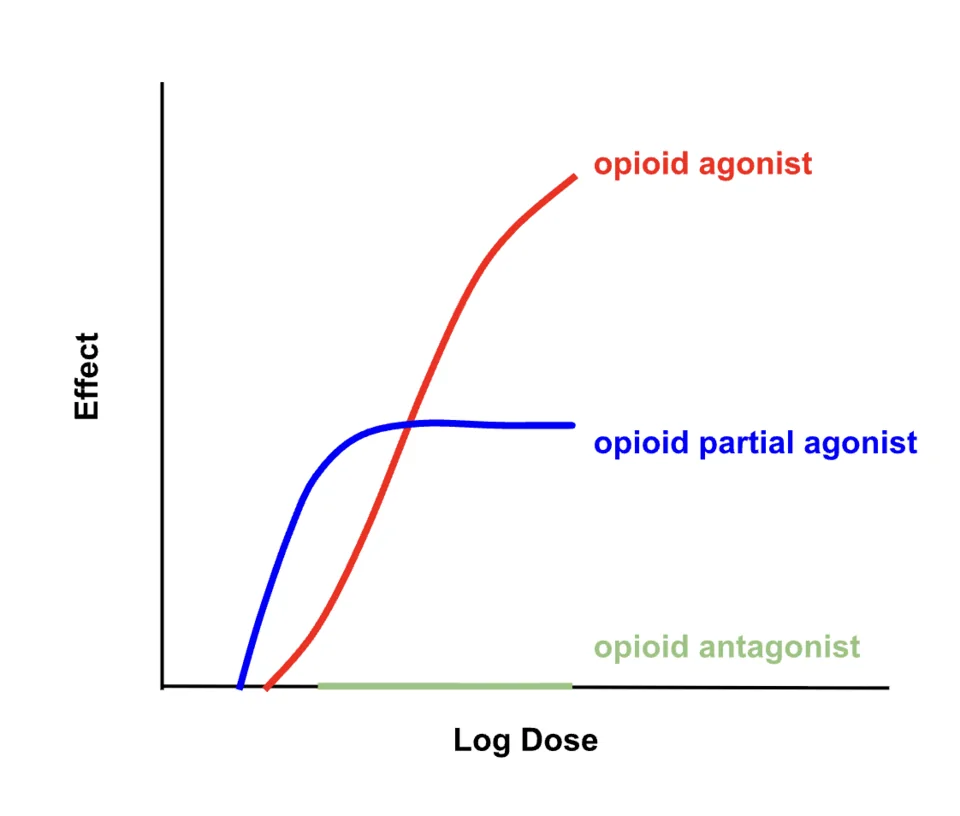
The drug-receptor interaction starts the process and depends on two key principles:
- Affinity and specificity of binding between drug and receptor
- Intrinsic activity: the ability of the bound drug to activate the receptor
Agonists and antagonists
- Agonist: binds and fully mimics the effect of the natural (endogenous) ligand.
- Antagonist: binds and blocks the response. It has zero efficacy and does not itself produce an effect.
- Partial agonist: gives a response somewhere in between, because it has low intrinsic efficacy. It may not give a full response at any dose.
- Inverse agonist: many receptors are active even without their natural ligand (constitutive activity). An inverse agonist binds, stabilises the receptor in an inactive form and reduces this activity.
Binding may be at the same site as the natural ligand (syntopic) or at a different site (allosteric), and may be reversible or irreversible, competitive or non-competitive.
- Competitive antagonism: the antagonist competes with the agonist for the binding site, and each can displace the other.
- Noncompetitive antagonism: the antagonist, for example by covalent binding, permanently impairs the drug's access to the receptor.
Affinity, efficacy and potency
| Term | Meaning | How it appears on the curve |
|---|---|---|
| Affinity | How strongly the drug binds the receptor | Combined with efficacy to decide potency |
| Efficacy | The capacity of a bound drug to activate the receptor and produce a response. A full agonist has high efficacy. | Reflected in Emax, the maximum effect |
| Potency | The amount of drug needed to produce an effect. When two drugs give equivalent responses, the one whose curve lies to the left (smaller EC50) is more potent. | Reflected in EC50 (or C50). A low value means high potency. |
EC50 is the concentration that gives 50% of Emax. Comparing maximal effects depends only on efficacy, but potency depends on both affinity and efficacy.
Potency versus efficacy: potency is about where the curve sits left or right (EC50). Efficacy is about how high it reaches (Emax). A very potent drug is not necessarily more efficacious.
Spare receptors
A tissue can give its maximum response even when an agonist occupies less than 100% of the receptors. Such a tissue is said to have spare receptors (a receptor reserve). At the neuromuscular junction, only 20 to 25% of the nicotinic receptors need to bind acetylcholine to make all the muscle fibres contract, so 75 to 80% are spare.
There are two consequences:
- Near-maximal effects occur at very low concentrations of drug or transmitter.
- Most receptors must be occupied by an antagonist before transmission is affected. This explains the margin of safety of neuromuscular transmission.
From receptor to response: signal transduction
After the drug binds, the receptor may act directly on cell function, or pass a message to intermediate molecules called transducers. The receptor, its cellular target and the intermediate molecules together are the receptor-effector system, or signal transduction pathway. Transducers often act by making, moving or breaking down small molecules called second messengers, for example cAMP or nitric oxide.
This system lets the cell coordinate signals from many ligands and amplify them. That is why a tiny amount of drug at a receptor can have a large biological effect. Enzyme cascades in the pathway amplify the signal, which makes these pathways good drug targets.
| Receptor family | Examples of natural ligand and transducer | Example drugs |
|---|---|---|
| GPCR (G protein-coupled receptor, seven transmembrane helices) | Beta adrenergic receptors: noradrenaline, adrenaline, dopamine; Gs and adenylyl cyclase | Dobutamine, propranolol |
| GPCR | Muscarinic receptors: acetylcholine; Gi and Gq | Atropine |
| Ligand-gated ion channels | Acetylcholine, GABA, 5HT | Nicotine, gabapentin |
| Voltage-gated ion channels | No ligand; opened by membrane depolarisation | Lidocaine, verapamil |
| Receptor tyrosine kinases (transmembrane enzymes) | Insulin and growth factors | Imatinib |
| Cytokine receptors | Interleukins and other cytokines; Jak/STAT | Interferons, anakinra |
GPCRs are a large family. Their ligands include neurotransmitters such as acetylcholine, amines such as noradrenaline, eicosanoids, peptide hormones, opioids and GABA.
Different second messengers can give opposite effects in the same cell. In smooth muscle, calcium is a contractile signal, but activating the beta receptor, cAMP and PKA pathway causes relaxation.
Not all agonists on one receptor behave the same. With some receptors, different ligands give qualitatively different cellular effects. This is called biased agonism.
Dose-response relationships
Classically, drug effects are measured by dose-response studies. Today pharmacodynamics also means the quantitative analysis of the relationship between drug concentration (in blood or at the site of action) and the effect on physiological processes.
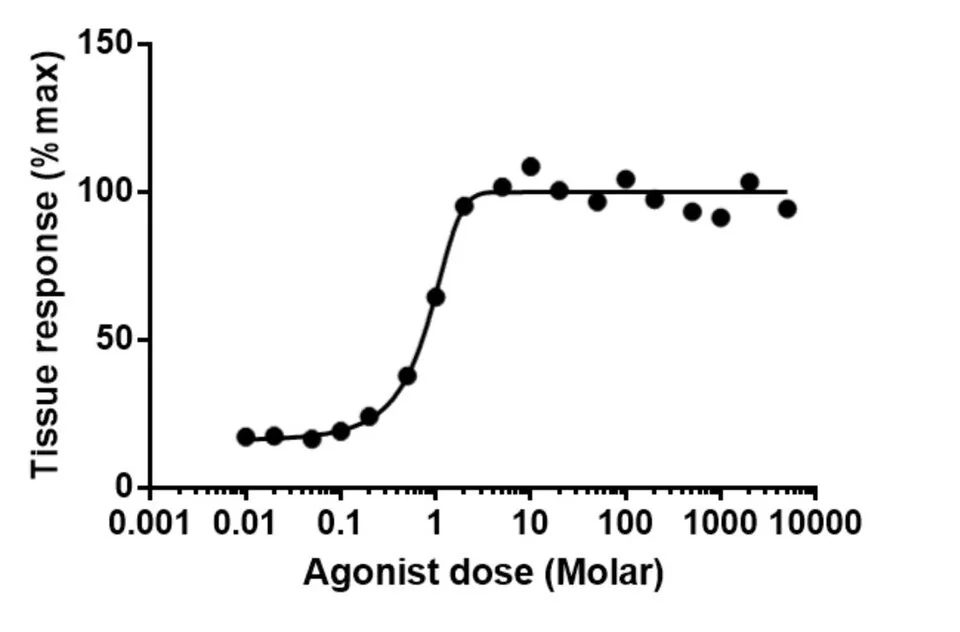
Graded dose-response (one individual)
Larger doses usually give a larger response. The relationship is curved:
- Low doses give little effect.
- Once effects appear, a small rise in dose gives a relatively large rise in effect.
- Near the maximum, large rises in dose give little further effect.
When dose is plotted on a logarithmic scale, the middle part of the curve becomes a straight line and the whole curve is sigmoid (S-shaped). Plotting the percentage of receptors occupied against log concentration also gives a sigmoid curve.
The curve can be described by these parameters:
- E0: baseline effect with no drug
- Emax: the maximum effect, related to the intrinsic efficacy of the drug. A drug with no efficacy has Emax equal to E0.
- C50 (or EC50): concentration giving half-maximal effect; a measure of potency
- Gamma: the steepness of the curve. A value below 1 means a very gradual rise in effect. A value above 4 means that once an effect appears, small rises in concentration give large rises in effect until the maximum is reached.
Quantal dose-response (a population)
In a quantal relationship, the effect in each person is judged as either present or absent. The percentage of the population responding rises as the dose rises.
- ED50: the dose producing the specified effect in 50% of the population
- LD50: the median lethal dose, found in experimental animals
- Therapeutic index: the LD50/ED50 ratio, an indication of how selective a drug is for its wanted effects versus its adverse effects. It can also be written as the C50 for toxicity divided by the C50 for the desired effect.
- Therapeutic window: the range between the concentration giving the desired effect and the concentration giving toxicity
For most drugs the therapeutic index is greater than 100. Some important drugs have an index of less than 10, for example digoxin, warfarin, insulin, phenytoin and opioids. These need careful dose titration for each patient.
Time course of effect
The time course of the effect does not always match the plasma concentration. Pharmacodynamic models add an effect compartment (the biophase) to the usual pharmacokinetic model. This is the hypothetical site that links the plasma concentration curve to the time course of effect.
A delay between dose and effect can have pharmacokinetic causes, such as slow uptake into the target tissue. It can also arise because binding to the receptor is only the first step in a chain of events. For example, the plasma half-life of clopidogrel is about 6 hours, but its antiplatelet effect outlasts this because it binds irreversibly to its receptor. In urgent treatment such as shock or status epilepticus, little delay is wanted.
Increasing the dose raises the peak effect, makes onset quicker and prolongs the duration of action.
Changes with repeated use
Desensitisation means the response falls when a drug is given continuously or repeatedly. The response may sometimes be restored by raising the dose, but in some cases the tissue becomes completely refractory.
- Tachyphylaxis: desensitisation that happens very rapidly, sometimes with the first dose. It suggests depletion of chemicals needed for the effect (for example a stored neurotransmitter) or receptor phosphorylation. Nitrovasodilators used for angina quickly produce complete tolerance by this process.
- Tolerance: a more gradual loss of response over days or weeks. It suggests changes in receptor number or counter-regulatory changes that offset the drug, such as salt and water retention during vasodilator therapy.
Types of tolerance:
- Innate: a genetically determined lack of sensitivity the first time the drug is taken
- Acquired: pharmacokinetic (for example faster metabolism after repeated doses), pharmacodynamic (for example altered receptor density or coupling) and learned (including behavioural and conditioned tolerance)
Tolerance may develop at different speeds to different effects of the same drug. With opioids, tolerance to euphoria is rapid but tolerance to effects on respiration and blood pressure is slow. This gap can lead to fatal overdose.
Receptor up- and downregulation: chronic beta-blocker therapy upregulates beta-receptor density. This does not usually cause resistance to the blocker, but if the drug is stopped suddenly there may be severe agonist-mediated effects such as hypertension or tachycardia.
Drug combinations and interactions
All drug interactions are either pharmacokinetic or pharmacodynamic. Pharmacodynamic interactions change the action of one drug at its target site, independent of any change in its concentration. They are much less common than pharmacokinetic ones.
The result may be a greater response (synergism), a smaller response (antagonism) or an abnormal response.
Synergism
- Additive: the effects go in the same direction and simply add up (A + B = effect of A plus effect of B). The side effects of the two drugs may differ and not add up, so the combination can be better tolerated than a higher dose of one drug.
- Positive synergism (superadditive): the combined effect is greater than the sum.
- Negative synergism (subadditive): the combined effect is less than expected from addition.
An isobologram plots the EC50 of drug A against the EC50 of drug B. The straight line joining them is the line of additivity for a 50% response. If the combination is superadditive, the concentrations needed fall below the line. If it is subadditive, they lie above the line. Combining drugs with different mechanisms may allow lower doses of each, which reduces concentration-dependent adverse effects.
Examples of pharmacodynamic interactions
- Benzodiazepines, sedating antihistamines, neuroleptics, opioids and alcohol together: excessive sedation and respiratory depression
- Sildenafil with organic nitrates: sharp fall in blood pressure and myocardial ischaemia
- ACE inhibitors with potassium-sparing diuretics: severe hyperkalaemia
- Propranolol in a digitalised patient: marked bradycardia
- Propranolol in diabetics on insulin or sulfonylureas: pronounced hypoglycaemia that may be silent
- A beta-lactam antibiotic with a bacteriostatic drug such as tetracycline: its bactericidal action is antagonised
- Levodopa with antidopaminergic drugs such as neuroleptics and metoclopramide: its antiparkinsonian action is blocked
- Aspirin and other NSAIDs with furosemide: reduced diuretic action
Adverse effects as a part of pharmacodynamics
Few drugs are specific enough to give only the wanted effect, so unwanted effects are part of therapeutics. The clinical response, including adverse effects, results from an interaction between the drug and the patient's susceptibility.
Classification of adverse drug reactions (ADRs)
| Type | Features | Examples |
|---|---|---|
| A (augmented) | Predictable from the drug's known pharmacology, dose-dependent, common and usually mild. A normal response that is quantitatively abnormal. Corrected by dose adjustment. | Constipation with opioids, hypotension with antihypertensives, bleeding with anticoagulants |
| B (bizarre) | Not predictable, not clearly dose-dependent, rare and often severe. Patients are hypersusceptible because of immunological or genetic factors. Serious reactions need withdrawal of the drug. | Anaphylaxis with penicillin, peripheral neuropathy with isoniazid in poor acetylators |
| C (chronic) | Appears only after prolonged continuous exposure | Osteoporosis with glucocorticoids, retinopathy with chloroquine |
| D (delayed) | Delayed in onset, such as carcinogenic and teratogenic effects | Second malignancies with anticancer drugs |
| E (end of dose) | Occurs when a drug is stopped | Abrupt stopping of corticosteroids causing adrenal insufficiency; stopping propranolol |
Rare serious ADRs are usually not found before a drug is marketed, because few, relatively healthy patients are studied in trials.
Mechanisms of toxicity
Drug toxicity can be grouped into five overlapping categories by mechanism. Two of them:
- On-target toxicity: an exaggerated response from modulating the intended target. Causes include dosing errors, altered pharmacokinetics (liver or kidney disease, interactions), changes in receptor number, or activation of the same target in an unintended tissue (osteoporosis with corticosteroids, myositis with statins).
- Off-target toxicity: the drug interacts with targets other than the intended one. For example, terfenadine, an H1 antagonist, also inhibits a cardiac potassium channel (hERG).
Side effects can arise from the same action that gives the therapeutic effect, or from an unrelated property. For example, many common side effects of tricyclic antidepressants come from blocking muscarinic acetylcholine receptors or histamine receptors.
Mnemonics
Curve in one line: "Left means potent (low EC50), high means efficacious (big Emax), steep means a large gamma."
Practice MCQs
Pharmacodynamics is best defined as:
- A. What the body does to the drug
- B. The movement of a drug from the site of administration into plasma
- C. The study of the effects of drugs on the body and their mechanisms of action
- D. The rate of elimination of a drug
Show answer
Answer: C. Pharmacodynamics is the study of what the drug does to the body, including its effects and mechanisms of action. Absorption, distribution, metabolism and excretion belong to pharmacokinetics.
Drug X and drug Y produce the same maximal response, but the dose-response curve of X lies to the left of Y. Which statement is correct?
- A. X has lower efficacy than Y
- B. X is more potent than Y
- C. X has a higher EC50 than Y
- D. X is a partial agonist and Y is a full agonist
Show answer
Answer: B. When two drugs give equivalent responses, the one whose curve lies to the left has the smaller EC50 and is the more potent. Potency and efficacy are different: efficacy is shown by the maximum effect.
At the neuromuscular junction, the presence of spare receptors means that:
- A. Every receptor must be occupied to produce contraction
- B. The drug has no efficacy
- C. Tolerance develops quickly
- D. Most receptors must be occupied by an antagonist before transmission is affected
Show answer
Answer: D. Because of spare receptors, a full response needs only a fraction of receptors to be occupied. So most receptors must be blocked by an antagonist before transmission is affected, which gives a margin of safety.
Anaphylaxis caused by penicillin is an example of which type of adverse drug reaction?
- A. Type B (bizarre)
- B. Type A (augmented)
- C. Type C (chronic)
- D. Type E (end of dose)
Show answer
Answer: A. Anaphylaxis to penicillin is unpredictable, rare, often severe and not simply dose-related, because it depends on immunological hypersusceptibility. That makes it a type B reaction. Type A reactions are predictable extensions of the drug's pharmacology.
Compared with tolerance, tachyphylaxis is:
- A. A gradual loss of response over weeks
- B. A genetically determined lack of response to the first dose
- C. A very rapid loss of response, sometimes with the first dose
- D. An increase in response with repeated doses
Show answer
Answer: C. Tachyphylaxis is very rapid desensitisation, sometimes with the first dose, and suggests depletion of a needed chemical or receptor phosphorylation. Tolerance is a slower loss of response over days or weeks, linked to receptor number or counter-regulatory changes.
On an isobologram, if the concentrations of drugs A and B needed for a 50% response fall below the line of additivity, the combination shows:
- A. Negative synergism
- B. Positive synergism
- C. Simple additivity
- D. Non-competitive antagonism
Show answer
Answer: B. On an isobologram, a line joining the EC50 values of two drugs shows additivity. If the concentrations needed for a given response fall below this line, the combination is superadditive, which is positive synergism.
Viva questions
Define pharmacodynamics.
It is the study of the biochemical, cellular and physiological effects of drugs and their mechanisms of action, in other words what the drug does to the body. It covers both therapeutic and toxic effects.
Name the four main types of drug target.
Enzymes, ion channels, transporters and receptors. A few drugs act on other proteins such as tubulin, or on nucleic acids.
Differentiate an agonist, a partial agonist, an antagonist and an inverse agonist.
An agonist fully mimics the natural ligand. A partial agonist gives a response in between. An antagonist binds but has zero efficacy and blocks the response. An inverse agonist stabilises the receptor in its inactive form and reduces the receptor's constitutive activity.
What is the difference between potency and efficacy?
Potency is the amount of drug needed for an effect and is shown by EC50, with the curve lying further left for a more potent drug. Efficacy is the ability of the bound drug to activate the receptor and is shown by Emax, the maximum effect.
What are spare receptors and why do they matter?
They are receptors in excess of the number needed for a full response. At the neuromuscular junction only 20 to 25% need to be occupied. They allow near-maximal effects at low drug concentrations and give a margin of safety against antagonists.
Define therapeutic index and name drugs with a low index.
It is the LD50/ED50 ratio, a measure of how selective a drug is for its wanted effect over its toxic effect. Most drugs have an index above 100. Digoxin, warfarin, insulin, phenytoin and opioids have an index below 10, so their doses must be titrated carefully.
Distinguish type A and type B adverse drug reactions.
Type A is predictable from the drug's pharmacology, dose-dependent, common and usually mild, for example constipation with opioids. Type B is unpredictable, not clearly dose-related, rare and often severe, for example anaphylaxis with penicillin.
Flashcards
Still stuck on potency versus efficacy? Ask the GalenAI tutor and practise pharmacodynamics MCQs.