Quick answer: The lac operon is the unit in E. coli that controls lactose metabolism. It has a regulatory gene (I), a promoter (P), an operator (O) and three structural genes (Z, Y, A). Without lactose, the repressor sits on the operator and switches the operon off. Lactose inactivates the repressor, so the three enzymes are made. Glucose lowers cAMP and reduces expression.
What is an operon?
Before the lac operon, a few terms need defining.
- A cistron is the smallest unit of genetic expression. It is the stretch of DNA that codes for one subunit of a protein molecule.
- The older idea of "one gene, one enzyme" does not always hold, because many enzymes are built from two or more nonidentical subunits (polypeptide chains). It has therefore been replaced by one cistron, one subunit.
- An operon is the coordinated unit of genetic expression in bacteria. Several genes that work together are switched on and off as a group.
The operon idea was introduced in 1961 (Nobel Prize 1965). It came from studies of how the bacterium E. coli regulates the metabolism of lactose. This model is popularly known as the lac operon. Working out gene regulation in prokaryotes (bacteria) helped us understand how information flows from genes to mRNA to specific proteins.
Structure of the lac operon
The lac operon has these parts:
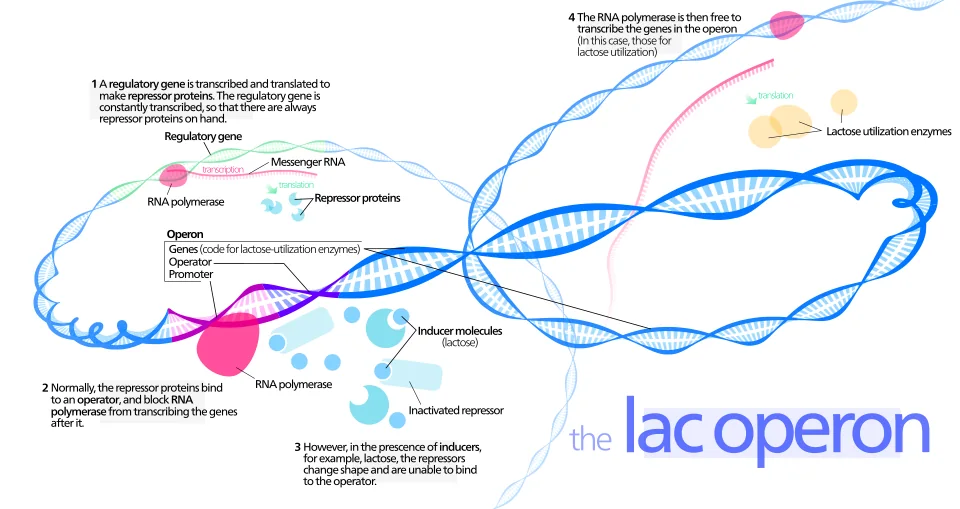
| Part | What it is | Role |
|---|---|---|
| Regulatory gene (I, or lacI) | A gene with its own promoter. The letter I stands for inhibition. | Codes for the repressor protein |
| Promoter (P) | A site next to the operator | RNA polymerase binds here |
| Operator (O) | A site downstream of the promoter, where the repressor binds | Acts as the switch: when it is occupied, transcription is blocked |
| CAP site | A site just upstream of the promoter, where the CAP-cAMP complex binds | Allows maximal transcription |
| Z gene | Structural gene | Codes for beta-galactosidase |
| Y gene | Structural gene | Codes for galactoside permease |
| A gene | Structural gene | Codes for galactoside acetylase |
The regulatory region sits upstream of the three structural genes. It consists of the promoter, where RNA polymerase binds, and two further sites, the operator and the CAP site, where regulatory proteins bind.
What the three enzymes do
- Beta-galactosidase hydrolyses lactose (a beta-galactoside) into galactose and glucose.
- Permease is responsible for transport of lactose into the cell.
- Acetylase is coded by the A gene. Its function remains a mystery, so do not try to give it a role in an exam answer beyond naming it.
One mRNA, separate proteins
The structural genes Z, Y and A are transcribed into a single large mRNA. Because one mRNA carries more than one cistron, it is called polycistronic mRNA. Each protein is then translated separately. The three proteins are not cut out of a single large precursor.
Gene order, I P O Z Y A: read the diagram left to right. The repressor gene comes first and has its own promoter. Then the promoter and operator, then the structural genes, which code for beta-galactosidase, permease and acetylase in that order.
Cis-acting elements and trans-acting factors
Gene regulation uses two kinds of partner.
- Cis-acting elements are DNA sequences that are bound by regulatory molecules. In the lac operon, the operator and the CAP site are examples.
- Trans-acting molecules are usually proteins. They are made from genes different from the genes they regulate. They bind to the cis-acting elements on DNA.
The repressor is a trans-acting factor. It is made from the lacI gene and then binds to the operator.
The lac repressor
The normal lacI gene is expressed constitutively. That means it is expressed at a constant rate, so a steady supply of repressor subunits is made. Four identical subunits, each with a molecular weight of 38,000, assemble into a tetrameric Lac repressor molecule.
The repressor binds to the operator through a helix-turn-helix motif. A motif is a small recurring structural pattern in a protein that lets it bind DNA.
Repression: when lactose is absent
When there is no lactose, the repressor is active. It binds to the operator site, which lies downstream of the promoter. Its presence interferes with the progress of RNA polymerase and blocks transcription of the structural genes. The enzymes for lactose metabolism are therefore not made.
This is an example of negative regulation: the regulator acts as a brake. The repressor is a negative regulator of gene expression.
Induction: when lactose is present
If lactose (the inducer) is present in the medium, a small amount of it can enter the E. coli cell. The repressor has a high affinity for the inducer. Inside the cell a small amount of lactose is converted to its isomer allolactose, which is the form that binds the repressor. The sequence of events is:
- The inducer (lactose, as allolactose) binds to the repressor.
- The binding causes a conformational change (a change in shape) in the repressor.
- The repressor is inactivated and can no longer bind to the operator.
- RNA polymerase attaches at the promoter and transcription proceeds.
- Polycistronic mRNA for Z, Y and A is formed, and the three enzymes are made.
Lactose acts by inactivating the repressor molecules, so the process is called derepression of the lac operon. Put simply, lactose induces the synthesis of beta-galactosidase, galactoside permease and galactoside acetylase.
Constitutive and inducible genes
- Constitutive genes are expressed at a constant rate. The lacI gene is an example.
- Inducible genes are those whose products rise when an inducer is present. The enzymes of the lac operon are inducible: they are made when lactose is there to induce them.
Gratuitous inducers
Some structural analogs of lactose can induce the lac operon but are not substrates for beta-galactosidase. These are called gratuitous inducers. A structural analog is a molecule with a shape similar to another molecule.
Isopropylthiogalactoside (IPTG) is a gratuitous inducer and is used extensively to study the lac operon. Because the enzyme does not break it down, the inducer is not used up, which is what makes it useful in experiments.
Catabolite repression: the effect of glucose
Bacteria use glucose as a fuel in preference to any other sugar. When E. coli is exposed to both lactose and glucose, the cells first metabolize the glucose. They then temporarily stop growing until the lac operon genes become induced and the cell can use lactose as an energy source. Although lactose is present from the start, the cell does not induce the enzymes needed to break it down until the glucose has been used up.
This phenomenon was first thought to be repression of the operon by some breakdown product (catabolite) of glucose, so it was named catabolite repression. We now know it is mediated by the catabolite activator protein (CAP) acting together with cyclic AMP (cAMP). CAP is also called the cAMP regulatory protein (CRP). Many other inducible enzyme systems in prokaryotes are also sensitive to catabolite repression.
How glucose lowers the signal
- The bacterium accumulates cAMP only when it is starved of a source of carbon.
- Glucose inhibits adenylyl cyclase, the enzyme that converts ATP to cAMP.
- So when glucose (or enough glycerol for growth) is present, there is too little cAMP to bind to CAP.
- Without cAMP-saturated CAP, RNA polymerase cannot start transcription of the operon at the maximal rate.
How CAP-cAMP turns expression up
When the CAP-cAMP complex is present, it binds at the CAP response element just upstream of the promoter, and transcription occurs at maximal levels. A region of CAP directly contacts the alpha subunit of RNA polymerase. These protein to protein contacts help RNA polymerase bind to the promoter.
CAP-cAMP is therefore a positive regulator, because its presence is needed for optimal expression.
Two switches, two directions: LacI repressor is the negative regulator (it blocks). CAP-cAMP is the positive regulator (it boosts). The operon is controlled by both.
Putting the two controls together
The lacZ, lacY and lacA genes are expressed only when the operator site is empty and the CAP site is occupied by the CAP-cAMP complex.
| Condition | Repressor | CAP-cAMP | Result |
|---|---|---|---|
| Glucose present, no lactose | Bound to operator | Lacking, because glucose keeps cAMP low | Operon off |
| Lactose present, glucose absent | Inactivated by lactose, so the operator is empty | Present, because cAMP is high when carbon is scarce | Operon on at the maximal level |
| Lactose and glucose both present | Inactivated by lactose | Lacking, because glucose keeps cAMP low | Cells use glucose first; transcription is negligible until glucose is exhausted, even if lactose is plentiful |
Maximal activity of the operon occurs when glucose is low (so cAMP is high and CAP is active) and lactose is present (so the repressor cannot bind to the operator).
A small leak keeps the cell ready
Even when the operon is turned off by catabolite repression, the repressor transiently comes off the operator at a slow rate. This allows a very low level of expression. A few molecules of permease and beta-galactosidase get made. This lets the organism respond rapidly if glucose becomes unavailable.
Why this topic matters
Studying lactose metabolism in E. coli led to the discovery of the basic principles of how gene transcription is activated and repressed. The same ideas, such as cis-acting elements, trans-acting proteins, DNA-binding motifs, and regulators that act positively or negatively, help in understanding regulation of gene expression in general.
Mnemonics
Lac operon in one line: "Lactose inactivates the repressor, glucose switches off cAMP." Repressor off plus cAMP-CAP on equals maximal expression.
Z, Y, A: Z is the one that breaks lactose (beta-galactosidase). Y brings lactose in (permease, think "why does lactose get in?"). A is the acetylase whose function is still unclear.
Practice MCQs
The structural gene of the lac operon that codes for beta-galactosidase is:
- A. lacI
- B. lacZ
- C. lacY
- D. lacA
Show answer
Answer: B. The Z gene codes for beta-galactosidase, which hydrolyses lactose to galactose and glucose. Y codes for permease and A for acetylase.
In the presence of lactose, the lac operon is switched on because lactose:
- A. Binds to RNA polymerase and activates it
- B. Binds to the operator and removes the promoter
- C. Binds to the repressor and prevents it from binding to the operator
- D. Increases the synthesis of the repressor
Show answer
Answer: C. Lactose binds the repressor and changes its shape. The inactivated repressor cannot bind the operator, so RNA polymerase can transcribe the structural genes.
Why is the lac operon poorly expressed in a cell that has plenty of glucose, even when lactose is present?
- A. Glucose keeps cAMP low, so CAP-cAMP is lacking
- B. Glucose binds the operator directly
- C. Glucose destroys beta-galactosidase mRNA after translation
- D. Glucose increases the amount of repressor subunits
Show answer
Answer: A. Glucose inhibits adenylyl cyclase, the enzyme that converts ATP to cAMP. With little cAMP, CAP cannot be activated and the operon is not expressed at the maximal rate.
Isopropylthiogalactoside (IPTG) is best described as:
- A. A substrate hydrolysed by beta-galactosidase into galactose and glucose
- B. A competitive inhibitor of adenylyl cyclase
- C. A repressor of the lac operon
- D. A gratuitous inducer that is not a substrate for beta-galactosidase
Show answer
Answer: D. A gratuitous inducer is a structural analog of lactose that induces the operon but is not a substrate for beta-galactosidase. IPTG is the standard example.
The CAP-cAMP complex acts on the lac operon as:
- A. A negative regulator that blocks RNA polymerase
- B. A positive regulator that helps RNA polymerase bind the promoter
- C. A structural gene product
- D. A substrate of permease
Show answer
Answer: B. CAP-cAMP binds just upstream of the promoter and helps RNA polymerase bind, so its presence is needed for optimal expression. That makes it a positive regulator. The repressor is the negative regulator.
Which statement about the expression of the lac structural genes is correct?
- A. Each gene is transcribed into its own separate mRNA
- B. A single large protein is made and then cut into three enzymes
- C. One polycistronic mRNA is made, and each protein is translated separately
- D. The three enzymes are made only when the operator is occupied by repressor
Show answer
Answer: C. The Z, Y and A genes are transcribed into one large polycistronic mRNA, but each protein is translated separately and is not cut from a single large precursor.
Viva questions
What is an operon?
The coordinated unit of genetic expression in bacteria. The concept came from studies of lactose metabolism in E. coli, which is the lac operon.
Name the components of the lac operon.
A regulatory gene (I), a promoter (P) where RNA polymerase binds, an operator (O) where the repressor binds, and three structural genes Z, Y and A. The CAP site, where CAP-cAMP binds, lies just upstream of the promoter.
What do the Z, Y and A genes code for?
Z codes for beta-galactosidase, which splits lactose into galactose and glucose. Y codes for permease, which transports lactose into the cell. A codes for acetylase, whose function remains a mystery.
How does the repressor switch the operon off?
The repressor binds the operator through a helix-turn-helix motif. This interferes with the progress of RNA polymerase and blocks transcription of the structural genes. This is negative regulation.
How does lactose induce the operon?
Lactose binds the repressor and changes its shape. The repressor is inactivated and cannot bind the operator, so RNA polymerase transcribes the genes and the three enzymes are made. This is derepression.
What is catabolite repression?
Cells use glucose first and do not induce the lac enzymes until glucose is exhausted, even if lactose is present. It is mediated by CAP together with cAMP. Glucose inhibits adenylyl cyclase, so cAMP stays low.
What is a gratuitous inducer? Give an example.
A structural analog of lactose that induces the lac operon but is not a substrate for beta-galactosidase. IPTG (isopropylthiogalactoside) is an example and is widely used to study the operon.
Flashcards
Still unsure how glucose and lactose control the operon? Ask the GalenAI tutor and practise lac operon MCQs.