Quick answer: DNA replication is how a cell copies its DNA before it divides. It is semiconservative, so each daughter molecule has one old strand and one new strand. Helicase opens the double helix at an origin, primase makes an RNA primer, DNA polymerase extends it in the 5' to 3' direction, and ligase joins the fragments.
What is DNA replication?
DNA is the genetic material. When a cell divides, each daughter cell must receive an identical copy of the genetic information. Replication is the process in which DNA copies itself to give identical daughter molecules. It is carried out with high fidelity, which means very few copying errors, and this is essential for the survival of the species.
The parent DNA has two strands that are complementary to each other. Both strands are copied at the same time. Each new DNA molecule contains one original strand and one newly made strand. This is called semiconservative replication, because half of the original DNA is conserved in each daughter molecule.
Replication has these features:
- It is semiconservative.
- It is bidirectional: it moves in both directions from the starting point.
- It takes place through replication bubbles and replication forks.
- New DNA is always made in the 5' to 3' direction.
The details were first worked out in the bacterium Escherichia coli (E. coli). Bacteria are called prokaryotes here, and the steps below describe them first. Eukaryotic cells, including human cells, follow the same general principles but are more complex. In either case, once replication starts, the cell is committed to copying the whole genome.
Complementary base pairing and the template
Replication begins by breaking the weak hydrogen bonds between the bases. This leaves a single strand with each base unpaired. Adenine always pairs with thymine, and guanine always pairs with cytosine. This complementary base pairing is the key to accurate copying. An unpaired base attracts a free nucleotide only if that nucleotide carries the correct complementary base.
Each separated strand is a template: the molecule on which a complementary molecule is built. DNA polymerases can only copy from a single-stranded template, so the strands must be separated first.
Where replication starts: the origin
Replication starts at a site called the origin of replication.
- In prokaryotes there is a single origin.
- In eukaryotes there are multiple origins on each chromosome, with as many as 100 in humans. Clusters of adjacent origins start together, so the whole genome is copied within the time available.
In E. coli the protein DnaA binds to specific sequences at the origin. This melts short, AT-rich regions, using ATP, and creates local regions of single-stranded DNA. In yeast the equivalent proteins are called the origin recognition complex (ORC), and similar proteins are found in all eukaryotes studied.
Replication moves in both directions from each origin. The opened region, with the new synthesis going on in it, is a replication bubble. Each end of the bubble is a replication fork.
The replication fork: who does what?
At the fork, the events happen in this order:
- Helicase unwinds a short segment of the parent double helix. It uses energy from ATP.
- Single-stranded DNA-binding (SSB) proteins bind to the exposed single strands and stop them from pairing up again.
- Primase makes a short RNA primer.
- DNA polymerase starts making the new daughter strand.
The complex of helicase and primase that moves along the fork is called the primosome.
| Protein or enzyme | Role | Eukaryotic counterpart or note |
|---|---|---|
| DnaA | Binds the origin and melts AT-rich DNA | ORC; the MCM complex then unwinds DNA |
| Helicase (DnaB, needs DnaC) | Unwinds the double helix; needs ATP | MCM complex |
| SSB proteins | Keep the separated strands apart | Replication protein A (RPA) |
| Topoisomerase (gyrase in bacteria) | Removes supercoils ahead of the fork | Human type I and type II topoisomerases |
| Primase (DnaG) | Makes the RNA primer | DNA polymerase alpha makes the primers |
| DNA polymerase III | Main enzyme that extends the DNA chain | DNA polymerases delta and epsilon |
| DNA polymerase I | Removes the RNA primer, fills the gap, proofreads | RNase H and FEN1 remove primers |
| DNA ligase | Seals the last break in the backbone | Same job in eukaryotes |
| Sliding clamp (two beta subunits) | Holds polymerase on the DNA | PCNA, loaded with the help of replication factor C (RFC) |
Supercoils and topoisomerases
As the helix is unwound, the DNA ahead of the fork becomes overwound. Think of two twisted ropes tied at one end. If you pull the free ends apart, the ropes twist around each other. These twists are supercoils, and if they build up they stop further unwinding.
DNA topoisomerases remove the supercoils.
- Type I topoisomerase cuts one strand, passes the intact strand through the break, and reseals it. It does not need ATP. It has both nuclease (cutting) and ligase (resealing) activity.
- Type II topoisomerase cuts both strands and reseals them. In bacteria it is called gyrase.
Leading and lagging strands
The two parental strands run in opposite directions (they are antiparallel). DNA polymerases can add a nucleotide only to the 3' end of a growing chain, so they can only build DNA in the 5' to 3' direction. No enzyme in any organism polymerises DNA in the 3' to 5' direction. This creates a problem, because both new strands cannot simply grow in the direction the fork is moving.
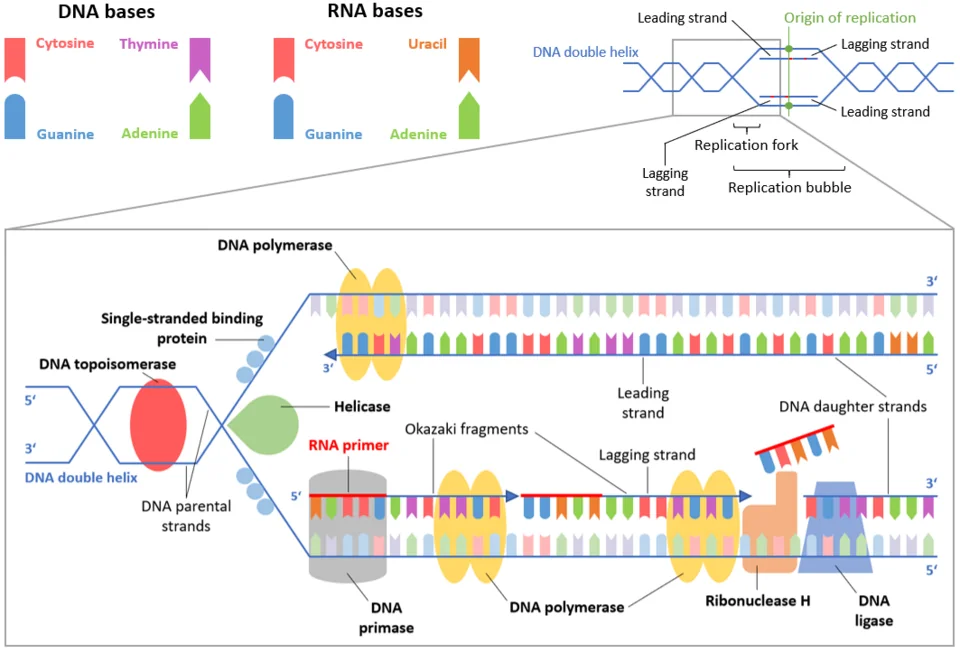
- The leading strand is made continuously in the same direction as the fork. It needs only one primer, at the origin.
- The lagging strand is made discontinuously, in short pieces, each still built 5' to 3' but in the direction away from the fork. Each piece needs its own primer, so primers are made again and again at the fork.
The short pieces of the lagging strand are called Okazaki fragments. The fragments are made in short spurts of 150 to 250 nucleotides. Later they are joined into one continuous strand. In bacteria the same enzyme can copy both strands at the same time. In eukaryotes polymerases epsilon and delta carry out leading and lagging strand synthesis.
RNA primers
DNA polymerases cannot start a new strand on a totally single-stranded template. They need an RNA primer: a short double-stranded region where RNA is base-paired to the template, with a free hydroxyl group on the 3' end of the RNA. The polymerase adds the first deoxynucleotide to this 3' hydroxyl group.
Primase is a specific RNA polymerase. In E. coli it makes primers about ten nucleotides long, complementary and antiparallel to the template. In the primer, uracil (U) pairs with adenine (A) of the DNA. Primase also works in the 5' to 3' direction.
Chain elongation and proofreading
DNA polymerase III extends the primer by adding deoxyribonucleotides one at a time to the 3' end. The order of nucleotides is dictated by the template.
- The building blocks are the deoxyribonucleoside triphosphates (dATP, dTTP, dCTP, dGTP).
- Pyrophosphate (PPi) is released as each nucleotide is added. Hydrolysis of PPi means two high-energy bonds are used for every nucleotide added.
- All four triphosphates must be present. If one runs short, synthesis stops when it is used up.
DNA polymerases share three important properties:
- Chain elongation: the rate of polymerisation, in nucleotides per second.
- Processivity: how many nucleotides are added before the polymerase comes off the template.
- Proofreading: finding copying errors and correcting them.
In E. coli, polymerase III has the highest rate of elongation and is the most processive of the polymerases. When it binds the sliding clamp (two identical beta subunits), the complex becomes much more stable and processive. Processivity ranges from 100 to more than 50,000 nucleotides, and elongation is 20 to 50 nucleotides per second.
Proofreading uses a 3' to 5' exonuclease activity. An exonuclease removes one nucleotide at a time from the end of a chain. An endonuclease, in contrast, cuts within the chain. Proofreading must move backwards, 3' to 5', because the error has to be removed in the direction opposite to synthesis. The correct nucleotide is then put in by the 5' to 3' polymerase activity. Checking that each base matches the template greatly improves the accuracy of replication.
Removing primers and sealing the gaps
Polymerase III keeps working on the lagging strand until it reaches the next RNA primer. Then the primer is removed and the gap is filled by DNA polymerase I:
- Polymerase I finds the nick, the space between the 3' end of the new DNA and the 5' end of the next primer.
- Its 5' to 3' exonuclease activity removes the RNA nucleotides ahead of it.
- Its 5' to 3' polymerase activity replaces them with deoxyribonucleotides.
- Its 3' to 5' exonuclease activity proofreads the new chain.
- DNA ligase forms the last phosphodiester bond, between the 5' phosphate of the DNA made by polymerase III and the 3' hydroxyl of the DNA made by polymerase I. This step needs energy, which in most organisms comes from cleaving ATP to AMP and PPi.
DNA polymerase II takes part in DNA repair. Polymerases I and II are mostly involved in proofreading and repair.
In eukaryotes the primers are removed by RNase H and FEN1 rather than by a DNA polymerase.
Replication in eukaryotes and the cell cycle
The process closely follows that of prokaryotes, with some differences:
- There are multiple origins instead of one.
- Eukaryotic SSB-like and helicase-like proteins do the same jobs: RPA and the MCM complex.
- On the leading strand, a sliding clamp called PCNA forms a ring around the DNA. The factor RFC is needed to form the ring.
- Lagging strand synthesis is more complex and involves RPA, RFC, RNase H and FEN1.
- Replication is somewhat slower than in bacteria. This may be because of interference by nucleosomes.
- After replication, newly made DNA is quickly assembled into nucleosomes, with the help of histone chaperone proteins.
Replication is tied to the cell cycle. DNA is replicated only in the S phase, once per cell cycle. The cell prepares for DNA synthesis in G1 and for mitosis in G2. The M phase is mitosis, and G0 is the dormant, non-dividing state. In S phase the genome doubles, and a large number of polymerases (500 to 1,000) work at the same time. Copying the whole DNA takes about 8 to 10 hours. Origin-binding proteins are removed or degraded after firing, so origins fire only once per cell cycle. Cyclins (A, B, D and E) rise and fall during the cycle and act on cyclin-dependent kinases (CDKs), which control the move from one phase to the next. Checkpoints stop cells with damaged DNA from entering S phase.
Telomeres and telomerase
Linear chromosomes have a problem at their ends. The lagging strand cannot be completed to the very end, so each round of replication would shorten the DNA. Telomeres are special structures at the ends of eukaryotic chromosomes that prevent continuous loss of DNA and stop chromosomes fusing with each other. Human telomeres are made of repeats of the sequence TTAGGG.
Telomerase keeps telomeres from shrinking. It is unusual because it contains both protein and RNA:
- The protein part acts as a reverse transcriptase, an RNA-directed DNA polymerase.
- The RNA part is a short template. It base-pairs with the GT-rich single-stranded 3' end of the telomere.
- The enzyme extends the 3' end in the 5' to 3' direction, then translocates (moves) to the new end and repeats the cycle.
- The lengthened strand can then be used by primase to make a primer, and the gap is filled in the usual way.
Telomerase is highly active in the early embryo. After birth it stays active in germ cells, stem cells and most cancer cells, but not in ordinary somatic cells. In somatic cells the telomeres shorten with each division. Once the telomere supply is used up, roughly 100 cell divisions in humans, the cell stops dividing and becomes senescent. For this reason telomeres are called mitotic clocks, and they are linked to ageing and to cancer.
In Werner syndrome there is accelerated telomere shortening, and in dyskeratosis congenita telomeres are short because of abnormal telomere biology.
Drugs that block DNA replication
Because replication needs particular enzymes and building blocks, blocking it slows rapidly dividing cells, bacteria and viruses.
| Drug | Target or action | Use |
|---|---|---|
| Ciprofloxacin, nalidixic acid, novobiocin | Inhibit bacterial gyrase, so bacterial DNA cannot be copied | Antibacterial. They have almost no effect on human enzymes. |
| Camptothecin | Inhibits topoisomerase I | Cancer treatment |
| Etoposide, amsacrine | Inhibit topoisomerase II | Cancer treatment |
| Doxorubicin and adriamycin | Inhibit human topoisomerases | Anticancer |
| 6-Mercaptopurine, 5-fluorouracil | Nucleotide analogs that inhibit DNA replication | Anticancer |
| Cytarabine (araC) | Sugar changed to arabinose, so the chain cannot be extended | Anticancer |
| Vidarabine (araA) | Same idea, with adenine arabinoside | Antiviral |
| Zidovudine (AZT), didanosine (ddI) | Modified sugar stops chain elongation. In ddI a group is removed from the 3' carbon of the sugar. They are changed to active nucleotides inside the cell and compete with the normal precursors used by viral reverse transcriptase. | Antiviral (retroviruses such as HIV) |
| Methotrexate | Inhibits dihydrofolate reductase. Thymidylate synthase makes the thymidine needed for DNA, and it and dihydrofolate reductase are especially active in tissues with a high rate of cell division. | Cancer chemotherapy |
Nucleoside drugs are usually given as nucleosides and then converted to the active nucleotides by cellular salvage enzymes.
Retroviruses carry their genome as single-stranded RNA. Their enzyme reverse transcriptase first makes a DNA-RNA hybrid, the RNA is degraded by RNase H, and the remaining DNA strand is copied into double-stranded DNA that can integrate into the host genome. This is why drugs aimed at DNA synthesis also work against these viruses.
A one-line sequence to remember
Order of events: unwind (helicase), stabilise (SSB), relax supercoils (topoisomerase), prime (primase), extend (polymerase III), remove primer and fill (polymerase I), seal (ligase).
Practice MCQs
The lagging strand is made in fragments because:
- A. Helicase works only on one strand
- B. Primase can work only once at the origin
- C. DNA polymerase can add nucleotides only to the 3' end of a chain
- D. Ligase cannot join DNA
Show answer
Answer: C. DNA polymerases can add nucleotides only to a 3' end, so they can build DNA only in the 5' to 3' direction. No enzyme polymerises in the 3' to 5' direction. The strand running the other way must therefore be made in short pieces, the Okazaki fragments.
Why does DNA synthesis need an RNA primer?
- A. Polymerase needs a free 3' hydroxyl group to which it can add the first nucleotide
- B. The primer unwinds the helix
- C. The primer proofreads the new strand
- D. The primer seals nicks between fragments
Show answer
Answer: A. DNA polymerases cannot begin a strand on a totally single-stranded template. They need a primer, here a short RNA paired to the template, with a free 3' hydroxyl group that accepts the first deoxynucleotide.
In E. coli, which enzyme removes the RNA primer and fills the gap with DNA?
- A. DNA polymerase III
- B. DNA polymerase I
- C. DNA ligase
- D. Helicase
Show answer
Answer: B. DNA polymerase I has 5' to 3' exonuclease activity that removes the RNA primer, and its polymerase activity fills the gap with DNA. Ligase then seals the final break.
Ciprofloxacin blocks bacterial DNA replication by inhibiting:
- A. DNA ligase
- B. Primase
- C. Human topoisomerase I
- D. Gyrase (a type II topoisomerase)
Show answer
Answer: D. Ciprofloxacin, nalidixic acid and novobiocin inhibit bacterial gyrase, a type II topoisomerase that relieves supercoils in bacterial DNA. They have almost no effect on human enzymes, so they block bacterial replication without harming the host.
Which statement about telomerase is correct?
- A. It is a pure protein enzyme with no RNA
- B. It uses its own RNA as a template to extend the 3' end of the telomere
- C. It is highly active in all somatic cells
- D. It removes RNA primers from Okazaki fragments
Show answer
Answer: B. Telomerase contains a protein with reverse transcriptase activity and an RNA that serves as the template for extending telomere repeats. It is active in germ cells, stem cells and most cancer cells, but not in ordinary somatic cells.
The sliding clamp (beta subunits) of DNA polymerase III mainly increases:
- A. Stability and processivity of the polymerase
- B. The number of RNA primers made
- C. The rate of helicase unwinding
- D. The size of Okazaki fragments only
Show answer
Answer: A. When polymerase III binds the sliding clamp, the polymerase-DNA complex becomes much more stable and processive, so many more nucleotides are added before it comes off the template.
Viva questions
What do we mean by semiconservative replication?
Each daughter DNA molecule contains one strand from the parent and one newly made strand. Half of the original DNA is conserved in each daughter.
Where does replication start, and how does it differ in bacteria and humans?
It starts at an origin of replication. Bacteria have a single origin. Eukaryotes have multiple origins on each chromosome, and replication moves in both directions from each one, forming replication bubbles.
Name the proteins that open the DNA at the fork and what each does.
Helicase unwinds the double helix and needs ATP. SSB proteins (RPA in eukaryotes) keep the strands apart. Topoisomerases remove the supercoils that build up ahead of the fork.
What are Okazaki fragments?
Short pieces of DNA made discontinuously on the lagging strand, each starting from an RNA primer. They are later joined by DNA ligase into one continuous strand.
How is the RNA primer removed in bacteria and in eukaryotes?
In bacteria, DNA polymerase I removes it with its 5' to 3' exonuclease activity and fills the gap with DNA. In eukaryotes, RNase H and FEN1 remove it. Ligase then seals the nick.
How does the cell proofread new DNA?
DNA polymerase checks that each added base is complementary to the template. Its 3' to 5' exonuclease activity removes a wrong nucleotide, and the polymerase then adds the correct one.
What is the role of telomerase and why does it matter?
It extends the 3' end of telomeres using its own RNA template, so chromosome ends do not shorten with each division. It is active in germ cells, stem cells and cancer cells. Without it, somatic cells shorten their telomeres and eventually become senescent.
Flashcards
Still confused about leading and lagging strands? Ask the GalenAI tutor and practise DNA replication MCQs.