Quick answer: Cholesterol is made from acetyl CoA, which supplies every carbon atom, with NADPH as the reducing agent. The pathway runs in the cytosol and smooth endoplasmic reticulum: acetyl CoA to HMG CoA, mevalonate, isoprenoid units, squalene, lanosterol, then cholesterol. HMG CoA reductase, which makes mevalonate, is the rate-limiting enzyme and the target of statins.
Why does the body make cholesterol?
Cholesterol is an amphipathic lipid, meaning it has both a water-loving and a fat-loving part. It has a single hydroxyl group on carbon 3 of the A ring, and a fatty acid can be attached there to form a cholesteryl ester, the storage form. Cholesterol does several jobs:
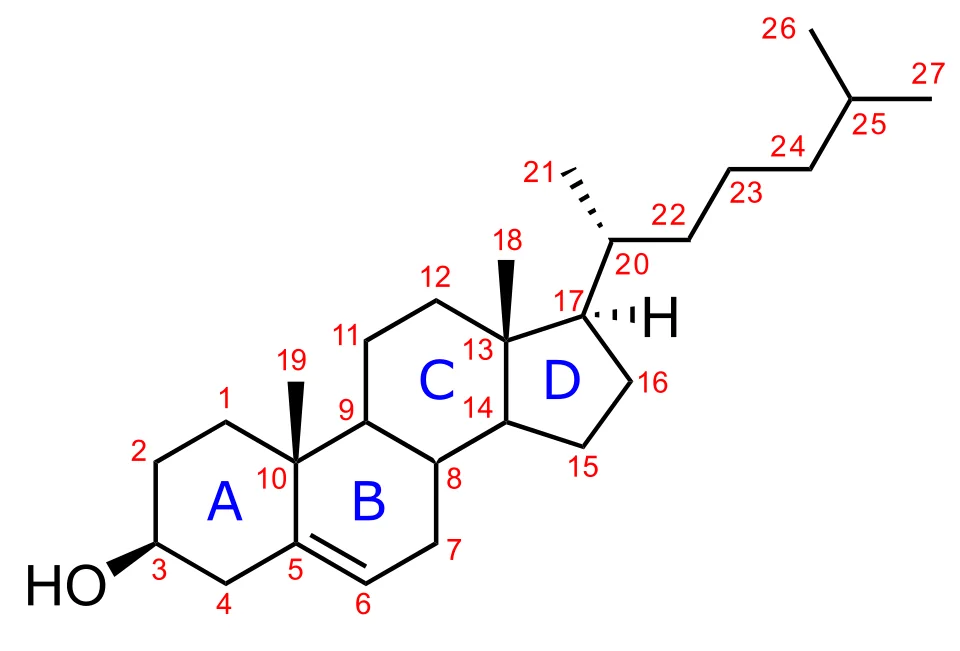
- It is an essential structural part of cell membranes, where it helps keep the right permeability and fluidity. It is also in the outer layer of plasma lipoproteins.
- It is the precursor of all other steroids in the body: corticosteroids, sex hormones, bile acids and vitamin D.
- It is carried in plasma inside lipoproteins. Low-density lipoprotein (LDL) supplies cholesterol to tissues, and high-density lipoprotein (HDL) removes free cholesterol from tissues and takes it to the liver for removal (reverse cholesterol transport).
Too much cholesterol is linked to gallstones and to vascular disease, mainly atherosclerosis. Too little is linked to severe developmental defects, as in Smith-Lemli-Opitz syndrome (see below).
Cholesterol is also found in foods of animal origin such as egg yolk, meat, liver and brain. But the body does not depend on diet alone, because it makes its own.
Where is cholesterol made?
Almost all human tissues can make cholesterol. The biggest contributions to the body's cholesterol pool come from the liver, intestine, adrenal cortex and reproductive tissues (ovaries, testes and placenta).
The enzymes work in two places: the cytosol and the membrane of the smooth endoplasmic reticulum (ER). Squalene synthetase is a microsomal enzyme. HMG CoA reductase and the enzymes that convert lanosterol to cholesterol are associated with the ER.
Raw materials and energy
As with fatty acids, all the carbon atoms in cholesterol come from acetate (acetyl CoA). NADPH supplies the reducing equivalents. The pathway needs energy, which comes from breaking the high-energy thioester bond of acetyl CoA and the terminal phosphate bond of ATP.
The five stages at a glance
| Stage | Key compounds | Carbons |
|---|---|---|
| 1. Formation of mevalonate | Acetyl CoA, acetoacetyl CoA, HMG CoA, mevalonate | 2, then 6 |
| 2. Production of isoprenoid units | Isopentenyl pyrophosphate (IPP) and dimethylallyl pyrophosphate (DPP) | 5 |
| 3. Synthesis of squalene | Geranyl pyrophosphate (GPP), farnesyl pyrophosphate (FPP), squalene | 10, 15, then 30 |
| 4. Squalene to lanosterol | Lanosterol, the first sterol | 30 |
| 5. Lanosterol to cholesterol | 7-dehydrocholesterol, then cholesterol | 27 |
Stage 1: from acetyl CoA to mevalonate

- Two molecules of acetyl CoA condense to form acetoacetyl CoA. The enzyme is cytosolic thiolase.
- A third acetyl CoA is added by HMG CoA synthase to form HMG CoA (3-hydroxy-3-methylglutaryl CoA), a six-carbon compound.
- HMG CoA reductase reduces HMG CoA to mevalonate, using NADPH (2 NADPH are used).
The first two reactions are the same as those that make ketone bodies. But the two pathways are separate. Ketone bodies are made in mitochondria and cholesterol is made in the cytosol. So the cell has two pools of HMG CoA and two isoenzymes of HMG CoA synthase: the cytosolic one is used for cholesterol and the mitochondrial one for ketone bodies.
Do not mix up the two HMG CoA pathways: mitochondrial HMG CoA goes to ketone bodies, and cytosolic HMG CoA goes to cholesterol. The rate-limiting step of cholesterol synthesis (HMG CoA reductase) lies after HMG CoA is formed.
HMG CoA reductase is the rate-limiting enzyme of cholesterol synthesis and the main control point. It is an ER membrane protein.
Stage 2: isoprenoid units
- Mevalonate is phosphorylated by three kinases using ATP. This gives 3-phospho-5-pyrophosphomevalonate.
- Decarboxylation of this compound gives isopentenyl pyrophosphate (IPP), a five-carbon isoprene unit. This step also needs ATP.
- IPP is isomerised to 3,3-dimethylallyl pyrophosphate (DPP), another five-carbon unit.
IPP is the precursor of a whole family of molecules called isoprenoids. Cholesterol is a sterol isoprenoid. Nonsterol isoprenoids include dolichol, found in glycoproteins, and ubiquinone (coenzyme Q), part of the electron transport chain.
Stage 3: building squalene
- IPP and DPP condense to form the ten-carbon geranyl pyrophosphate (GPP).
- A second IPP condenses with GPP to form the fifteen-carbon farnesyl pyrophosphate (FPP).
- Two molecules of FPP combine, releasing pyrophosphate, and are reduced, forming the thirty-carbon squalene.
Squalene is built from six isoprenoid units. Three ATP are used for every mevalonate converted to IPP, so 18 ATP are needed in total to make squalene. Pyrophosphate is released in each of the condensation steps, which makes these reactions irreversible.
Farnesyl pyrophosphate is a branch point. Ubiquinone and dolichol both come from it. FPP also has another use: attaching a farnesyl group to proteins, called prenylation, is one way of anchoring proteins to the plasma membrane. Some GTP-binding proteins in the cell membrane carry a farnesyl or a 20-carbon geranylgeranyl group.
Stage 4: squalene to lanosterol
Squalene is hydroxylated and then cyclises to form lanosterol, a 30-carbon sterol and the first sterol in the pathway. The reactions use molecular oxygen and NADPH, and the enzymes are associated with the ER. The hydroxylation of squalene is what triggers the ring closure.
Stage 5: lanosterol to cholesterol
This is a long, multistep process of about 19 enzyme reactions, all on the ER. The most important changes are:
- The carbon number falls from 30 to 27.
- Two methyl groups are removed from carbon 4 and one from carbon 14.
- The double bond shifts from carbon 8 to carbon 5.
- The double bond between carbon 24 and carbon 25 is reduced.
Among the intermediates are 14-desmethyl lanosterol, zymosterol, cholestadienol and desmosterol. The penultimate product is 7-dehydrocholesterol, which is reduced to give cholesterol.
From squalene onwards the intermediates have no phosphate groups and are very hydrophobic. They need an intracellular sterol carrier protein to keep them in solution. Before squalene, the phosphate groups on the intermediates help keep these water-insoluble compounds in solution.
Regulation of cholesterol synthesis
Synthesis is controlled at the HMG CoA reductase step. The body balances the rate of cholesterol synthesis against the rate of excretion. If the balance fails, plasma cholesterol can rise and vascular disease can follow.
| Mechanism | How it works |
|---|---|
| Feedback by the end product | The end product cholesterol controls its own synthesis by reducing the amount of enzyme made. More cholesterol in the diet means less de novo synthesis, especially in the liver |
| Gene expression (SREBP-2) | Low cholesterol activates transcription of the reductase gene, giving more enzyme. High cholesterol represses it |
| Sterol-accelerated degradation | When sterol levels are high, the reductase binds to insig proteins, is ubiquitinated and is broken down by the proteasome |
| Phosphorylation | AMP-activated protein kinase (AMPK) phosphorylates and inactivates the enzyme. A phosphatase (activated by insulin) dephosphorylates and activates it |
| Hormones | Insulin and thyroxine increase cholesterol synthesis. Glucagon and glucocorticoids decrease it |
| Drugs | Statins inhibit the enzyme |
How SREBP works
SREBP (sterol regulatory element-binding protein) is a protein in the ER membrane. It is joined to a second ER protein, SCAP (SREBP cleavage-activating protein).
- When cellular sterol is low: the SREBP-SCAP complex moves from the ER to the Golgi. In the Golgi, two proteases cut SREBP in turn. A soluble fragment enters the nucleus, binds the sterol regulatory element (SRE) in the gene and acts as a transcription factor. More HMG CoA reductase is made, so more cholesterol is made.
- When sterol is abundant: sterols bind SCAP, and SCAP binds the insig proteins in the ER membrane. The SCAP-SREBP complex stays in the ER, so SREBP is not activated and cholesterol synthesis falls.
Insig is a protein whose expression is induced by insulin. Insig also promotes the degradation of HMG CoA reductase. Cholesterol synthesis and reductase activity also show a diurnal (day and night) variation.
Phosphorylation and hormones
The reductase exists in two forms that can be converted into each other. The dephosphorylated form is active and the phosphorylated form is inactive. The hormones act through cAMP, in a way comparable to the control of glycogen synthase. Glucagon and glucocorticoids favour the inactive, phosphorylated form and so lower cholesterol synthesis. Insulin and thyroxine favour the active, dephosphorylated form and so raise it.
Statins
The last step of mevalonate formation is the site of action of the most effective class of cholesterol-lowering drugs, the statins. Statins are HMG CoA reductase inhibitors. Compactin and lovastatin (mevinolin) are fungal products of this kind, used to lower serum cholesterol.
Clinical correlation: disorders of cholesterol synthesis
Several inborn errors affect the pathway. Defects early in the pathway are rare. Those after the farnesyl pyrophosphate branch point affect the sterol part of the pathway.
| Disorder | Defect | Key points |
|---|---|---|
| Smith-Lemli-Opitz syndrome (SLOS) | 7-dehydrocholesterol reductase (partial deficiency). It is the enzyme involved in the migration of the double bond | Autosomal recessive. The commonest disorder of cholesterol synthesis, incidence between 1 in 15,000 and 1 in 60,000 in white people. Wide range of severity: facial dysmorphism, syndactyly of the toes, undescended testes, failure to thrive, microcephaly, mental retardation and autism. Photosensitivity can be severe. Diagnosis is by raised plasma 7-dehydrocholesterol. Treatment includes dietary cholesterol (such as egg yolk) and HMG CoA reductase inhibition to prevent the build-up of toxic precursors |
| Mevalonate kinase deficiency | Mevalonate kinase, the enzyme just before the first committed step of the pathway | Autosomal recessive and rare, with a wide range of severity. The severe form is mevalonic aciduria, with a lot of mevalonate in the urine, ataxia, psychomotor slowing, brain malformations and enlarged liver. The mild form is hyper IgD syndrome (HIDS), a periodic fever disorder, often with skin rash |
| Conradi-Hunermann syndrome and CHILD syndrome | Sterol delta 8 to delta 7 isomerase deficiency, and 3 beta-hydroxysteroid C-4 dehydrogenase deficiency | Two defects that cause skin problems including ichthyosis |
Cholesterol deficiency in SLOS is thought to disrupt the Hedgehog signalling pathway. In SLOS, measure cholesterol by gas chromatography, because standard lipoprotein assays also measure the precursors and may give a false result.
Mnemonics
Carbon count on the way up: 2 (acetyl CoA), 6 (HMG CoA and mevalonate), 5 (IPP), 10 (GPP), 15 (FPP), 30 (squalene and lanosterol), 27 (cholesterol).
Hormones and HMG CoA reductase: insulin and thyroxine switch it on (dephosphorylated, active). Glucagon and glucocorticoids switch it off (phosphorylated, inactive).
Practice MCQs
The rate-limiting enzyme of cholesterol synthesis is:
- A. HMG CoA synthase
- B. HMG CoA reductase
- C. Thiolase
- D. Squalene synthetase
Show answer
Answer: B. HMG CoA reductase converts HMG CoA to mevalonate. It is the rate-limiting enzyme and the main control point of cholesterol synthesis.
Statins lower cholesterol by inhibiting:
- A. Squalene synthetase
- B. Mevalonate kinase
- C. HMG CoA synthase
- D. HMG CoA reductase
Show answer
Answer: D. Statins inhibit HMG CoA reductase, the enzyme that makes mevalonate from HMG CoA. This is the principal regulatory step of the pathway.
The source of all the carbon atoms in cholesterol is:
- A. Acetyl CoA
- B. Glucose carbon skeleton only
- C. Amino acid nitrogen
- D. Dietary cholesterol
Show answer
Answer: A. All the carbon atoms of cholesterol come from acetate (acetyl CoA). NADPH supplies the reducing equivalents.
Squalene, a 30-carbon compound, is formed from:
- A. Two molecules of geranyl pyrophosphate
- B. Three molecules of IPP and one of DPP
- C. Two molecules of farnesyl pyrophosphate
- D. Four molecules of mevalonate
Show answer
Answer: C. Two FPP molecules combine, release pyrophosphate and are reduced to give the 30-carbon squalene. The 15-carbon FPP is formed earlier from GPP and a second IPP.
When the cellular cholesterol level is high, HMG CoA reductase activity falls mainly because:
- A. Insulin dephosphorylates the enzyme
- B. The enzyme is degraded and its gene expression is reduced
- C. Mevalonate kinase is activated
- D. Thyroxine levels rise
Show answer
Answer: B. When cellular sterol is high, the reductase binds insig proteins, is ubiquitinated and is degraded. In addition, sterols keep the SCAP-SREBP complex in the ER, so less reductase gene expression occurs.
A child has facial dysmorphism, syndactyly of the toes, microcephaly and photosensitivity, with raised plasma 7-dehydrocholesterol. The enzyme deficient is:
- A. Mevalonate kinase
- B. HMG CoA reductase
- C. 7-dehydrocholesterol reductase
- D. Sterol 27-hydroxylase
Show answer
Answer: C. Smith-Lemli-Opitz syndrome is an autosomal recessive disorder from deficiency of 7-dehydrocholesterol reductase. It is the commonest disorder of cholesterol synthesis, and plasma 7-dehydrocholesterol is raised.
Viva questions
Where is cholesterol synthesised, and in which organs mainly?
In the cytosol and the smooth endoplasmic reticulum. Almost all tissues can make it, but mainly the liver, intestine, adrenal cortex and reproductive tissues.
Outline the steps of cholesterol synthesis.
Acetyl CoA gives acetoacetyl CoA and then HMG CoA, which HMG CoA reductase reduces to mevalonate. Mevalonate gives the five-carbon IPP and DPP, which build GPP, FPP and then squalene. Squalene cyclises to lanosterol, which becomes cholesterol in about 19 reactions.
How are the two HMG CoA pathways kept separate?
Ketone body synthesis is in mitochondria and cholesterol synthesis is in the cytosol. There are two pools of HMG CoA and two HMG CoA synthase isoenzymes, one cytosolic and one mitochondrial.
How much ATP is needed to make squalene?
Eighteen ATP. Squalene is made from six isoprenoid units, and three ATP are used per mevalonate converted to IPP.
How is HMG CoA reductase regulated?
By feedback from cholesterol, by SREBP-2 control of gene expression, by sterol-accelerated degradation through insig, and by phosphorylation (AMPK makes it inactive, an insulin-activated phosphatase makes it active). Insulin and thyroxine raise activity, and glucagon and glucocorticoids lower it.
What is the mechanism of action of statins?
They inhibit HMG CoA reductase, the rate-limiting enzyme, so less mevalonate and less cholesterol are made.
Name other products that come from farnesyl pyrophosphate.
Ubiquinone (coenzyme Q) and dolichol. Farnesyl groups are also attached to proteins in prenylation, which anchors them to membranes.
Flashcards
Still stuck on the steps or the regulation? Ask the GalenAI tutor and practise cholesterol synthesis MCQs.