Quick answer: The pentose phosphate pathway (HMP shunt) is a cytosolic route for glucose 6-phosphate that makes no ATP. It has two jobs: forming NADPH, for fatty acid and steroid synthesis and for reduced glutathione, and forming ribose 5-phosphate for nucleotides. Glucose 6-phosphate dehydrogenase (G6PD) is the regulated first enzyme, and its deficiency causes hemolysis.
What is the pentose phosphate pathway?
The pentose phosphate pathway is also called the hexose monophosphate (HMP) shunt or the 6-phosphogluconate pathway. It is an alternative route for the metabolism of glucose. Like glycolysis, its enzymes are in the cytosol of the cell.
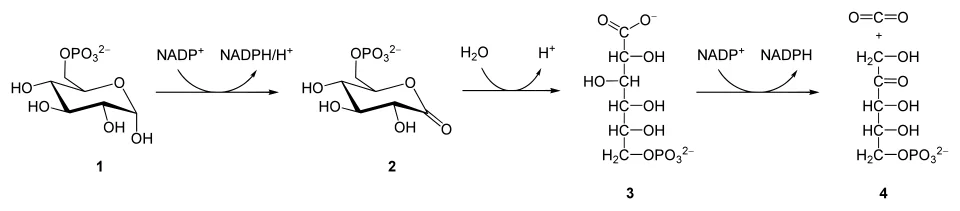
Its key features are:
- It has an irreversible oxidative phase (two dehydrogenation steps with a hydrolysis between them), followed by a series of reversible sugar-phosphate interconversions.
- No ATP is directly consumed or produced.
- Carbon 1 of glucose 6-phosphate is released as CO2.
- Two NADPH are made for each glucose 6-phosphate that enters the oxidative part.
- It provides a major share of the body's NADPH, which acts as a biochemical reductant (a molecule that donates electrons and hydrogen for reduction reactions).
- It makes ribose 5-phosphate, and it gives a way to use five-carbon sugars that come from the diet or from the breakdown of structural carbohydrates in the body.
It has two major functions:
- Forming NADPH for the synthesis of fatty acids and steroids, and for keeping glutathione in its reduced form for antioxidant activity.
- Forming ribose for the synthesis of nucleotides and nucleic acids.
How it differs from glycolysis
Glucose 6-phosphate is common to both pathways, but they are otherwise quite different.
| Feature | Glycolysis | Pentose phosphate pathway |
|---|---|---|
| Hydrogen acceptor | NAD+ | NADP+ |
| CO2 | Not produced | Produced |
| ATP | Produced | Not generated |
| Location | Cytosol | Cytosol |
| Main purpose | Breakdown of glucose for energy | NADPH and pentose sugars |
The two pathways are connected. Xylulose 5-phosphate activates a protein phosphatase that dephosphorylates the bifunctional enzyme 6-phosphofructo-2-kinase/fructose 2,6-bisphosphatase. This switches on the kinase and switches off the phosphatase, so fructose 2,6-bisphosphate rises, phosphofructokinase-1 becomes more active and glycolytic flux increases. Xylulose 5-phosphate also activates the protein phosphatase that starts the nuclear translocation and DNA binding of the carbohydrate response element-binding protein. This increases fatty acid synthesis after a high-carbohydrate diet.
Physiology texts add that the pathway is responsible for as much as 30% of glucose breakdown in the liver, and even more than that in fat cells. It can provide energy independently of the enzymes of the citric acid cycle, so it is an alternative route when certain enzyme abnormalities occur in cells.
The two phases
The pathway is divided into an irreversible oxidative phase and a reversible non-oxidative phase.
Oxidative phase
The oxidative part has three reactions. It converts glucose 6-phosphate to ribulose 5-phosphate, CO2 and two molecules of NADPH.
| Step | Enzyme | Product and notes |
|---|---|---|
| 1 | Glucose 6-phosphate dehydrogenase (G6PD) | Glucose 6-phosphate is dehydrogenated to 6-phosphogluconolactone, with NADPH formed. Irreversible. This is the regulated step. |
| 2 | 6-Phosphogluconolactone hydrolase (gluconolactone hydrolase) | Hydrolyses 6-phosphogluconolactone to 6-phosphogluconate. Irreversible and not rate-limiting. |
| 3 | 6-Phosphogluconate dehydrogenase | Oxidative decarboxylation of 6-phosphogluconate to ribulose 5-phosphate, CO2 (from carbon 1 of glucose) and a second NADPH. Irreversible. Needs NADP+ as hydrogen acceptor. |
So the oxidative phase is where glucose undergoes dehydrogenation and decarboxylation to give a pentose, and where all the NADPH of the pathway is made.
Non-oxidative phase
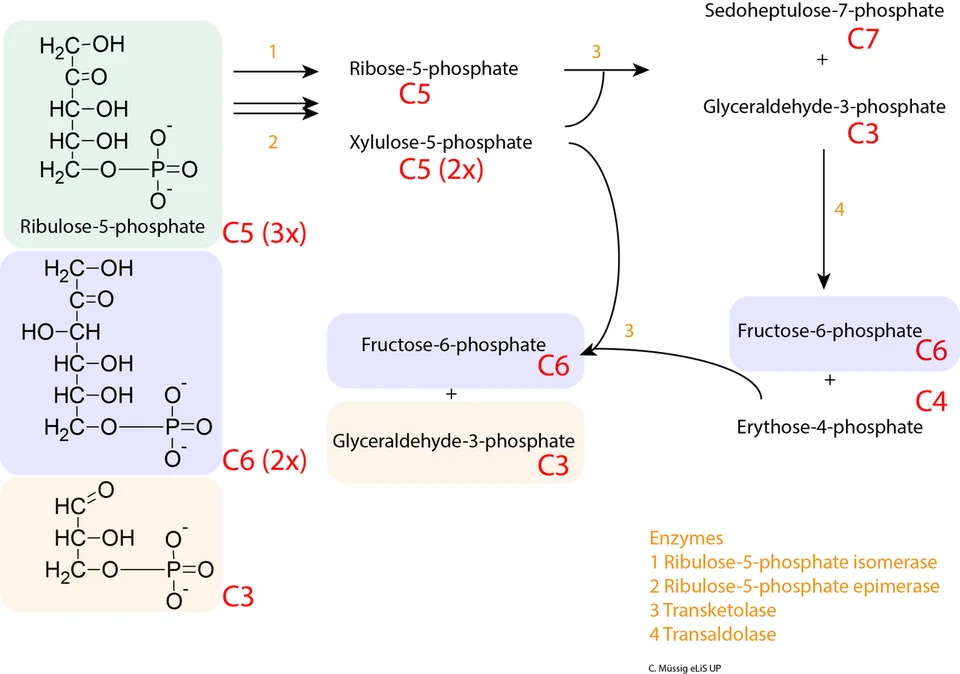
Here ribulose 5-phosphate is converted back into glucose 6-phosphate by a series of reversible reactions. They involve mainly two enzymes, transketolase and transaldolase. These reactions interconvert three, four, five and seven carbon sugars.
- Ribulose 5-phosphate 3-epimerase changes the configuration about carbon 3 of ribulose 5-phosphate and forms xylulose 5-phosphate, also a ketopentose.
- Ribose 5-phosphate ketoisomerase converts ribulose 5-phosphate to the aldopentose ribose 5-phosphate. This is the sugar used for nucleotide and nucleic acid synthesis.
- Transketolase transfers a two-carbon unit (carbons 1 and 2 of a ketose) onto the aldehyde carbon of an aldose. It turns a ketose into an aldose with two carbons fewer, and an aldose into a ketose with two carbons more. In the shunt it moves the two-carbon unit from xylulose 5-phosphate to ribose 5-phosphate, giving the seven-carbon ketose sedoheptulose 7-phosphate and the three-carbon aldose glyceraldehyde 3-phosphate. The reaction needs Mg2+ and thiamine pyrophosphate (TPP, vitamin B1) as coenzyme. The two-carbon unit is carried as glycolaldehyde bound to TPP.
- Transaldolase then transfers a three-carbon dihydroxyacetone unit (carbons 1 to 3) from sedoheptulose 7-phosphate onto glyceraldehyde 3-phosphate. The products are erythrose 4-phosphate and fructose 6-phosphate.
The sugars are then rearranged so that glucose 6-phosphate is regenerated, together with the glycolytic intermediate glyceraldehyde 3-phosphate. Since two molecules of glyceraldehyde 3-phosphate can regenerate glucose 6-phosphate, the pathway can account for the complete oxidation of glucose.
The overall balance
To oxidize glucose 6-phosphate completely to CO2, the pathway must start with six molecules. Of these six, five are regenerated and twelve NADPH are produced:
6 glucose 6-phosphate + 12 NADP+ + 6 H2O gives 6 CO2 + 12 NADPH + 12 H+ + 5 glucose 6-phosphate
The pathway is cyclical, and one molecule of glucose is metabolized for each turn of the cycle. Only five molecules of glucose are resynthesized for every six that enter.
Remember the two halves: the oxidative half is irreversible and makes NADPH and CO2. The non-oxidative half is reversible, makes ribose 5-phosphate, and needs thiamine through transketolase.
Regulation
G6PD controls the pathway. The first reaction, catalysed by G6PD, is the most important regulatory step. It is irreversible, and NADPH inhibits G6PD. It is the ratio of NADPH to NADP+ that ultimately sets the flux through the cycle.
- Under most metabolic conditions the ratio of NADPH to NADP+ is high enough to inhibit the enzyme strongly.
- When the demand for NADPH rises, the ratio falls and flux increases because G6PD becomes more active.
- Insulin raises expression of the gene for G6PD, and insulin can also induce 6-phosphogluconate dehydrogenase. Flux therefore increases in the well-fed state, when lipogenesis (fat synthesis) is high.
The rate and direction of the reversible reactions depend on the supply and demand for the intermediates. Because these reactions are reversible, the non-oxidative part can be entered from fructose 6-phosphate and glyceraldehyde 3-phosphate (glycolytic intermediates) when ribose is needed and G6PD is inhibited.
Which tissues use the pathway?
The pathway is active in liver, adipose tissue, adrenal cortex, thyroid, erythrocytes, testis and lactating mammary gland. Its activity is low in non-lactating mammary gland and in skeletal muscle. The active tissues use NADPH for reductive syntheses.
| Tissue | Why it needs NADPH |
|---|---|
| Liver, adipose tissue, lactating mammary gland | Fatty acid biosynthesis |
| Adrenal cortex, ovaries, testes, placenta | Steroid hormone synthesis |
| Erythrocytes | Reduced glutathione |
In skeletal muscle only the first few enzymes of the shunt are active. Muscle can still make pentoses, so the full pathway may not be needed for pentose synthesis.
What NADPH is used for
- Fatty acid and steroid synthesis: NADPH is the source of reducing equivalents in reductive biosynthesis.
- Some amino acid synthesis: NADPH is used by glutamate dehydrogenase to make certain amino acids.
- Antioxidant defence: cells make hydrogen peroxide (H2O2) continuously, which can damage unsaturated lipids, proteins and DNA. NADPH supports antioxidant reactions that prevent much of this damage. It keeps glutathione in its functional reduced form through NADPH-dependent glutathione reductase.
- Drug metabolism.
- Superoxide generation in phagocytes by NADPH oxidase.
- Hydroxylation reactions in the endoplasmic reticulum. There, an isoenzyme of G6PD, hexose-6-phosphate dehydrogenase, provides NADPH for hydroxylation (mixed function oxidase) reactions. It also supplies NADPH for 11-beta-hydroxysteroid dehydrogenase-1, which reduces inactive cortisone to active cortisol in liver, the nervous system and adipose tissue. This is the major source of intracellular cortisol in those tissues and may matter in obesity and the metabolic syndrome.
What ribose 5-phosphate is used for
Ribose 5-phosphate, or its derivatives, is needed to make nucleic acids (RNA and DNA) and many nucleotides, such as ATP, NAD+, FAD and CoA.
G6PD deficiency and favism
Genetic defects of G6PD impair the generation of NADPH.
- They are common in populations of Mediterranean and Afro-Caribbean origin.
- The gene is on the X chromosome, so it is mainly males who are affected.
- Some 400 million people carry a mutated gene for G6PD. It is the most common genetic defect, but most carriers have no symptoms.
- The distribution of mutant genes parallels that of malaria, which suggests that being heterozygous gives resistance against malaria.
- Large deletions or frameshift mutations have not been found, which suggests that complete absence of G6PD activity is probably lethal.
Why red cells burst
Red cells depend on NADPH to keep glutathione reduced. If NADPH cannot be made, glutathione cannot be kept in its functional form. The defect shows as hemolysis (hemolytic anemia) when susceptible people face oxidative stress. Triggers include:
- Infection
- Drugs such as the antimalarial primaquine, and sulfonamides
- Eating fava beans (Vicia faba), which gives the disease its name, favism
Many mutations are known in the gene, giving two main variants of favism. In the Afro-Caribbean variant the enzyme is unstable, so the average red cell activity is low, and it is the older erythrocytes that are mainly affected. Hemolysis is therefore episodic.
Exam link: primaquine, sulfonamides or fava beans cause hemolysis in G6PD deficiency. The missing link is NADPH, then reduced glutathione. It is a failure of glutathione, not of ribose or ribulose.
Thiamine and transketolase
Transketolase needs thiamine diphosphate (vitamin B1) as coenzyme. Measuring erythrocyte transketolase and its activation by thiamine diphosphate gives an index of vitamin B1 nutritional status.
Essential pentosuria
Essential pentosuria is a benign disorder found mainly in Ashkenazi Jews. It is an autosomal recessive trait.
- The urine contains L-xylulose in increased amounts.
- The cause is a block in converting L-xylulose to xylitol, because of xylitol dehydrogenase deficiency.
- It is usually found by accident, in a urine test for reducing substances.
- No treatment is needed.
Rarer disorders of the pentose phosphate pathway also exist. In one, deficiency of transaldolase leads to low transaldolase activity. Few patients with this have reported liver cirrhosis, hepatosplenomegaly, severe neonatal hepatopathy and cardiomyopathy. The urine shows raised levels of the polyols arabitol, ribitol and erythritol, and erythronic acid is a hallmark metabolite. Diagnosis can be confirmed by measuring transaldolase activity in fibroblasts, lymphoblasts or liver tissue, or by checking urinary polyols.
Mnemonics
Pentose phosphate pathway in one line: "Oxidative makes NADPH, non-oxidative makes ribose, and G6PD is the gatekeeper that NADPH itself shuts."
NADPH versus NADH: the shunt uses NADP+ as acceptor. NADPH is for building things (fat, steroids) and for protecting cells (glutathione). It is not for ATP.
Practice MCQs
The regulated, rate-controlling enzyme of the pentose phosphate pathway is:
- A. Transketolase
- B. Transaldolase
- C. Glucose 6-phosphate dehydrogenase
- D. 6-Phosphogluconolactone hydrolase
Show answer
Answer: C. Glucose 6-phosphate dehydrogenase catalyses the first, irreversible reaction and is the regulated step. It is inhibited by NADPH.
Erythrocyte transketolase activity is used to assess the nutritional status of:
- A. Vitamin C
- B. Vitamin B1 (thiamine)
- C. Vitamin B12
- D. Niacin
Show answer
Answer: B. Transketolase needs thiamine diphosphate (vitamin B1) as coenzyme, and erythrocyte transketolase activity is used as an index of vitamin B1 status.
A man given primaquine develops hemolysis. The most likely underlying defect is a lack of:
- A. Ribose 5-phosphate
- B. Ribulose 5-phosphate
- C. Oxidized NAD
- D. Reduced glutathione, because of too little NADPH
Show answer
Answer: D. A young man with G6PD deficiency cannot make enough NADPH, so he cannot keep glutathione reduced. Oxidant drugs such as primaquine then cause hemolysis. Glucose 6-phosphate levels are not affected.
Which statement about the pentose phosphate pathway is correct?
- A. It produces NADPH and no ATP is directly made or used
- B. It occurs in mitochondria and uses NAD+
- C. It produces ATP in the oxidative phase
- D. Its enzymes are all irreversible
Show answer
Answer: A. The pathway makes NADPH and pentoses and generates no ATP. It also releases CO2, which glycolysis does not.
How many NADPH molecules are produced in the oxidative phase for each glucose 6-phosphate that enters?
- A. One
- B. Two
- C. Three
- D. Four
Show answer
Answer: B. The two oxidative dehydrogenase steps each give one NADPH, so two NADPH are formed per glucose 6-phosphate, with release of CO2 from carbon 1.
The pentose phosphate pathway is LEAST active in:
- A. Adipose tissue
- B. Adrenal cortex
- C. Skeletal muscle
- D. Lactating mammary gland
Show answer
Answer: C. Fat synthesis and steroid synthesis need NADPH, and the pathway is active in liver, adipose tissue and adrenal cortex. Skeletal muscle has low activity.
Viva questions
Where does the pentose phosphate pathway occur, and does it make ATP?
In the cytosol. No ATP is directly made or used. Its products are NADPH, CO2 and pentose sugars.
What are the two main functions of the pathway?
Forming NADPH for fatty acid and steroid synthesis and for reduced glutathione, and forming ribose 5-phosphate for nucleotide and nucleic acid synthesis.
Name the reactions of the oxidative phase.
Glucose 6-phosphate dehydrogenase, then 6-phosphogluconolactone hydrolase, then 6-phosphogluconate dehydrogenase. The result is ribulose 5-phosphate, CO2 and two NADPH.
How is the pathway regulated?
G6PD, the first enzyme, is irreversible and is inhibited by NADPH. The NADPH to NADP+ ratio controls flux. Insulin raises G6PD expression in the fed state.
What do transketolase and transaldolase do?
Transketolase transfers a two-carbon unit and needs thiamine diphosphate and Mg2+. Transaldolase transfers a three-carbon unit. Together they interconvert sugars and regenerate fructose 6-phosphate and glyceraldehyde 3-phosphate.
Why does G6PD deficiency cause hemolysis?
Red cells need NADPH to keep glutathione reduced. Without NADPH, oxidative stress from infection, primaquine, sulfonamides or fava beans damages red cells and causes hemolytic anemia. The gene is X-linked, so males are mainly affected.
What is essential pentosuria?
A benign autosomal recessive condition, mainly in Ashkenazi Jews, with increased L-xylulose in urine because of xylitol dehydrogenase deficiency. It needs no treatment.
Flashcards
Still unsure why G6PD deficiency causes hemolysis? Ask the GalenAI tutor and practise pentose phosphate pathway MCQs.