Quick answer: Lipoproteins are spherical particles of lipids and proteins that carry water-insoluble fats and cholesterol through plasma. A neutral lipid core is wrapped in a shell of phospholipid, free cholesterol and apolipoproteins. Four main groups exist: chylomicrons carry dietary fat, VLDL carries liver triglyceride, LDL delivers cholesterol to tissues, and HDL returns cholesterol to the liver.
Why do we need lipoproteins?
Lipids are poorly soluble in water, yet they must travel in blood from the gut, the liver and adipose tissue to the tissues that use or store them. The body solves this by packing lipids with proteins into complexes called lipoproteins. They do two jobs: they keep the lipids soluble in plasma, and they deliver the lipids to (and from) the tissues.
Humans transport lipid less perfectly than many other animals. Over time, lipid, especially cholesterol, gradually deposits in tissues. When this contributes to plaque formation, the blood vessels narrow. This is atherosclerosis, and it is the main reason lipoproteins matter clinically.
Structure of a lipoprotein particle
Every lipoprotein has the same plan:
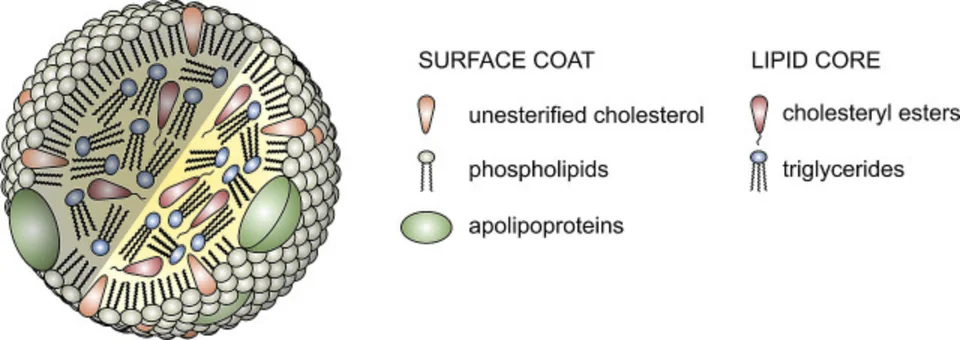
- Core: neutral (uncharged, hydrophobic) lipid, mainly triacylglycerol (TG, also called triglyceride) and cholesteryl ester (cholesterol with a fatty acid attached).
- Surface shell: phospholipids, free (unesterified) cholesterol and apolipoproteins (also called apoproteins), the protein part of the particle.
The surface molecules are amphipathic, meaning they have a water-loving (polar) end and a water-fearing (nonpolar) end. The polar ends face the plasma and the nonpolar ends face the core, which is what makes the whole particle soluble in plasma. Most lipoproteins are spherical, but young (nascent) HDL particles start as flat discs.
The protein share of the particle rises as the lipid share falls. Protein is only 1 to 2% of a chylomicron, about 7 to 10% of VLDL, about 21% of LDL, and 32 to 57% of HDL, depending on the HDL subclass. So the particles become denser as the protein share rises: chylomicrons are the least dense and largest, and HDL is the densest.
How lipoproteins are classified
Lipoproteins can be separated in two ways:
- By density, using ultracentrifugation. Chylomicrons, chylomicron remnants, VLDL and IDL have a density below 1.006 g/mL. LDL, HDL and Lp(a) make up the denser fraction.
- By electrophoretic mobility. Chylomicrons stay at the origin, VLDL runs in the pre-beta region, and HDL runs in the alpha region.
| Lipoprotein | Origin | Main lipid | Major apolipoproteins |
|---|---|---|---|
| Chylomicron | Intestine | Triacylglycerol (about 85% by weight) | B-48 (also A-I, A-IV, C, E) |
| Chylomicron remnant | Derived from chylomicrons | Triacylglycerol, cholesterol | B-48, E |
| VLDL | Liver | Triacylglycerol | B-100 (also C-I, C-II, C-III, E) |
| IDL | Derived from VLDL | Triacylglycerol and cholesterol | B-100, E |
| LDL | Derived from IDL | Cholesterol (cholesteryl ester) | B-100 |
| HDL | Liver, intestine and plasma | Phospholipid and cholesterol | A-I, A-II (also C, E) |
| Lp(a) | Liver | Cholesterol | B-100 plus apo(a) |
IDL (intermediate-density lipoprotein) is the remnant of VLDL after some of its triglyceride has been removed. The word remnant in general means a particle left behind after lipase enzymes have removed much of its triglyceride.
Apolipoproteins: what they do
Apolipoproteins perform three main jobs:
- They are structural components of the particle. Some are essential and cannot be removed, and others move freely between lipoproteins.
- They are ligands: they are recognised by cell-surface receptors.
- They activate enzymes involved in lipoprotein metabolism.
| Apolipoprotein | Where found | Key function |
|---|---|---|
| apo B-48 | Chylomicrons and their remnants | Needed to assemble and secrete chylomicrons from the intestine. Not recognised by the LDL receptor. It is called B-48 because it is 48% of the protein coded by the apo B gene. |
| apo B-100 | VLDL, IDL, LDL | Needed to assemble and secrete VLDL from the liver. Binds the LDL receptor. |
| apo C-II | Chylomicrons, VLDL, HDL | Activates lipoprotein lipase (LPL) |
| apo E | Remnants, IDL, some HDL | Ligand for receptors in the liver, so it mediates remnant and IDL uptake |
| apo A-I | HDL (its main protein), also chylomicrons | Activates LCAT and helps cholesterol efflux from cells |
Apolipoproteins other than apo B exchange actively between particles in the blood. HDL acts as a store, or repository, of apo C and apo E, which it hands to chylomicrons and VLDL and takes back later.
Two other apolipoproteins are worth knowing. ApoC-III inhibits lipolysis by LPL. ApoA-V helps LPL hydrolyse triglyceride-rich lipoproteins.
The exogenous (dietary) pathway: chylomicrons
- Dietary fat is digested and absorbed in the small intestine. In the intestinal cells it is packed into chylomicrons with apo B-48. They are released into lymph and then reach the blood.
- The chylomicrons pick up apo C and apo E from HDL.
- In capillaries, lipoprotein lipase (LPL) hydrolyses much of the triglyceride into free fatty acids and glycerol. LPL sits on the capillary walls of adipose tissue, cardiac muscle and skeletal muscle. ApoC-II is its activator.
- The particle shrinks. It loses apo C-II, which returns to HDL, but keeps apo E. It becomes a chylomicron remnant: about half the diameter of the parent chylomicron and relatively rich in cholesterol and cholesteryl ester.
- The liver takes up the remnant rapidly. Apo E is the signal recognised by the receptors there.
Chylomicrons also carry fat-soluble vitamins (A, D, E and K) in their core, which is why defects in chylomicron formation can cause vitamin deficiency.
The endogenous pathway: VLDL, IDL and LDL
- The liver assembles VLDL from triglyceride, cholesteryl ester, phospholipid and apo B-100. When lipid is not available, apo B-100 is degraded inside the cell instead.
- In the blood, VLDL picks up apo E and apo C from HDL. LPL removes most of its triglyceride, as it does for chylomicrons. The free fatty acids go to tissues, and in fat they are turned back into triglyceride for storage.
- As triglyceride is removed, VLDL becomes smaller and denser. It sheds apo C, gains apo E and becomes IDL.
- IDL has two possible fates. It is taken up by the liver through its apo E, or hepatic lipase removes more lipid and converts it to LDL.
- LDL is rich in cholesteryl ester and carries apo B-100. It delivers cholesterol from the liver to the tissues and is cleared mainly through the LDL receptor.
One-line summary of the four groups: chylomicrons carry dietary fat from the gut, VLDL carries triglyceride from the liver, LDL delivers cholesterol to the tissues, and HDL brings cholesterol back to the liver.
The LDL receptor
The LDL receptor is a large glycoprotein found on most cells. The liver holds about 70% of the body's LDL receptors, and about two thirds of LDL is cleared through it.
It recognises apo B-100 and apo E, but not apo B-48. So it can take up LDL, IDL, VLDL and apo E-containing chylomicron remnants. Most HDL particles lack apo E and do not use it.
How the receptor works:
- The receptor binds its ligand at the cell surface and migrates to a coated pit, a region of membrane marked by the protein clathrin.
- The pit folds inward and forms a vesicle that becomes an endosome.
- The endosome becomes acidic, and the ligand separates from the receptor. This structure is called CURL, the Compartment for Uncoupling of Receptor and Ligand.
- The receptor returns to the cell surface and is reused. The lipoprotein goes to lysosomes, where acid hydrolases break it down into free cholesterol, amino acids, fatty acids and phospholipids that the cell can reuse.
Effect on the cell: cholesterol released this way inhibits HMG CoA reductase, so the cell makes less cholesterol of its own. Cells also tightly control how many LDL receptors they show, depending on their cholesterol content.
PCSK9 is a protein that alters the shape of the LDL receptor, so the receptor is degraded instead of recycling to the surface. Loss-of-function PCSK9 mutations give low LDL and lower risk of vascular disease. Antibodies against PCSK9 are used as treatment.
Exporting cholesterol from lysosomes needs two proteins, NPC1 and NPC2. When they are mutated, cholesterol accumulates inside cells, which is Niemann-Pick type C.
Macrophages do not take up native LDL through this route. They take up chemically modified LDL (for example oxidised LDL) through scavenger receptors, and this is thought to be part of how atherosclerotic plaque forms.
HDL and reverse cholesterol transport
Reverse cholesterol transport is the pathway by which HDL picks up cholesterol from peripheral cells and returns it to the liver for excretion.
- Origin: the liver and intestine make apo A-I, the main protein of HDL. About 80% of HDL comes from the liver and 20% from the intestine.
- Nascent HDL: lipid-poor apo A-I binds a membrane transporter called ABCA1. This makes cholesterol and phospholipid move out of cells onto apo A-I, forming a disc-shaped nascent HDL particle.
- LCAT: the enzyme lecithin:cholesterol acyltransferase is activated by apo A-I. It transfers a fatty acid from lecithin to the free hydroxyl group of cholesterol, forming cholesteryl ester. The nonpolar cholesteryl ester moves into the core, so the disc swells into a sphere. Esterifying cholesterol also keeps a concentration gradient going, so more cholesterol is drawn in from tissues. LCAT accounts for virtually all plasma cholesteryl ester in humans.
- Maturation: cholesterol-poor HDL3 particles take up cholesterol and grow into the larger, less dense HDL2.
- Return to the liver: this happens by two routes. About half of mature HDL2 is removed directly by HDL receptors on the liver (including scavenger receptor B1). The rest of the cholesteryl ester is passed to VLDL, IDL and LDL by cholesteryl ester transfer protein (CETP), in exchange for triglyceride. These particles then carry it to the liver.
- Recycling: unlike apo B-100 particles, the apo A-I part of HDL is recycled and resecreted.
HDL and heart disease: in population studies, high HDL goes with low cardiovascular risk, and an HDL cholesterol below 40 mg/dL is a risk factor for coronary heart disease. But genetic studies have cast doubt on whether HDL itself protects. People with lifelong HDL deficiency from ABCA1 mutations do not have extra risk, and gene variants that raise HDL do not give protection. Measuring HDL cholesterol also does not capture how well HDL actually moves cholesterol.
Lipoprotein(a)
Lp(a) is similar to LDL in lipid and protein content, but it carries an extra protein, apo(a), which the liver makes and attaches to apo B-100 by a disulfide bond. Apo(a) impedes clearance by the LDL receptor. High Lp(a) is inherited and is a causal risk factor for atherosclerotic cardiovascular disease and aortic stenosis. It is atherogenic because it deposits in the artery wall and may also prevent clot lysis by plasminogen. A level above 30 mg/dL goes with increased risk of coronary heart disease, even when LDL cholesterol is only moderately raised.
Lipoproteins and atherosclerosis
- Atheroma is a focal disease of large and medium-sized arteries. The earliest visible lesion is the fatty streak, which can progress to fibrous or fatty plaques.
- Remnant particles and LDL promote atherosclerosis. Among the lipids in a blood lipid profile, LDL is richest in cholesterol and has the strongest link with atherosclerosis. VLDL carries much of the triglyceride, so its level parallels the triglyceride level, but its effect is less marked than that of LDL.
- Diets rich in saturated fat (eggs, meat, milk, butter) and trans fats raise plasma cholesterol.
Reference values used in a lipid profile (mg/dL):
- Total cholesterol: desirable 140 to 200, borderline high 200 to 240
- Triglycerides: below 150
- LDL cholesterol: optimal below 100
A total cholesterol above 260 mg/dL in men and women aged 30 to 50 years carries about three times the risk of ischaemic heart disease compared with normal levels.
Primary dyslipoproteinemias
A dyslipoproteinemia is an abnormality of lipoprotein levels. Primary forms come from a defect in lipoprotein formation, transport or breakdown. Not every abnormality is harmful. Apart from familial hypercholesterolemia, the single-gene disorders are very rare.
| Disorder | Defect | Key features |
|---|---|---|
| Familial hypercholesterolemia (type IIa) | Defective LDL receptor, a mutation in the receptor-binding region of apo B-100, or gain-of-function PCSK9 | Raised LDL and cholesterol, tendon xanthomas, premature coronary disease. Autosomal co-dominant; about 1 in 500. |
| Familial LPL deficiency (type I) | Missing or abnormal LPL, or apo C-II deficiency (which leaves LPL inactive) | Slow clearance of chylomicrons and VLDL, very high triglyceride, recurrent pancreatitis in complete deficiency. No increased coronary risk. |
| Familial dysbetalipoproteinemia (type III, broad beta disease) | Abnormal apo E (commonly E2/E2) with poor binding to receptors | Remnants accumulate; cholesterol and triglyceride both raised. Palmar xanthomas. Needs a second factor such as obesity, diabetes or hypothyroidism. |
| Abetalipoproteinemia | Apo B cannot be loaded with lipid | No chylomicrons, VLDL or LDL; rare; low blood triglyceride; fat accumulates in intestine and liver; fat malabsorption. Early death avoided with large doses of fat-soluble vitamins, especially vitamin E. |
| Tangier disease and apo A-I deficiency | ABCA1 or apo A-I defect | Low or near absent HDL; atherosclerosis in the elderly |
| LCAT deficiency | Lack of LCAT | Low HDL (fish-eye disease is one form) |
In type III disease, lipoprotein electrophoresis is the key test. Cholesterol-rich VLDL runs as a broad beta band instead of the usual pre-beta band. There are three common apo E isoforms: E2, E3 and E4. E2 has lower affinity for the LDL receptor.
Secondary causes of dyslipidaemia
Many acquired factors worsen or cause abnormal lipids, often together with inherited tendencies.
- High-carbohydrate diet: the liver turns carbohydrate into fatty acids, esterifies them to triglyceride and secretes them in VLDL, so triglyceride rises. Replacing carbohydrate with saturated fat can raise LDL cholesterol.
- Obesity, insulin resistance and type 2 diabetes: the most frequent contributors, mainly by raising triglyceride. More free fatty acids reach the liver from expanded, insulin-resistant fat tissue and are packed into VLDL.
- Metabolic syndrome: abdominal obesity, raised blood pressure and impaired glucose tolerance cluster with high triglyceride and low HDL.
- Other conditions: hypothyroidism, nephrotic syndrome and obstructive jaundice. Second-generation antipsychotics such as olanzapine are also associated with dyslipidaemia.
Drugs that act on lipoprotein metabolism
- Statins inhibit HMG-CoA reductase, the enzyme that makes mevalonate, the rate-limiting step of cholesterol synthesis. The fall in cholesterol inside liver cells increases LDL receptors on the hepatocyte surface and reduces hepatic VLDL and LDL production. The main effect is a fall in plasma LDL, with some reduction in triglyceride and a rise in HDL. Mild side effects include muscle pain and raised liver enzymes. Rare serious effects include myositis, which can progress to rhabdomyolysis.
- PCSK9 antibodies raise LDL receptor numbers by stopping receptor degradation.
- Lomitapide inhibits microsomal triglyceride transfer protein (MTP), which is needed to assemble and release apo B-containing lipoproteins. It is used as an add-on in homozygous familial hypercholesterolemia. It lowers lipoprotein secretion by the liver, while most other drugs raise LDL uptake.
Mnemonics
Who carries what: chylomicron carries food fat from the gut, VLDL carries liver fat out, LDL delivers cholesterol to cells, HDL brings cholesterol back to the liver.
Which B? B-48 belongs to the intestine (chylomicrons) and the LDL receptor ignores it. B-100 belongs to the liver (VLDL, IDL, LDL) and the LDL receptor binds it.
Practice MCQs
Which apolipoprotein activates lipoprotein lipase?
- A. Apo A-I
- B. Apo B-48
- C. Apo C-II
- D. Apo E
Show answer
Answer: C. ApoC-II is the activator (cofactor) of lipoprotein lipase. Without it LPL is inactive, so chylomicrons and VLDL are cleared slowly and triglyceride rises. ApoA-I activates LCAT, and apo E is a receptor ligand.
Which statement about the LDL receptor is correct?
- A. It binds apo B-48 on chylomicron remnants
- B. It recognises apo B-100 and apo E
- C. It is found only in the liver
- D. It is degraded with the lipoprotein in the lysosome
Show answer
Answer: B. The LDL receptor recognises apo B-100 and apo E, but not apo B-48. It is present on all cell types, although the liver holds about 70% of the total, and the receptor is recycled to the surface after the ligand dissociates in the acidic endosome.
The basic defect in abetalipoproteinemia is:
- A. Deficiency of lipoprotein lipase
- B. Defective LDL receptor
- C. Abnormal apo E
- D. Failure to load apo B with lipid
Show answer
Answer: D. In abetalipoproteinemia apo B cannot be loaded with lipid, so no chylomicrons, VLDL or LDL are formed. Fat accumulates in the intestine and liver, and fat-soluble vitamins such as vitamin E are poorly delivered.
Which enzyme, activated by apo A-I, forms cholesteryl ester on HDL?
- A. LCAT
- B. CETP
- C. Lipoprotein lipase
- D. HMG-CoA reductase
Show answer
Answer: A. LCAT is activated by apo A-I on HDL. It esterifies free cholesterol, and the cholesteryl ester moves into the core. This keeps a concentration gradient that draws more cholesterol from tissues into HDL.
The main way statins lower plasma LDL is by:
- A. Inhibiting lipoprotein lipase
- B. Inhibiting CETP
- C. Increasing hepatic VLDL secretion
- D. Inhibiting HMG-CoA reductase, which increases hepatic LDL receptors
Show answer
Answer: D. Statins inhibit HMG-CoA reductase and lower hepatocyte cholesterol. The liver responds by increasing LDL receptors on its surface and making less VLDL and LDL, so plasma LDL falls.
In familial dysbetalipoproteinemia (type III), the underlying defect is:
- A. Abnormal apo E causing remnant accumulation
- B. A defective LDL receptor
- C. Lipoprotein lipase deficiency
- D. Absence of apo A-I
Show answer
Answer: A. In type III disease an abnormal apo E (commonly E2/E2) cannot bind liver receptors well. Remnants of chylomicrons and VLDL accumulate and run as a broad beta band, and both cholesterol and triglyceride are raised.
Viva questions
What are lipoproteins and why are they needed?
Lipoproteins are spherical complexes of lipid and protein. Lipids are poorly water soluble, so lipoproteins keep them soluble in plasma and carry them to and from tissues.
Describe the structure of a lipoprotein.
A neutral lipid core of triacylglycerol and cholesteryl ester is surrounded by a shell of phospholipid, free cholesterol and apolipoproteins. The polar ends face the plasma, which makes the particle soluble.
Name the four major groups of lipoproteins and their functions.
Chylomicrons carry dietary lipid. VLDL carries triacylglycerol from the liver. LDL delivers cholesterol to tissues. HDL removes cholesterol from tissues and returns it to the liver (reverse cholesterol transport).
What is the difference between apo B-48 and apo B-100?
Apo B-48 is the major protein of chylomicrons, made in the intestine. Apo B-100 is the major protein of VLDL, IDL and LDL, made in the liver. The LDL receptor binds apo B-100 but not apo B-48.
What happens to a chylomicron after it enters the blood?
It picks up apo C and apo E from HDL. LPL, activated by apo C-II, hydrolyses its triglyceride. It shrinks into a cholesterol-rich remnant that keeps apo E and is rapidly taken up by the liver.
Explain reverse cholesterol transport.
Lipid-poor apo A-I takes cholesterol and phospholipid from cells through ABCA1 to form nascent HDL. LCAT esterifies the cholesterol, and HDL grows. The cholesterol reaches the liver either directly through HDL receptors or via CETP transfer to VLDL, IDL and LDL.
What is familial hypercholesterolemia?
An autosomal co-dominant disorder with markedly raised LDL cholesterol, tendon xanthomas and premature coronary disease. It is caused by a defective LDL receptor, a defect in the receptor-binding region of apo B-100, or gain-of-function PCSK9 mutations.
Flashcards
Still unsure how chylomicrons, VLDL, LDL and HDL fit together? Ask the GalenAI tutor and practise lipoprotein MCQs.