Is AI Changing Medical College? Here's What 2026 Shows
Not another AI-will-replace-doctors piece. Three real, dated things happening in medical education right now, with the evidence attached.
Most "AI and medical education" pieces this year read the same way: a hot take about how everything is about to change, with maybe one example attached. Here are three things happening right now, each with a source you can check, and an honest read on what the evidence does and doesn't show yet.
The practice partner that doesn't get tired
Since fall 2025, Stanford's medical and physician assistant students have had access to two new tools built into their curriculum. Clinical Mind AI is a chatbot students talk to as if taking a patient's history, with real-time feedback on how they're doing. AI Clinical Coach listens to a student's case presentation and generates a report for faculty to review. Both sit inside a curriculum built around four learning objectives: how different types of AI work, how AI tools get used in practice, the ethical and legal issues involved, and how to critically evaluate what an AI tells you.
Stanford isn't alone in building this. A randomized trial published in BMC Medical Education in April 2026 compared AI virtual standardized patients with real standardized patients for teaching history-taking. The result was close to a dead heat: mean OSCE scores of 6.5 for the AI group versus 6.3 for the human-standardized-patient group, a difference with no statistical significance. A separate study at Peking University Third Hospital found that combining both, AI practice plus human standardized patients, was associated with better clinical reasoning than standardized patients alone. A small pilot at Indiana University School of Medicine, using ChatGPT-4o as a synthetic OSCE patient, got high usefulness and convenience ratings from the handful of students who tried it.
AI virtual patients aren't outperforming human ones. What they're actually good at is being available at 1 AM, as many times as a student wants, which is a scale problem, not a quality problem.
Someone finally wrote down what this training should cover
For a while, "add some AI to the curriculum" has meant different things at different colleges. A scoping review published in npj Digital Medicine in May 2026 tried to fix that. The authors searched four databases, found 4,071 records, and kept 54 studies from 22 countries that proposed AI competencies for medical training. Out of 564 individual competency statements, they built a taxonomy: seven domains, 37 competencies, 170 learning objectives, covering ethics, law and regulation, professionalism, clinical applications, critical appraisal of AI outputs, research, and the basic theory of how these systems work.
Worth being honest about the limits here. Most of the 54 included studies were editorials and opinion pieces, not trials, so this is a map of what experts think students should learn, not proof that teaching it this way works. Stanford's own four learning objectives were built independently, and they land inside the same general territory as the published taxonomy. Different colleges seem to be converging on similar ground even without a shared standard.
The money is moving faster than the evidence
In January 2026, the University of Pennsylvania's Perelman School of Medicine received an $8 million gift from Rod Wong, a Penn Medicine graduate and board member, and his wife Marti Speranza Wong, through the RTW Foundation. It's described as the largest single donation for curriculum innovation in the school's history. Most of the money is going toward hiring data scientists and engineers and building the platforms for a redesigned, self-paced curriculum.
Lisa Bellini, the project's lead, described the goal plainly: "We really need to incorporate the fundamentals of how best to use technology responsibly within the practice of medicine." That's a real investment in infrastructure and people, the kind that outlasts a single pilot project bolted onto an existing course. It also means Penn is still building what Stanford already has running in classrooms, which says something about how uneven this rollout is across colleges.
What's still missing
Put the three together and a pattern shows up. There's real activity. Tools are in active use, a competency framework is published, and serious money is committed. There's also a gap nobody's closed yet. No large, multi-site trial has shown that AI-assisted training produces better doctors than the training medical colleges were already running. The BMC trial found parity, not superiority. The competency taxonomy is mostly expert opinion, not outcomes data. Even Penn's gift funds infrastructure for a redesign that hasn't happened yet.
None of that means the activity is wasted. It means the honest claim right now is that this is probably useful and scales well, not that it's proven to teach better. Most of the coverage this year blurs those two claims into one.
Where GalenAI fits
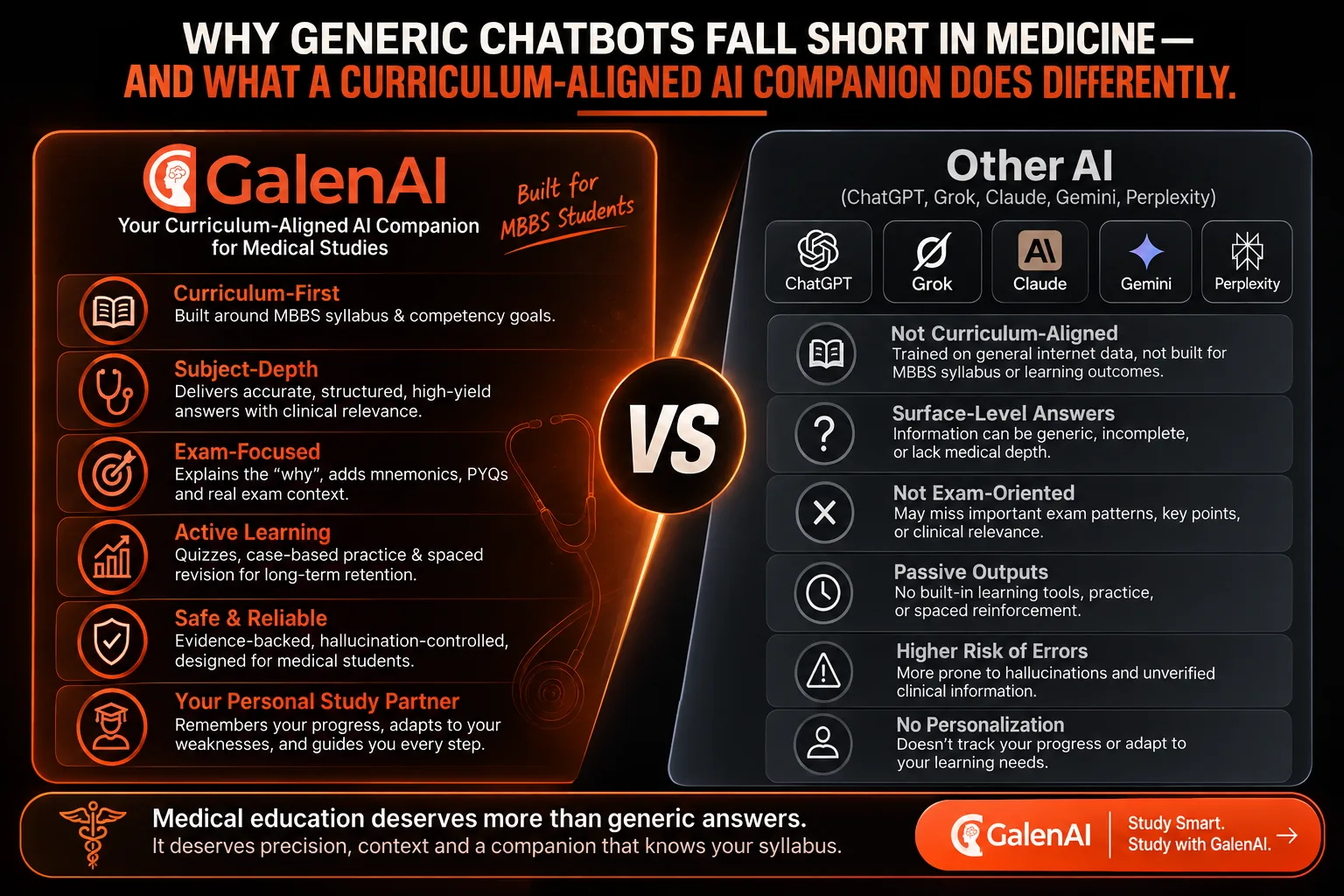
The tools getting built at Stanford, an AI that listens to a history-taking attempt and gives feedback, are the same category of tool GalenAI's Case-based mode already is: a practice partner that works through a patient scenario with you, symptoms to diagnosis, available whenever you actually have ten minutes instead of whenever a human standardized patient is booked.
The studies above point at one thing. Structured practice, not passive reading, is what builds clinical skill. GalenAI is built around that instead of around answering questions and hoping it sticks.
- Case-based mode walks you through a patient from symptoms to diagnosis, the same skill AI virtual patients are being built to train
- Socratic mode asks guiding questions instead of handing you the answer
- Explain mode and Quick Q&A for a clear, fast answer when that's what you need
- Every answer grounded in curriculum-based, NMC-standard textbook content, not the open web, so you can check it rather than trust it
Want a practice partner that's actually grounded in your syllabus? Try GalenAI free.
Sources & References
- 1.Randomized trial of AI virtual standardized patients versus standardized patients for history-taking instruction, BMC Medical Education, April 2026
- 2."Virtual Patients and Standardized Patients Combined Training Is Associated With Improved Clinical Reasoning Among Medical Students," PMC, 2026
- 3."Revolutionizing OSCE Preparation Through AI-Driven Synthetic Patients," IMPRS, Indiana University School of Medicine, 2026
- 4.Hunt, Sprehe et al., "What the AI Era Doctor Should Know: A Scoping Review of Proposed Artificial Intelligence Competencies for Medical Education," npj Digital Medicine, May 12, 2026
- 5.Kimberlee D'Ardenne, "AI Makes Its Way Into Medical School Curriculum," Stanford Medicine Magazine, September 22, 2025
- 6.The Philadelphia Inquirer, "Penn Receives $8 Million Gift to Redesign Medical School Curriculum," January 22, 2026