From Chatbot to Clinic: How Conversational AI Is Quietly Rewiring the Doctor Visit
Ambient AI scribes already sit in on millions of US doctor visits. The data shows real time saved and real burnout relief, plus error rates worth knowing before you trust the note.
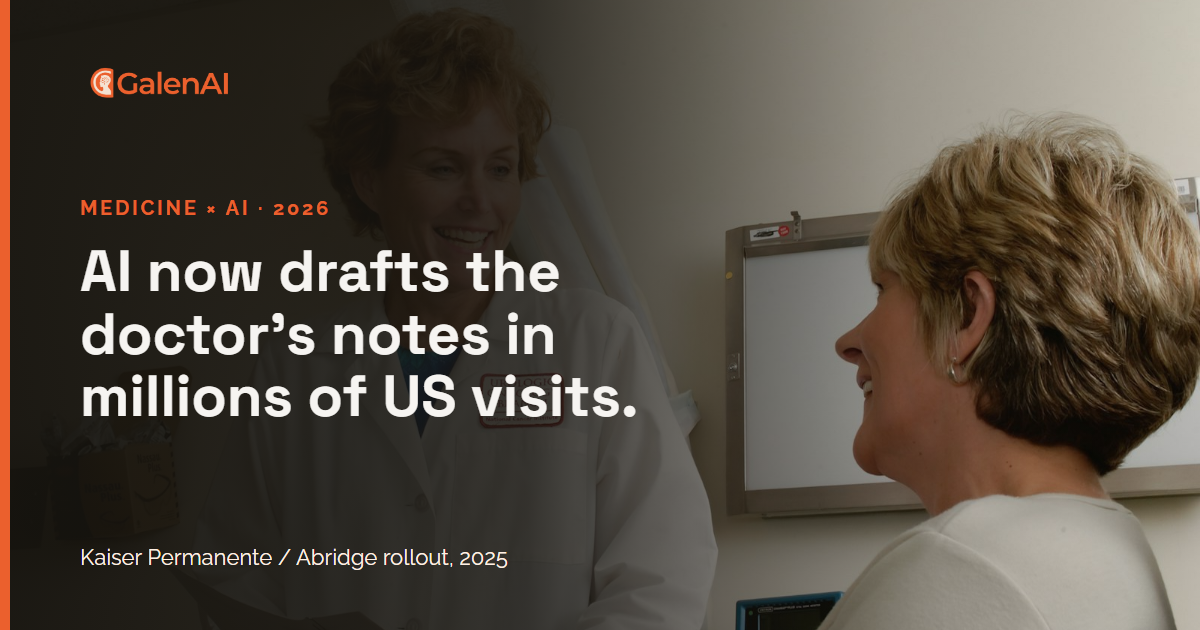
The next time you watch a doctor during a consultation, look for a phone propped against the monitor, or a small device clipped near the desk. It's probably not just there for calls. A growing number of clinicians now let an AI listen to the whole visit, then draft the note before they've even walked the patient to the door.
Nobody announced this with a press conference. It crept in one hospital system at a time, and the research behind it is now big enough to say something real about what it changes, and what it doesn't.
Meet the new listener in the room
These tools are usually called ambient AI scribes. A microphone picks up the conversation, and the software turns it into a structured clinical note, the kind that used to take a doctor twenty minutes to type up after hours.
Kaiser Permanente gives a sense of scale. It rolled out Abridge's ambient documentation tool across 40 hospitals and more than 600 medical offices in eight states and Washington, D.C., putting it in front of more than 24,000 physicians. A Kaiser executive called it the fastest technology rollout the system had done in over twenty years (Fierce Healthcare, 2025).
The largest independent look at the effect so far comes from the Ambient Clinical Documentation Collaborative, a multi-hospital research effort covering Mass General Brigham, Emory, UCSF, Yale New Haven Health, and UC Davis. Its JAMA study compared 1,809 clinicians who adopted an ambient scribe against 6,770 who didn't, across 8,581 clinicians total.
Documentation time specifically fell by 16 minutes per 8 scheduled patient hours, and adopters saw about 0.49 more visits a week. The catch is that only around a third of clinicians who had the tool used it often enough to see the biggest gains, which tells you this isn't some switch that flips the moment it's installed.
Less typing, more eye contact
Time saved is one thing. Whether it actually makes the job feel better is a separate question, and it's the one most doctors actually care about.
A study across six US health systems, including Yale and Sutter Health, gave 263 clinicians an ambient scribe and checked their burnout before and after 30 days of use. The share reporting burnout dropped from 51.9% to 38.8%, a 13-point swing with a result unlikely to be chance (adjusted odds ratio 0.26, P < .001) (Olson et al., 2025).
That's a real effect, not a marketing line. It also lines up with what Kaiser found internally: across 2.5 million patient encounters over about a year, the heaviest users of its ambient scribe, clinicians who used it in at least 100 visits, saved the system close to 16,000 hours of documentation time (Kaiser Permanente Division of Research, 2025). Adoption was highest in the departments that were already the most burned out and buried in paperwork, which is probably not a coincidence.
Why you still can't trust it blindly
Here's the part that doesn't make it into the vendor brochures. These notes are drafts, and drafts have mistakes.
One instrument-validation study tested two commercial AI scribe products on simulated encounters and found at least one error in 31 of 44 draft notes, 70% of them, averaging 2.9 errors per note. Most of those were omissions: details the clinician actually said that just never made it into the note (Biro et al., 2025).
A separate study comparing AI-drafted notes with physician-written ones found hallucinations, meaning something in the note that didn't happen in the visit, in 31% of AI notes versus 20% of the human-written ones. And yet when reviewers were asked which notes they preferred overall, they picked the AI-drafted ones more often, 47% to 39% (Frontiers in Artificial Intelligence, 2025). Higher error rate, higher preference. Both things were true in the same study.
A scribe that saves time and still needs a careful read isn't a contradiction. It's just what a draft is. The risk shows up only when nobody reads it that way.
Do patients actually trust this?
Patients have an opinion here too, and it's more specific than you'd guess.
A Salesforce survey of 3,200 adults across eight countries found that patients are three times more likely to trust an AI tool built into their own doctor's portal than a public chatbot answering the same question. Most also want limits: 89% said a clear option to escalate to a human is essential before they'd trust AI for administrative tasks, 90% said the same for anything medical, and 91% said patients should be able to opt out of AI-driven clinical recommendations entirely (Salesforce, 2026).
So the trust isn't in AI as a category. It's conditional, tied to who's running it and how easy it is to reach a person when something feels off.
What about India?
Almost everything above happened in US hospitals, and that's worth saying plainly rather than quietly skipping over. Ambient scribes built for English-heavy, single-language consultations don't automatically work in a country where a single visit might move between Hindi, English, and a regional language in the same sentence.
A 2026 preprint from a group of Indian and Microsoft Research India authors makes exactly this point: the clinical conversation data needed to build and test ambient scribes for Indian settings barely exists yet, and multilingual, code-switched conversation is the gap holding the technology back here (Jaiswal, Krithi S, Makani, Datta, Sitaram & Jain, 2026). It's a preprint, not yet peer reviewed, but it names a real and specific problem rather than a vague one.
Before you're the one signing the note
If you're a medical student, this isn't a distant trend. By the time you're seeing patients on your own, some version of this will probably be sitting in the room with you, drafting a note you'll be expected to check, fix, and sign your name to.
That's a skill nobody teaches explicitly yet: reading an AI-generated clinical note the way you'd read a junior colleague's work, assuming it's mostly right and still checking the parts that matter most. The habit of treating a confident AI answer as a draft, not a verdict, is worth building long before you're standing at a bedside with one in front of you.
That habit starts with how you study now, not the day you're handed your first AI-charted note.
Reading an AI draft critically is a skill, and it's one you can practice years before you're the one signing off on a note. GalenAI is built so every answer points back to curriculum-based, NMC-standard textbook content you can check it against, instead of asking you to just trust it.
What you can do with GalenAI
- Socratic mode: asks guiding questions instead of handing you the answer, the same instinct you need to read an AI note critically
- Case-based mode: build a full assessment step by step, instead of reading someone else's conclusion
- Explain mode and Quick Q&A for a clear, fast answer when that's what you need
- Flashcards with spaced review
- Attach your own notes or PDFs while you search
Why practice this now? The study earlier in this post found AI-drafted clinical notes hallucinated more often than human-written ones, and clinicians still preferred them. That's the exact tension you'll live with as a doctor: fast and useful, not always right. GalenAI is grounded in your syllabus rather than the open web, but it's still worth checking, which is the whole point. Build the habit now, on material you can already verify. Try GalenAI free.
Sources & References
- 1.Ambient Clinical Documentation Collaborative, JAMA, April 2026 (8,581 ambulatory clinicians, five US academic health systems)
- 2.Olson et al., "Use of Ambient AI Scribes to Reduce Administrative Burden and Professional Burnout," JAMA Network Open, October 2, 2025
- 3.Biro et al., "Accuracy and Safety of AI-Enabled Scribe Technology: Instrument Validation Study," Journal of Medical Internet Research, January 2025
- 4."Assessing the Quality of AI-Generated Clinical Notes: Validated Evaluation of a Large Language Model Ambient Scribe," Frontiers in Artificial Intelligence, October 22, 2025
- 5.Fierce Healthcare, "Kaiser Permanente Rolls Out Abridge's Gen AI Clinical Tech Across 40-Hospital System," 2025
- 6.Kaiser Permanente Division of Research, "AI-Assisted Notetaking Gains Steady Support From Kaiser Permanente Physicians," April 1, 2025
- 7.Salesforce, patient trust in healthcare AI survey (3,200 adults, 8 countries), June 24, 2026
- 8.Jaiswal, Krithi S, Makani, Datta, Sitaram & Jain, "Evaluating Ambient Clinical Scribes in India: The Need for Multilingual Real-World Clinical Conversation Data," arXiv preprint, September 2026