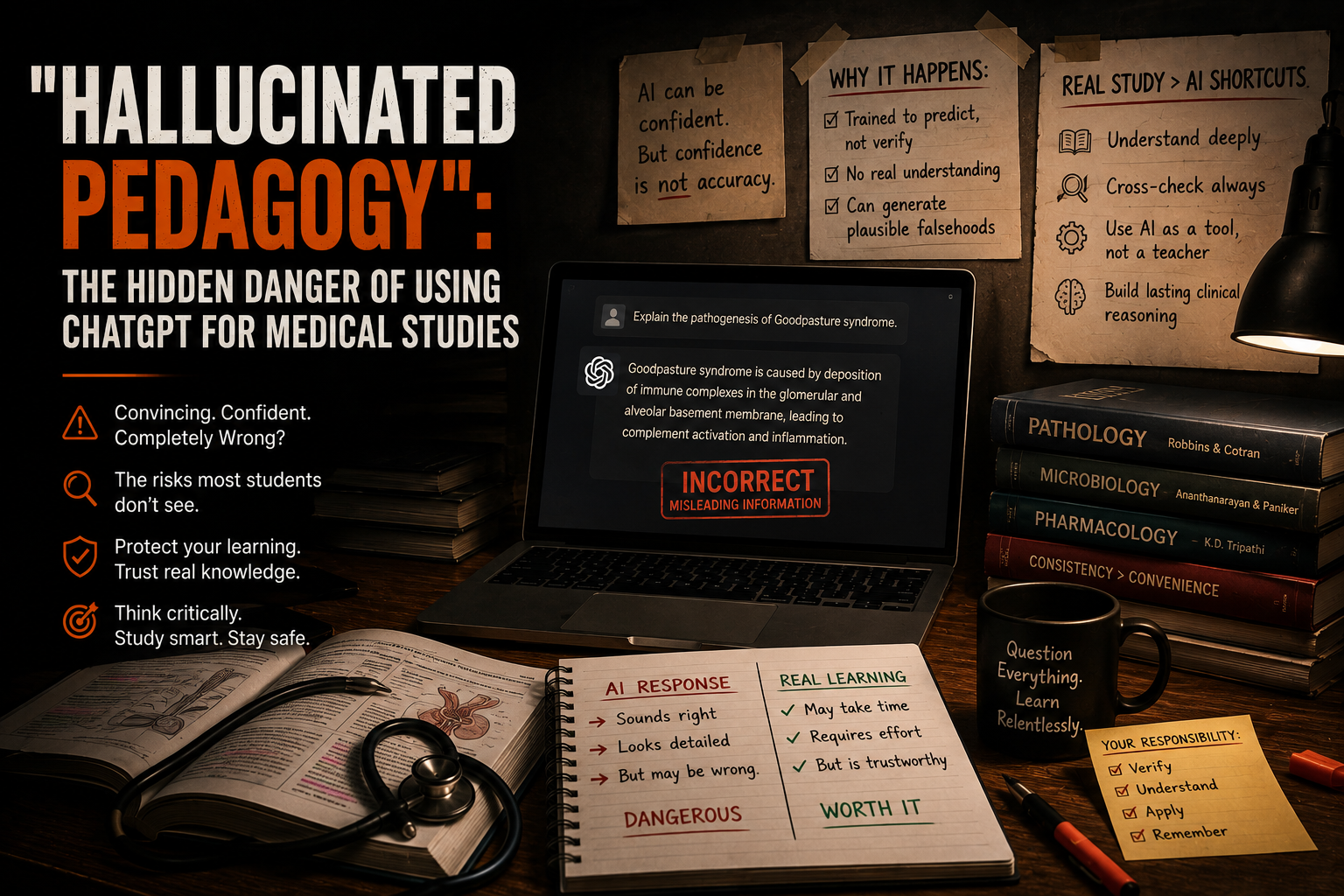
"Hallucinated Pedagogy": The Hidden Danger of Using ChatGPT for Medical Studies
One study found ChatGPT fabricated 69% of its medical citations, and they looked completely real. Here's why that's a different kind of dangerous while you're still learning.
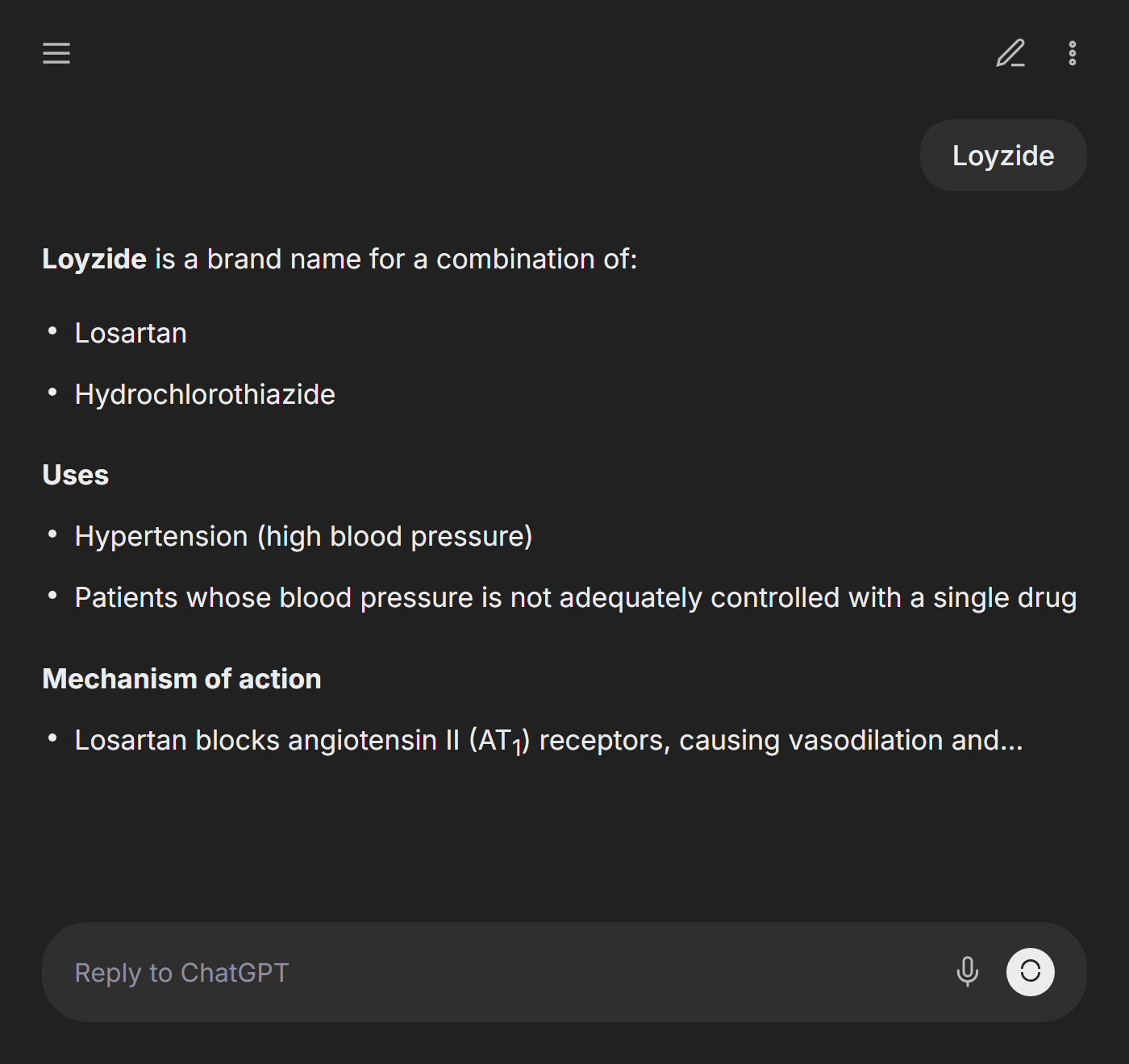
A doctor recently asked ChatGPT a simple question: what is Loyzide?
ChatGPT answered immediately, and confidently. Loyzide, it said, is a combination of Losartan and Hydrochlorothiazide, a blood pressure medication. It listed the uses, hypertension, patients not adequately controlled on a single drug, and explained the mechanism: Losartan blocking angiotensin II receptors to cause vasodilation.
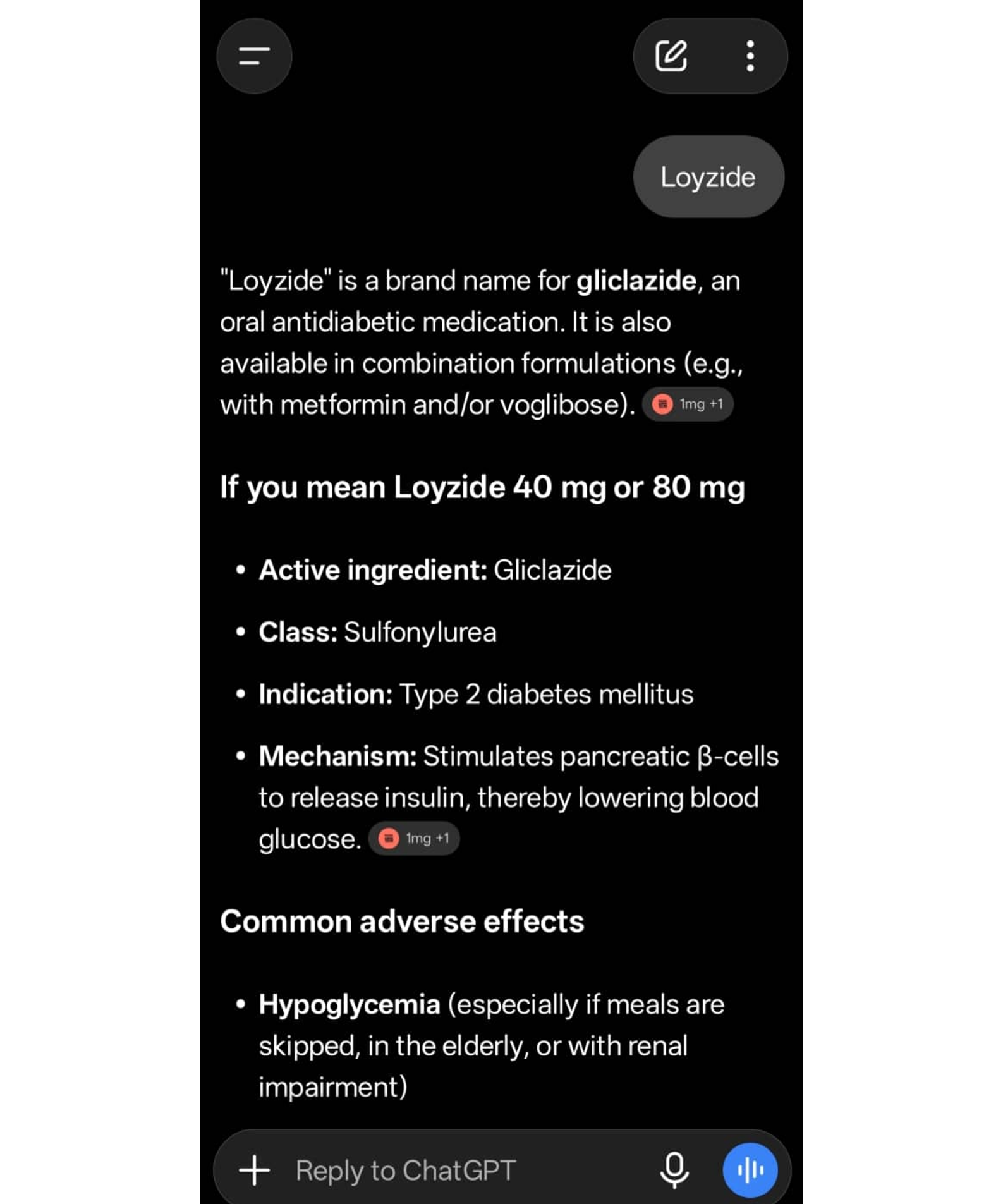
None of that is true. Loyzide isn't a blood pressure medication at all. Real product packaging for Loyzide, the actual brand sold in Indian pharmacies, identifies it as gliclazide, an oral antidiabetic. Not a different dose of the same idea. A different drug, for a different organ system, treating a different disease, working through a different mechanism entirely.
When the doctor went back and asked again, ChatGPT got it right: Loyzide as gliclazide, a sulfonylurea for type 2 diabetes, working by stimulating the pancreas to release insulin.
Same tool. Same tone. Same certainty, both times. One version would have taught a student that a diabetes medication treats blood pressure. Read quickly, at 1 AM, three chapters behind on Pharmacology, there was nothing in how either answer was delivered to tell them apart.
Here's what nobody tells you about a moment like that: you have no real way to know which answer is true, until you happen to check.
What "hallucinated pedagogy" actually means
AI hallucination usually gets described as a technical quirk, a model occasionally inventing a fact. That framing undersells what's actually happening when the tool is teaching you something for the first time. A senior doctor using ChatGPT to double-check a drug interaction already knows enough to notice when the answer looks off. A first-year student asking it to explain a mechanism they've never seen before has no such radar. The model isn't just occasionally wrong. It's confidently functioning as an instructor, and an instructor that fabricates doesn't announce itself. That gap, between how confident the answer sounds and how little you can verify it, is what's actually dangerous here. Call it hallucinated pedagogy: not a wrong answer, a wrong lesson, absorbed as fact because nothing about how it was delivered signaled otherwise.
The citations looked completely real
This isn't a hunch. It's been measured directly. Gravel and colleagues tested ChatGPT (GPT-3.5) against medical questions, checking 59 citations across 20 generated answers. 69% of those citations were fabricated outright. The more striking finding wasn't the rate, it was the quality of the fakes: the invented references used real journal names, real publishers, and author names that genuinely publish in the field. A follow-up analysis in Scientific Reports (Walters and Wilder) confirmed the same pattern held more broadly, fabricated citations that "look legitimate at first glance."
A newer 2026 study out of Deakin University, testing GPT-4o specifically on mental health literature, found more than half of all citations checked, 56%, were fake or contained errors. The rate wasn't constant across topics. For major depressive disorder, a heavily studied condition with abundant training data, only 6% of citations were fabricated. For binge eating disorder and body dysmorphic disorder, both less commonly covered, the fabrication rate jumped to 28% and 29%. The pattern is worth sitting with: the less common the topic, often exactly the topic you're relying on AI to explain because nobody else has, the higher the odds of an invented answer.
This isn't contained to individual study sessions either. A 2026 Lancet systematic review found a twelve-fold increase in fabricated reference rates appearing in actual published biomedical literature between 2023 and 2025, evidence that AI-generated hallucinations are already leaking into the sources students are taught to trust.
It's not just citations
The Loyzide mix-up wasn't a citation problem. It was the explanation itself, the drug class, the indication, the mechanism, that was wrong, which is a harder failure to catch because there's no reference to go check in the first place. That's not an isolated incident either. A 2023 medical-education hazards review found that ChatGPT, evaluated against a medical licensing exam, still missed more than one in three questions. The same review found a separate study in which researchers couldn't even locate 16% of the references ChatGPT had cited, not fabricated exactly, just unfindable. The review also flagged something quieter but just as serious: when a student uses the tool to generate a differential diagnosis but leaves out one physical exam finding, the model doesn't know what it doesn't have. It simply generates a confident, incomplete list, with no indication anything is missing.
Why this hits differently when you're the one learning
Overreliance is the word researchers keep coming back to, and survey data backs up why it's a real concern and not a hypothetical one: a meaningful share of students report rarely cross-checking or editing what ChatGPT gives them before using it to study. That's a reasonable habit to fall into. Verifying every answer defeats a lot of the speed that makes the tool appealing in the first place. But it means an error doesn't just cost you one wrong flashcard. It sits quietly inside your understanding of a topic, indistinguishable from everything you learned correctly, until it resurfaces on an exam, in a viva, or worse, years later at a bedside.
The danger was never that AI gets things wrong sometimes. Every source does. The danger is being taught by something that doesn't know when it's wrong, at the exact point in your training when you don't either.
What actually protects you
None of this means AI has no place in how you study. It means treating it like a very fast, very confident classmate rather than a textbook.
- Treat tone as irrelevant to accuracy. A fabricated citation and a real one are written with identical confidence. Only checking the source tells them apart.
- Be more skeptical, not less, on rare or less-covered topics. The data says that's exactly where fabrication rates climb.
- Never let a generated differential or explanation stand in for the physical findings or history you already have. The model can only reason about what you gave it.
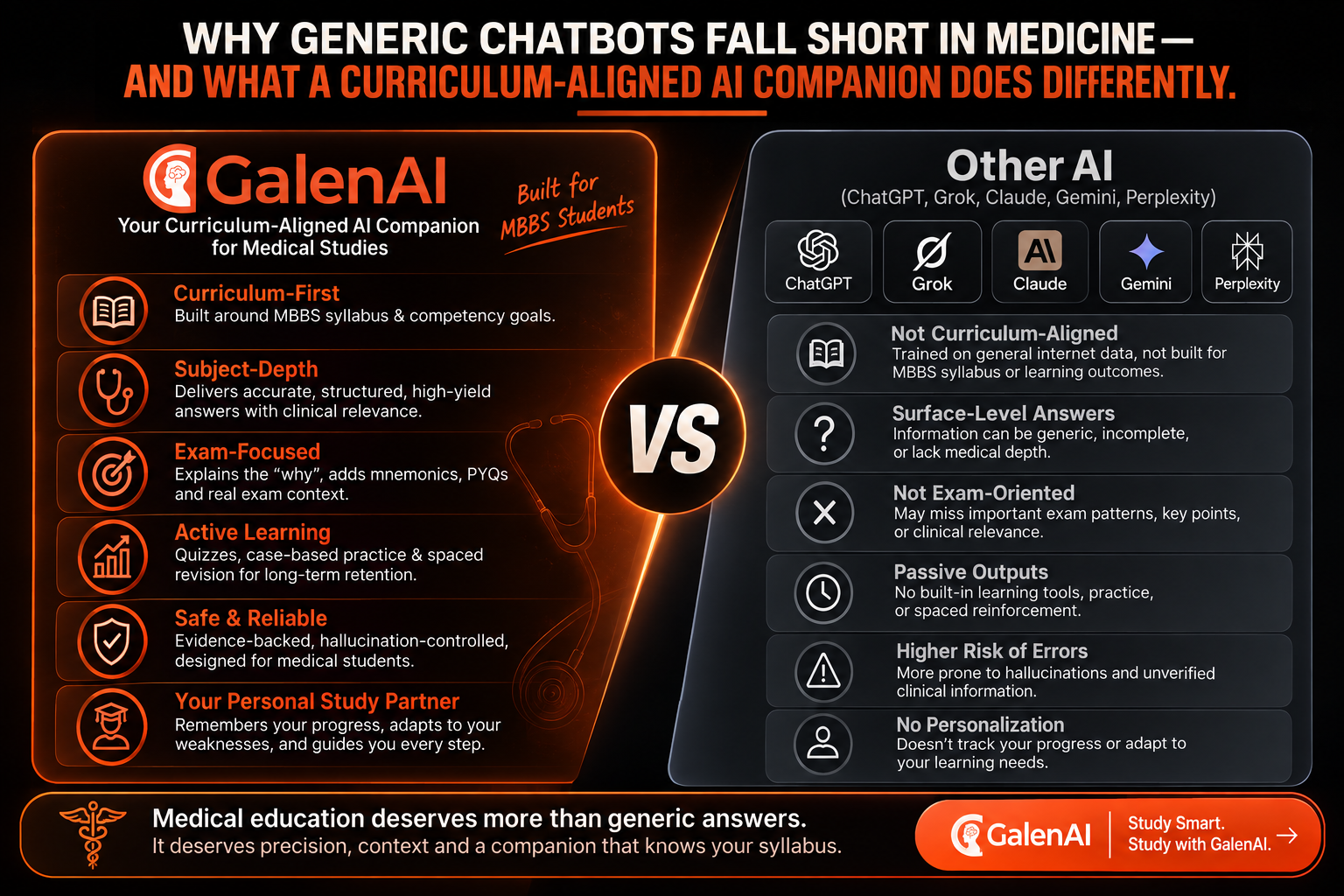
- Prefer tools built on vetted, curriculum-specific content over open-ended generation for anything you're learning for the first time. Grounded answers can still be wrong, but they're wrong less often, and they're checkable against a defined source.
That last point is the actual difference between a general-purpose chatbot and something built specifically for medical study. GalenAI's Tutor Mode and question banks are built on structured, curriculum-mapped content rather than freeform generation, and case-based mode is designed to show its reasoning step by step instead of asserting a conclusion. That doesn't make it immune to every failure mode above. No AI tool currently is. It does mean the answers you're studying from are grounded in something checkable, not a fluent guess dressed up as a citation.
Frequently asked questions
Does this mean I shouldn't use ChatGPT at all for medical studies?
Not necessarily. It means not trusting it as a sole, unverified source, especially for topics you're encountering for the first time or that are less commonly covered. Using it to rephrase or summarize something you can already check against a textbook is a lower-risk use than asking it to teach you something new from scratch.
How common are fabricated citations, really?
Across multiple independent studies, fabrication rates for AI-generated medical citations have ranged from roughly 20% to 69%, depending on the model and topic, and they consistently use real journal and publisher names, which is exactly why they're hard to catch by eye.
Why would a less common topic be more likely to get a hallucinated answer?
Models generate answers based on patterns in their training data. Well-studied topics have more real source material to draw from, so answers tend to track closer to fact. Less-studied topics have thinner real data, which gives the model more room to fill gaps with plausible-sounding invention.
What makes a tool "safer" for medical study than a general chatbot?
Grounding. A tool built on a defined, curriculum-mapped content base can be checked against that source. A general-purpose model generating freeform text from the open internet has no such boundary, which is exactly where fabrication tends to creep in.
The honest summary
ChatGPT isn't lying to you in any sense it's aware of. It's predicting plausible text, and plausible text about medicine is often indistinguishable from correct text, right up until it isn't. That's a survivable risk for a doctor checking something they already mostly know. It's a much harder one for a student building the foundation they'll rely on for the rest of their career. The fix isn't abandoning AI. It's knowing exactly when its confidence is worth trusting, and when it's the one thing you should verify before anything else.
Want AI-assisted studying that's grounded, not just fluent? GalenAI's Tutor Mode, question banks, and case-based practice are built on curriculum-mapped content, not open-ended generation. Try it free.
Sources & References
- 1.Real ChatGPT conversation shared with GalenAI by a practicing doctor (2026), documenting Loyzide (gliclazide) misidentified as a Losartan/Hydrochlorothiazide combination
- 2.Gravel, D'Amico, Smith, "Learning to fake it: limited responses and fabricated references provided by ChatGPT for medical questions" (2023)
- 3.StudyFinds / Deakin University, "ChatGPT's Hallucination Problem: Study Finds More Than Half Of AI's References Are Fabricated Or Contain Errors In Model GPT-4o" (2026)
- 4.PMC, "The Hazards of Using ChatGPT: A Call to Action for Medical Education Researchers" (2023)
- 5.The Lancet, systematic review on fabricated reference rates in biomedical literature, 2023-2025 (2026)