A Surgeon 120 Miles Away Just Treated a Stroke Patient With a Robot
It happened in March, under the name Operation Robo Angel. Here's what the case showed, and what it didn't.
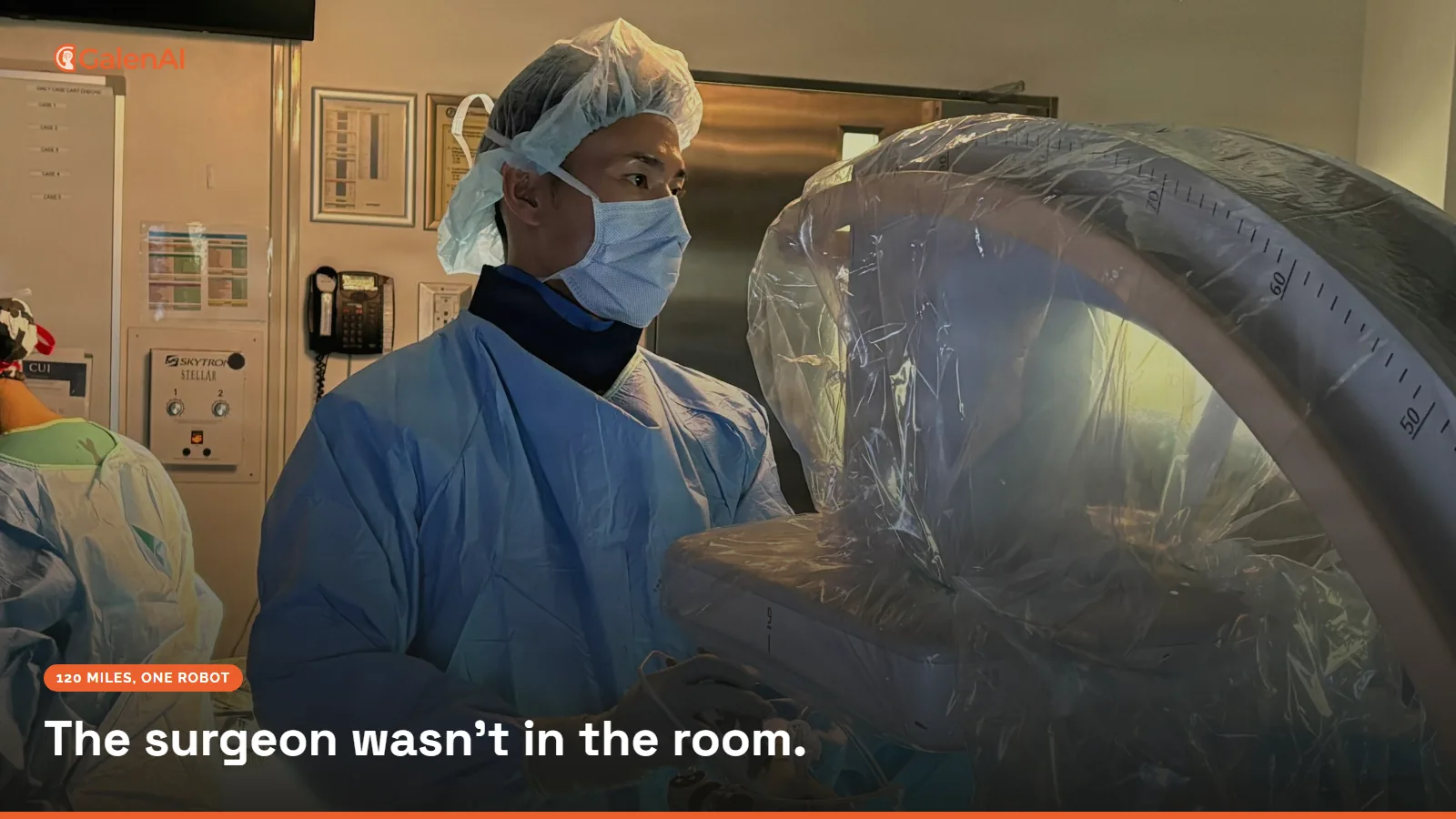
In March 2026, a neurosurgeon sat at a control console in Santiago, Panama, and operated on a stroke patient lying in an operating room in Panama City, more than 120 miles away. The company behind the robot called it Operation Robo Angel. Strip away the name and what's left is a real, documented case, the first time a robot performed a mechanical thrombectomy, the procedure that pulls a clot out of a blocked brain artery, under the control of a surgeon who wasn't in the building.
It's a genuinely new kind of case. It's also one case, built on a robot that still isn't cleared for use anywhere. Both things are true, and the coverage this spring mostly only told you the first one.
What happened in Panama
The system is called Iris, built by a company named XCath. On the day of the procedure, Dr. Vitor Mendes Pereira operated the robot's controls from a station in Santiago while the patient was prepped and treated at The Panama Clinic in Panama City. A local neurosurgeon and a robotic technologist were present in the room with the patient, handling anything the remote system couldn't. Getting the patient positioned and the equipment ready took about fifteen minutes before the procedure itself began.
XCath describes the case as the world's first remote telerobotic mechanical thrombectomy performed in a living patient, and says the connection showed no perceptible latency, meaning the surgeon's movements translated to the robot's instruments without a noticeable delay. That's the company's own characterization of its own case; it hasn't been independently verified or published in a peer-reviewed format as of this writing.
In September 2026, the FDA granted Iris a Breakthrough Device Designation. That's worth being precise about. It means the agency has agreed to prioritize and speed up its review of the device, not that the device has been cleared or approved. XCath says plainly that Iris remains under development and isn't cleared for commercial distribution in any country.
Why stroke is the hardest version of this problem
A mechanical thrombectomy only works if it happens fast, and it only works if there's someone qualified to do it. Both of those are harder than they sound outside a major stroke center.
The "fast" part has a number attached to it. In a widely cited 2006 modeling study published in the journal Stroke, neurologist Jeffrey Saver estimated that an average large-vessel ischemic stroke costs the brain roughly 1.9 million neurons for every minute it goes untreated. It's a modeled estimate, built from sensitivity analysis rather than a direct minute-by-minute count, but the scale of it is the point. By Saver's estimate, an hour without treatment ages the ischemic brain by roughly three and a half years.
The "qualified person" part is a staffing problem, not a technology problem, and it's the one remote robotics is aimed at. Thrombectomy requires a neurointerventionalist, a specialist most hospitals don't have on call at 2 AM, if they have one at all. The standard workaround is called drip and ship: give the patient a clot-dissolving drug, then transfer them to a bigger hospital that has the right specialist. Every mile of that transfer is time the brain doesn't have. A robot that lets a specialist operate from another city, in principle, removes the transfer and keeps the clock closer to zero.
What hasn't been shown yet
Here's the part that didn't make most of the headlines. XCath hasn't released outcome data from the Panama case. Whether the clot was fully removed, how the patient did afterward, none of that has been made public. A single case, with no published outcome, isn't evidence that remote robotic thrombectomy works. It's evidence that it's technically possible to attempt one.
A Breakthrough Device Designation speeds up FDA review. It isn't approval, and it isn't proof the device works at scale. As of this writing, Iris has not been cleared for use anywhere, and the one documented case hasn't published a patient outcome.
That gap matters more than it would for a lower-stakes procedure. Stroke treatment has almost no room for a technology to fail quietly. The honest state of this story, right now, is promising and unproven at the same time.
India already has a version of this, for different procedures
The Panama case wasn't the only telerobotic surgery news this year, and the other one has a more direct India connection. SS Innovations, an Indian company, builds a telesurgery robot called SSi Mantra. As of March 2026, it's authorized for remote procedures in India, Indonesia, and the Philippines, and the company reports more than 150 completed remote surgeries across an installed base in ten countries. Recent cases in India have included gastric bypass, gynecological, and cardiac procedures. The company has raised $18.6 million and is pursuing both FDA clearance and a CE mark.
SSi Mantra isn't being used for stroke thrombectomy yet, and it's a different robot built by a different company for a different set of procedures. But it's solving the same underlying problem Iris is, getting a specific surgeon's hands to a patient who's nowhere near them. One of these systems is already live in Indian hospitals. The other is a single case study in Panama. Worth knowing both exist, and worth not confusing where each one stands.
Where GalenAI fits
Whoever ends up operating the next version of these systems, in the room or a hundred miles from it, the thing that decides whether a stroke patient does well is the same as it's always been, recognizing what's happening fast enough, and knowing what to do about it inside a window that closes by the minute. No robot replaces that judgment. It just changes where the hands are.
Robotics can close the distance to a specialist. It can't substitute for knowing stroke presentation cold, recognizing a large-vessel occlusion, and understanding why every minute of delay has a cost. GalenAI is built to train that reasoning directly.
- Case-based mode walks you through a patient presentation step by step, from symptoms to diagnosis
- Socratic mode asks guiding questions instead of handing you the answer
- Explain mode and Quick Q&A for a clear, fast answer when that's what you need
- Every answer grounded in curriculum-based, NMC-standard textbook content, not the open web
Want to sharpen the clinical reasoning no robot can do for you? Try GalenAI free.
Sources & References
- 1.XCath, Inc., "XCath Announces FDA Breakthrough Device Designation for the Iris Surgical Robotic System," press release via BioSpace, September 10, 2026
- 2.XCath, Inc., coverage of "Operation Robo Angel," the first remote telerobotic mechanical thrombectomy in a living patient, March 2026, reported by Fiercebiotech, NeuroNews International, and MedTech Dive
- 3.MedTech Dive, "SS Innovations' telesurgery robot cleared for remote procedures in Indonesia and the Philippines," March 24, 2026
- 4.Saver, J.L., "Time Is Brain—Quantified," Stroke, 2006