The NEET Leak Didn't Just Cost You Time. Here's the Part Nobody Talks About.
Pathology has too many topics. Your notes are too long to revise. Sound familiar? Here's what to actually do about it, instead of another group chat debate.
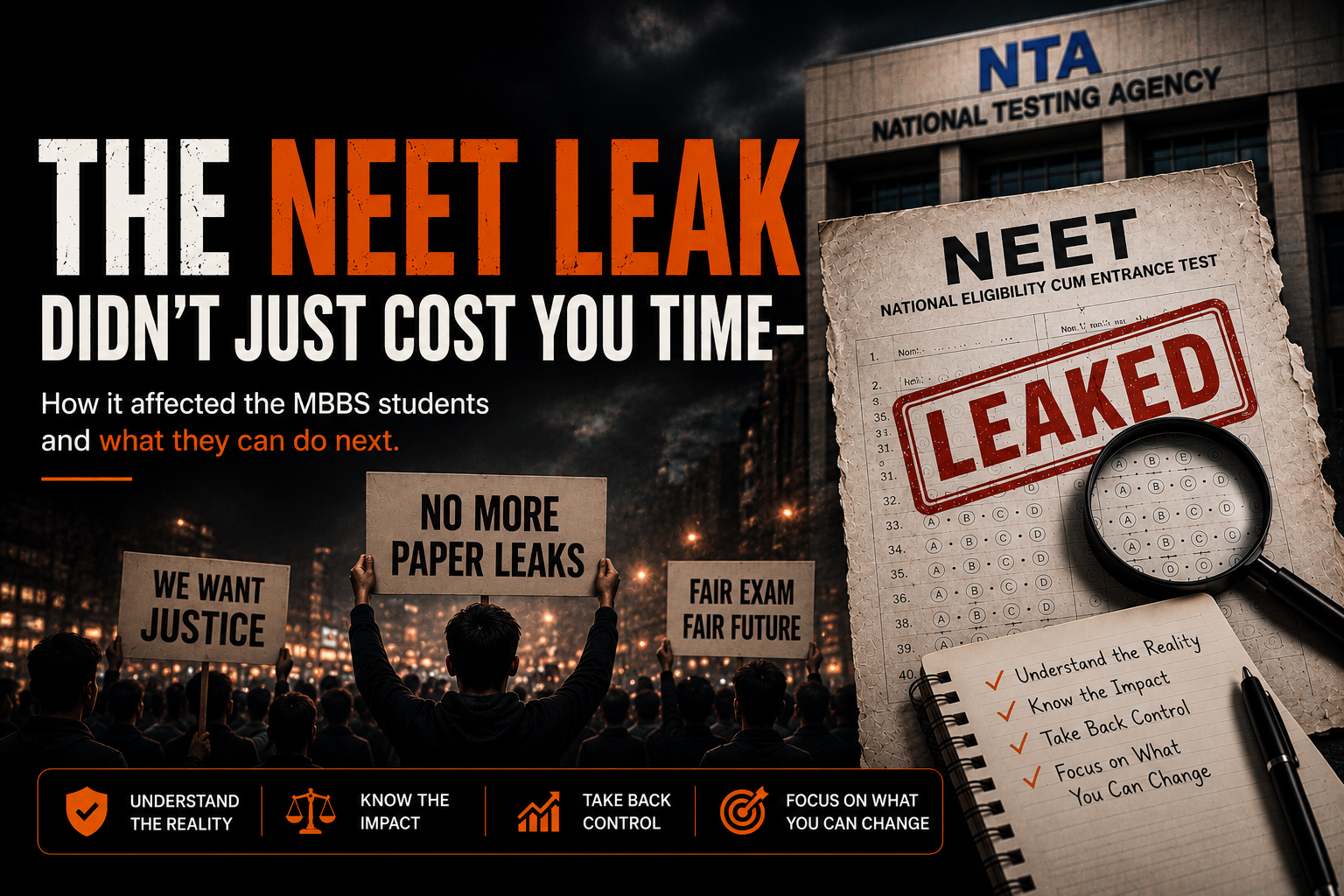
Another hectic day of lectures, assessments, and running on four hours of sleep. You finally push everything else aside, open your books, and think: let's study now.
Thirty minutes in, your phone buzzes ->Then again ->Then three more times stacked on top of each other.
You already know what it is without looking:-
- another forward about the exam controversy,
- another reply-all argument,
- another person with a take nobody asked for.
You open it anyway. Fifteen minutes disappear into a debate that will still be unresolved tomorrow, no matter how good your argument was tonight.
Underneath all that noise, two much quieter thoughts are still sitting there, the ones that actually show up once the group chat finally goes quiet:
- "Pathology has so many topics, I don't even know where to start."
- "I always seem to skip the one topic that ends up in the exam."
None of that has anything to do with any exam controversy. That's just what being an MBBS student feels like on a normal week, controversy or not. And yet somehow, this week, a good chunk of your batch group's time went into discussing a leak instead of any of it.
Being upset about it is fair. Exam integrity is worth caring about, and it deserves the scrutiny it's getting. Here's the part worth sitting with, separate from all that: the controversy will move through its own process, in a courtroom or a committee room, on its own timeline, regardless of how many more hours get spent discussing it tonight. Those two thoughts above won't resolve themselves the same way. They're still sitting there, exactly where you left them, waiting for the hour you get back once the discussion winds down. Here's what to actually do with that hour.
"Pathology has so many topics." Learn it once, then test yourself.
The instinct with a subject like Pathology is to keep re-reading the same forty pages hoping something sticks. It rarely does. What actually works is learning a topic properly once, then immediately checking whether it landed.
That's the two-step GalenAI is built around. Open Tutor Mode and ask it to walk you through the topic you're stuck on, Explain mode for a clean breakdown, Socratic mode if you wanted to be tested on what you know before you are handled the answer. Then, the moment you think you've got it, jump into the matching set in the question bank and find out for real. If you're getting it wrong, you know exactly which part to go back and fix, instead of vaguely re-reading the whole chapter again and hoping.
Topic by topic, that loop is faster than "so many topics" ever feels like it should be.
"My notes are huge, and I always miss something right before the exam." That's what flashcards are for.
This one isn't a discipline problem. Nobody has time to re-read forty pages of handwritten notes the night before an exam, so something always gets skipped, and it's usually exactly the thing that shows up on the paper.
Flashcards exist to solve precisely this. GalenAI turns your topics into short, crisp, one-idea-at-a-time cards instead of dense paragraphs, so a full subject's worth of revision fits into the kind of ten-minute gaps you actually have between classes or right before you sleep. You're not trying to re-read everything anymore. You're just moving through cards until nothing feels shaky.
The topic that always slips through the cracks stops slipping once it's a two-line card instead of a paragraph buried on page 34.
"I know the facts, but the second a question twists them, I freeze."
Recall and application are different muscles, and most study methods only train the first one. You can know a drug's mechanism cold and still blank the moment a case vignette asks what happens when a patient is also on three other medications.
That's exactly what case-based mode is for. Instead of a flat question and answer, you work through a patient scenario the way you'd actually encounter one, symptoms first, reasoning your way toward a diagnosis, one piece of information at a time. It's a closer rehearsal for a viva or a ward round than any Q&A block, and it's the fastest way to find out whether you actually understand a concept or just memorized its shape.
None of this requires more hours than you already have. It just moves some of them from a conversation that was never going to be settled in a group chat, into the parts of MBBS that are entirely up to you.
About the jokes, if you're facing them
If people are joking about whether you "really" earned your seat, arguing back rarely works, because the joke was never really about logic. What actually ends it is the same thing that fixes everything above: being visibly, provably good at the thing in question. A strong case presentation does more work than any comeback line, and it's a better use of the hour either way.
- Stuck on a topic? Tutor Mode explains it before you'd have gotten a reply in the group chat.
- Want to know if it actually landed? The question bank tells you in the same sitting.
- Dreading revision because your notes are too long? Flashcards turn the topic into something you can finish before your next class.
- Freeze on twisted questions? Case-based mode is where you practice freezing less.
Frequently asked questions
My batch group won't stop discussing the controversy. How do I disengage without seeming like I don't care?
You don't have to announce it. Mute the thread, stay in the group for anything logistical, and put the freed-up time into something concrete, a flashcard deck, a question bank set. Nobody remembers who replied to which forward. Everyone eventually notices who's actually prepared.
How do flashcards actually beat rereading my own notes?
Rereading is passive. Your eyes move across the page, but nothing is forced to happen in your memory. A flashcard makes you retrieve the answer yourself, which is the actual mechanism behind remembering something under exam pressure. Short and active beats long and passive almost every time.
Why use a question bank instead of just trusting that I understood the topic?
Understanding while reading and recalling under exam conditions are two different skills. A question bank is the fastest way to find the gap between them, while you can still do something about it.
How is case-based practice different from a regular question bank?
A question bank checks whether you know a fact. Case-based practice checks whether you can use it, the way you'll actually need to with a real patient. Both matter. Only one of them gets trained by most study methods.
The honest summary
The controversy will be decided somewhere else, not in a group chat, no matter how many hours go into the thread. Pathology's topic list, your overgrown notes, and the questions that twist just enough to catch you off guard, those are yours to fix, and unlike the controversy, they're entirely within your control.
Ready to put that hour back to work? Learn a topic in Tutor Mode, test it in the question bank, lock it in with flashcards, and stress-test it with a real case. Try it free
Sources & References
- 1.Outlook India, "NEET-UG 2026 Paper Leak Scandal: Collapse of Trust, Student Suicides and India's Medical Entrance Crisis" (2026)
- 2.Business Standard, "NEET-UG cancellation leaves students battling uncertainty, added costs" (2026)