Quick answer: Glomerular filtration rate (GFR) is the volume of plasma filtered into Bowman's space per minute by all nephrons of both kidneys. The normal value is about 125 mL/min, which is roughly 180 L a day. It depends on filtration pressure, surface area and permeability, and autoregulation keeps it steady. Inulin clearance measures it.
What is GFR?
The glomerular filtration rate (GFR) is the sum of the ultrafiltration rates from plasma into Bowman's space in every nephron. It is expressed as millilitres of filtrate produced per minute. It is the best overall index of kidney function in health and disease.
Put another way, GFR is the product of the average filtration rate of each nephron and the number of nephrons in both kidneys. It can also be thought of as the product of two things:
- How readily the glomerular membrane lets filtration happen (its permeability and surface area)
- The pressure inside the glomerular capillary that pushes fluid through the filter
Normal values
- In a healthy adult of average size the GFR is about 125 mL/min. That is 7.5 L an hour, or about 180 L a day.
- The reference value corrected for body surface area is given as 120 plus or minus 25 mL/min/1.73 m². Another reference gives about 130 for men and 120 for women, with wide variation between people.
- Normal urine volume is only about 1 to 2 L a day, so more than 99% of the filtrate is reabsorbed.
- The kidneys receive about 20% of the cardiac output and filter about 10% of that volume.
- About 20% of the renal plasma flow is filtered into Bowman's space. The ratio of GFR to renal plasma flow is the filtration fraction.
- GFR is indexed to body surface area (1.73 m² for the average person) because it varies with kidney size, which follows body size. Values in women are about 10% lower than in men even after this correction.
- GFR also varies with age, body size, physical activity, diet, blood pressure, drugs and states such as pregnancy.
The filtration barrier
Glomerular filtration is the passage of water and dissolved small molecules from plasma into the space of the glomerular capsule. Larger molecules are largely held back by the selective permeability of the glomerular basal lamina. These include plasma proteins above 70 kilodaltons, molecules with a net negative charge, polysaccharides, lipids and cells.
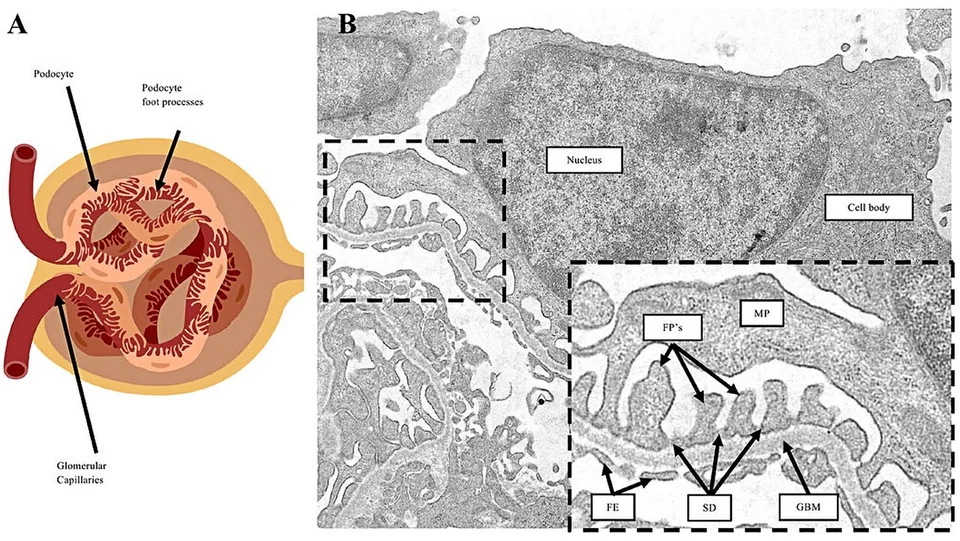
When first formed, the filtrate is isotonic with plasma and has the same concentration of ions and small molecules.
What determines GFR?
GFR depends on the net filtration pressure and the ultrafiltration coefficient (Kf).
- Kf is directly related to the permeability of the glomerular capillary and the surface area available for filtration. Permeability is fairly constant. Surface area can be reduced by intense sympathetic or angiotensin II stimulation, which lowers GFR. In humans Kf is between 8 and 18 nL/min/mmHg, depending on the method of measurement.
- Glomerular capillary pressure (PGC) is the main force pushing fluid out. It rises with renal artery pressure, but it is strongly influenced by the tone of the afferent arteriole (before the glomerulus) and the efferent arteriole (after it).
- Glomerular oncotic pressure opposes filtration. It depends directly on plasma oncotic pressure. As filtrate leaves, the protein concentration in the capillary rises along its length, which raises the oncotic pressure and limits further filtration.
- Bowman's capsule pressure also opposes filtration. Because almost no protein is filtered, the oncotic pressure in the capsule is negligible.
Changes in the glomerular filtration pressure have the biggest influence on GFR in both health and disease.
How the arterioles change GFR
| Change | Effect on glomerular capillary pressure | Effect on GFR |
|---|---|---|
| Afferent arteriole dilates | Rises, because more blood flows into the glomerulus | Increases |
| Afferent arteriole constricts (intense sympathetic or angiotensin II activity) | Falls | Decreases |
| Efferent arteriole constricts mildly (mild sympathetic or angiotensin II activity) | Rises | Tends to increase |
| Efferent arteriole constricts severely | Slows glomerular blood flow, which has the opposite effect | Decreases |
Both renal blood flow and perfusion pressure therefore determine GFR to a large extent.
Autoregulation of GFR
The kidney keeps renal blood flow and GFR relatively constant despite changes in arterial pressure. This is called autoregulation. It works even in a blood-perfused kidney removed from the body, so it does not depend on the rest of the body.
- GFR changes by less than 10% when arterial pressure falls to as low as 70 to 75 mm Hg or rises as high as 160 to 180 mm Hg.
- In most tissues, autoregulation protects oxygen and nutrient delivery. In the kidney, blood flow is already much higher than those needs. The main purpose here is to keep GFR constant, so that excretion of water and solutes can be controlled precisely.
- The mechanisms are not perfect, but they prevent large changes in GFR and urinary excretion that would otherwise follow every change in blood pressure.
Autoregulation depends on three main mechanisms that change afferent or efferent arteriolar tone:
- Myogenic reflex: the afferent arteriole constricts when pressure rises and dilates when pressure falls. This is the first line of defence against sudden changes in renal blood flow and protects the glomerular capillary.
- Tubuloglomerular feedback (TGF): specialised cells of the macula densa, in the thick ascending limb of the loop of Henle, sense solute concentration and tubular flow rate. A high tubular flow rate signals a filtration rate that is too high. The greater solute delivery to the macula densa then causes afferent arteriolar vasoconstriction, which lowers GFR.
- Angiotensin II constricts the efferent arteriole, which helps maintain filtration when perfusion pressure falls.
The juxtaglomerular apparatus regulates flow and filtration in each individual nephron.
Hormones and local factors
| Hormone or autacoid | Effect on GFR | Comment |
|---|---|---|
| Norepinephrine, epinephrine | Decrease | Constrict afferent and efferent arterioles. They matter little except when the sympathetic system is strongly activated, for example in severe haemorrhage. |
| Endothelin | Decreases | A vasoconstrictor peptide released by damaged vascular endothelium. Its physiological role is not fully understood. |
| Angiotensin II | Prevents a fall | Constricts the efferent arteriole, which helps keep GFR up when renal perfusion is low. |
| Nitric oxide (endothelial) | Increases | A vasodilator and a major regulator of GFR. |
| Prostaglandins (PGI2, PGE2) | Increase | Vasodilators. Their main role is to oppose angiotensin II. Cyclooxygenase inhibitors reduce renal blood flow and GFR only when the renin-angiotensin system is activated. |
Mesangial cells contract under vasoconstrictors, which lowers the filtration surface, Kf and the filtration of the single nephron. Vasodilators have the opposite effect.
Other points:
- GFR rises with protein intake, because renal plasma flow increases. The capacity of the kidney to raise GFR above normal is called renal functional reserve.
- GFR and kidney weight are increased in diabetes, pregnancy, after removal of one kidney and with high protein intake.
- Changes in sodium intake between 20 and 1000 mmol a day cause only small variations in GFR.
Measuring GFR: clearance
The clearance of a substance X is the volume of plasma completely cleared of X per minute. It is calculated as:
Clearance of X = (U × V) / P
where U is the urine concentration of X, V is the urine flow per minute and P is the plasma concentration of X.
Inulin: the gold standard
Inulin is a polysaccharide that passes freely through the glomerular capillary wall and is neither reabsorbed nor secreted by the tubules. The amount excreted in urine therefore equals the amount filtered, so inulin clearance equals the GFR. It is the gold standard, but it is not practical for routine use. A loading dose is given intravenously, followed by a continuous infusion to keep the plasma level constant, and then a timed urine collection is made.
Other exogenous markers that are completely filtered and not secreted or reabsorbed, such as radiolabelled EDTA, iothalamate and iohexol, can also be used. Direct measurement is usually kept for special situations, such as assessing potential live kidney donors.
Creatinine clearance
Creatinine is produced by muscle at a relatively constant rate, it is freely filtered and it is not reabsorbed. For this reason creatinine clearance is the most commonly used measure of GFR.
CrCl = (urine creatinine × urine volume) / (plasma creatinine × time in minutes)
Key points:
- It usually needs a 24-hour urine collection, which is inconvenient and often unreliable. The completeness of the collection can be checked from the creatinine content.
- Creatinine is secreted a little by the proximal tubule, so creatinine clearance is slightly higher than inulin clearance and overestimates GFR. This matters mostly when kidney function is poor.
- Plasma creatinine can rise after eating cooked meat, and some drugs affect it.
- Urea clearance underestimates GFR because the tubules reabsorb urea.
Plasma creatinine and GFR
In practice, plasma creatinine is used as the index of renal function. At steady state, creatinine excretion equals creatinine production. If GFR falls suddenly by 50%, the kidneys at first excrete only half as much creatinine and the plasma level rises until excretion matches production again. This happens at about twice the normal plasma creatinine. A fall of GFR to one quarter raises it to about four times normal, and one eighth to eight times normal.
So plasma creatinine is not linearly related to GFR: it is the reciprocal relationship. Serum creatinine may stay inside the reference range until the relative GFR loss exceeds about 50%, which is called the creatinine-blind range. Creatinine also depends on muscle mass, age, sex and diet.
Estimated GFR (eGFR)
Because direct measurement is difficult, equations are used to estimate GFR from serum creatinine plus age, sex and sometimes ethnic origin. Laboratories now routinely report eGFR when serum creatinine is measured.
- The MDRD equation uses serum creatinine, age, sex and ethnic origin. It is better correlated with true GFR when GFR is below 60 mL/min/1.73 m².
- The CKD-EPI equation is more accurate at higher GFRs, and it is better in people with relatively preserved kidney function.
- No equation is best in all populations or at all GFR levels. Equations perform poorly in unusual situations, such as extremes of muscle mass or in acutely ill patients, and they assume a stable plasma creatinine.
- Cystatin C is a protein produced at a constant rate by all nucleated cells. It is proposed as a more sensitive marker of early decline in GFR with less effect from muscle mass. Equations using both creatinine and cystatin C are more accurate than either alone.
GFR in clinical practice
- GFR is a criterion for defining and staging acute kidney disease and chronic kidney disease (CKD). A GFR below 60 mL/min/1.73 m² is regarded as abnormal at any age.
- In early CKD patients can have no symptoms, with only a biochemical rise in urea and creatinine. Later come nocturia, anaemia and disturbed calcium and phosphorus metabolism. With further decline, severe insufficiency brings uraemia and acidaemia.
- When GFR is 5% to 10% of normal, the condition is end-stage renal disease, and survival without renal replacement therapy becomes impossible.
- Blood urea nitrogen is not a good direct marker of GFR. It is influenced by non-renal factors and is not raised until GFR has fallen to almost 75% of normal.
- Decreased GFR is strongly associated with complications, and a falling GFR goes with falling tubular and endocrine functions of the kidney.
GFR and ageing
GFR declines with age. Single-nephron GFR does not change much with age, so the fall is likely because the number of nephrons declines. Renal plasma flow also falls with age, and it falls more than GFR, so the filtration fraction rises.
Common exam traps
Remember: inulin is the gold standard because it is filtered but neither reabsorbed nor secreted. Creatinine overestimates GFR slightly because it is secreted a little. Urea underestimates it because it is reabsorbed.
Practice MCQs
Which substance is the gold standard for measuring GFR?
- A. Urea
- B. Inulin
- C. Creatinine
- D. Para-aminohippurate
Show answer
Answer: B. Inulin is freely filtered and neither reabsorbed nor secreted, so the amount excreted equals the amount filtered. Its clearance therefore equals the GFR.
Creatinine clearance slightly overestimates GFR because creatinine is:
- A. Reabsorbed in the proximal tubule
- B. Not filtered at the glomerulus
- C. Secreted in small amounts by the tubules
- D. Produced only after meals
Show answer
Answer: C. Creatinine is slightly secreted by the proximal tubule, so its clearance is a little higher than inulin clearance and it overestimates GFR.
Which change would reduce GFR?
- A. Strong constriction of the afferent arteriole
- B. Dilatation of the afferent arteriole
- C. Mild constriction of the efferent arteriole
- D. Increase in glomerular surface area
Show answer
Answer: A. Intense afferent constriction lowers glomerular capillary pressure and GFR. Mild efferent constriction tends to raise pressure and GFR. Afferent dilatation raises pressure and GFR.
In tubuloglomerular feedback, increased solute delivery to the macula densa causes:
- A. Efferent arteriolar dilatation
- B. Increased renin release only, with no change in the arterioles
- C. Afferent arteriolar dilatation
- D. Afferent arteriolar constriction
Show answer
Answer: D. High tubular flow means filtration is too high. The macula densa senses the greater solute delivery and causes afferent arteriolar vasoconstriction, which lowers GFR.
If GFR falls to half of normal and steady state is regained, plasma creatinine will be about:
- A. Unchanged
- B. Twice normal
- C. Four times normal
- D. Half of normal
Show answer
Answer: B. Plasma creatinine rises to about twice normal when GFR halves. The relationship is reciprocal, not linear, so a small rise in creatinine can hide a large loss of GFR.
Autoregulation of GFR is effective over which range of arterial pressure?
- A. 40 to 60 mm Hg
- B. 50 to 100 mm Hg
- C. About 70 to 180 mm Hg
- D. 200 to 250 mm Hg
Show answer
Answer: C. Autoregulation keeps GFR changing by less than 10% across arterial pressures of about 70 to 75 up to 160 to 180 mm Hg. Its main purpose in the kidney is to keep GFR constant.
Viva questions
Define GFR and give its normal value.
The volume of plasma filtered into Bowman's space per minute by all nephrons of both kidneys. About 125 mL/min, or about 180 L a day.
What are the determinants of GFR?
The net filtration pressure (glomerular capillary pressure, opposed by oncotic pressure and capsular pressure) and the ultrafiltration coefficient Kf, which depends on capillary permeability and filtering surface area.
What is autoregulation of GFR and how is it achieved?
Constancy of GFR and renal blood flow despite changes in arterial pressure. It is achieved by the myogenic reflex of the afferent arteriole, tubuloglomerular feedback through the macula densa, and angiotensin II constriction of the efferent arteriole.
Why is inulin the gold standard for GFR?
It is freely filtered and neither reabsorbed nor secreted, so the amount excreted equals the amount filtered. It is not used routinely because it needs an infusion and a timed urine collection.
Why does creatinine clearance overestimate GFR slightly?
Because the proximal tubule secretes a small amount of creatinine. This matters most when kidney function is poor.
Why is serum creatinine a poor early marker of falling GFR?
It is not linearly related to GFR. It may stay within the reference range until more than about 50% of GFR is lost. It also depends on muscle mass, age, sex and diet.
What is the filtration fraction?
The ratio of GFR to renal plasma flow. About 20% of the renal plasma flow is filtered into Bowman's space.
Flashcards
Still unsure about autoregulation and tubuloglomerular feedback? Ask the GalenAI tutor and practise GFR MCQs.