Teaching AI to Medical Students: What the US Did and Where India Stands
The US moved AI into medical teaching within a single survey cycle. India has the policy language but little formal AI teaching so far. Here is what the numbers show, and why students who use chatbots still need answers they can check.
Two things are happening in medical education at the same time. Schools are being asked to teach AI as part of clinical training, and students are already using chatbots to study, often without anyone showing them how to check the answers. This post looks at how the US went from a handful of optional AI topics to formal guidance, where India stands now, and what the gap means for students.
India's MBBS seats have nearly tripled
On July 24, 2026, India's Ministry of Health told the Lok Sabha that the country has 844 medical colleges, up from 387 in 2014. MBBS seats went from 51,348 to 1,39,489 over the same period, and postgraduate seats from 31,185 to 86,360 (Ministry of Health and Family Welfare, 2026).
Seats are the easy part to count. What students are taught alongside them is harder to measure, and that is where the comparison with the US gets interesting.
How the US moved AI into teaching
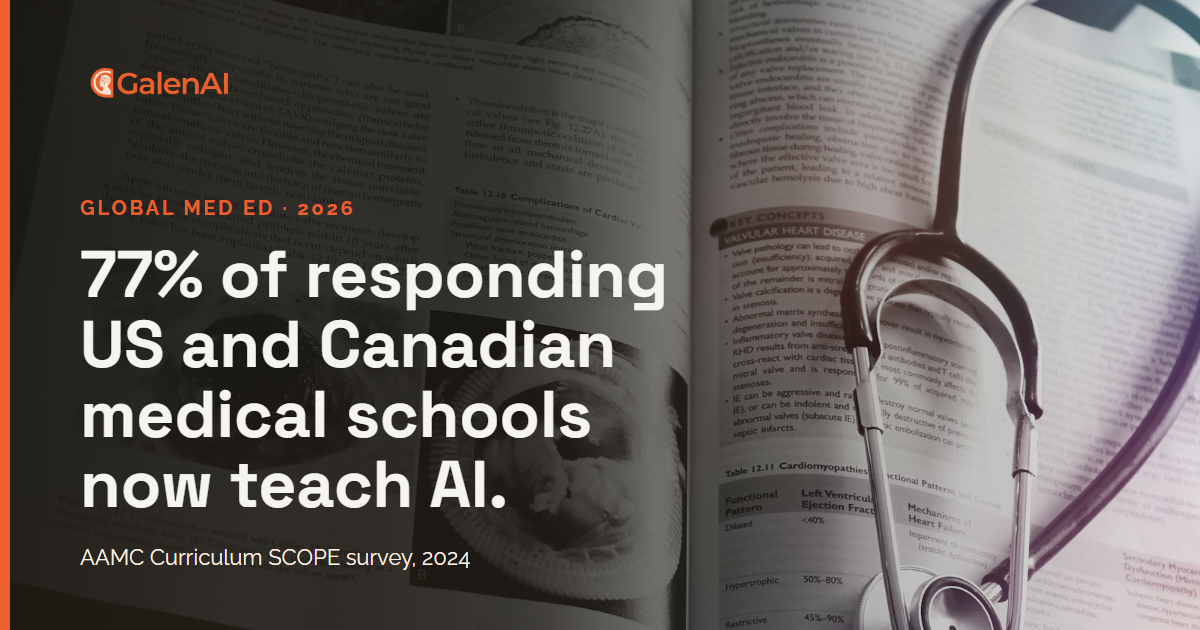
The US changed quickly. In the AAMC's Curriculum SCOPE survey, 88 of 166 responding MD and DO schools reported AI content in 2023, about 53%. A year later, 140 of 182 did, about 77%. Required AI content went from 61 of those 88 schools to 107 of the 140 (AAMC, 2025). The 2023 wave left out Canada, so read the trend as directional rather than exact.
Guidance followed. In January 2025 the AAMC published principles for responsible use of AI in medical education, and it revised them in July 2025. Principle 5 asks schools to build AI curricula with input from across the institution and to assess them as they go (AAMC, 2025). The AAMC's full competencies framework is still in development, with a final report due in fall 2026.
The gaps are real too. In 2024, 94 of 182 schools, about 52%, did not have an appropriate use policy for AI, and only 30% gave students secure access to AI agents (AAMC, 2025). Among osteopathic schools, 14 of the 15 deans who answered a 2025 survey said their school had no student-focused generative AI policy (Ichikawa et al., 2025). The LCME listed the impact of AI among its top ten challenges for medical education in June 2024 (LCME, 2024).
Where India stands
India's curriculum has started to name AI. The NMC's 2024 CBME curriculum letter includes the use of information technology and artificial intelligence in the foundation course, and an elective on AI and computers in health and medical education (NMC, 2024).
Teaching on the ground is thinner. In May 2026, Khilnani argued that formal AI literacy is still missing from undergraduate medical curricula in India, and proposed a 20-hour AI literacy module for the MBBS foundation course (Khilnani, 2026). The most visible national programme so far is an online AI course from the National Board of Examinations in Medical Sciences: 20 modules over six months, starting January 2026. It is open to PG trainees, faculty, and registered doctors, not MBBS students (Medical Dialogues, 2025).
Students show the same gap. In a survey of 217 students at AIIMS Nagpur, 91.2% had no prior AI training, and 87.1% wanted AI taught in the curriculum (Sorte et al., 2025).
Side by side
| Area | United States | India |
|---|---|---|
| AI in the curriculum | 77% of responding MD and DO schools in 2024 (AAMC, 2025) | No national survey found in the sources reviewed |
| National guidance | AAMC principles v2.0, July 2025 (AAMC, 2025) | CBME 2024 letter lists AI in the foundation course and electives (NMC, 2024) |
| Student AI training | Schools without an appropriate AI use policy: about 52% (AAMC, 2025) | 91.2% of 217 surveyed students had no prior AI training (Sorte et al., 2025) |
| Student AI use for study | Not measured in the sources reviewed | 91.6% of 297 AIIMS Rishikesh MBBS students use AI academically (Bokan et al., 2026) |
Put simply, India has the policy language, and a large share of its students already use these tools. What is still being built is the structured teaching that shows students how to use them well.
The US built AI teaching by surveying schools, publishing principles, and tracking gaps. India has named AI in its curriculum but has not yet measured how widely it is taught.
Students are getting wrong answers from chatbots
Indian students already rely on general chatbots. In a survey of 385 students in Mumbai, 86% used chatbots for academic work and 69.4% used them for exam preparation (Saran et al., 2025). At AIIMS Rishikesh, 72.1% of 297 students said they worried about accuracy, yet 55.9% said they trusted the output (Bokan et al., 2026). Those two numbers are the problem: students are cautious in theory and trusting in practice.
The errors are easy to measure. GPT-4 answered 129 of 200 NEET-PG 2023 questions correctly, or 64.5% (Paul et al., 2024). On NEET-PG-style practice sets, ChatGPT scored 60.7% and Bing AI 83.9% (Ramnani et al., 2024). On drug dosage queries, GPT-4 was right 83.77% of the time, so roughly one answer in six was wrong (Ramasubramanian et al., 2024).
Fabricated sources are a quieter problem. In one test of medical questions, 41 of 59 ChatGPT references (69%) were made up, though they looked like real citations from real journals (Gravel et al., 2023). An Indian study found 47% of 115 references fabricated and another 46% real but inaccurate (Bhattacharyya et al., 2023).
A doctor shared one case with us. They asked ChatGPT what Loyzide is. Loyzide is sold in Indian pharmacies, and its packaging says gliclazide, an antidiabetic. ChatGPT first described it as a losartan and hydrochlorothiazide combination, a blood pressure drug. When asked again, it gave the right answer. Both replies sounded equally sure.
Two caveats matter. The accuracy studies test models from 2023 and 2024, and we found no Indian study that measures real harm to a student from an AI error. The pattern is consistent, but the harm itself has not been measured yet.
Where GalenAI fits
Picture a student asking a general chatbot about a drug. They get a clear answer with no source, and no way to tell whether it matches the textbook they will be examined on. GalenAI is built for that gap. It answers from curriculum-based, NMC-standard textbook content rather than the open web, so the student can check the answer against material they are already studying. Tutor Mode gives a few ways in: a step-by-step explanation, a Socratic run of questions, a patient case, or a quick answer between sessions.
No AI is error-free, and GalenAI does not say otherwise. The goal is simple: a student preparing for NEET-PG or their MBBS exams should be able to see where an answer came from before they rely on it.
Why choose GalenAI over ChatGPT? A general chatbot answers from the open web and gives every answer the same confidence. GalenAI keeps answers tied to your curriculum, so you can check them, and it builds recall with flashcards and clinical cases, not just answers. No AI is error-free, but with GalenAI you can always see where an answer came from. Try GalenAI free.
Sources & References
- 1.AAMC, "Artificial Intelligence Curricula in U.S. and Canadian Medical Schools," Curriculum SCOPE Survey, June 2025
- 2.AAMC, "Principles for Responsible Use of Artificial Intelligence in and for Medical Education," version 2.0, July 31, 2025
- 3.Ichikawa et al., JMIR Medical Education, February 11, 2025
- 4.LCME, "Top Ten Challenges," June 2024
- 5.National Medical Commission, Undergraduate Medical Education Board, CBME curriculum letter (D-11011/500/2024-AcademicCell), September 12, 2024
- 6.Medical Dialogues, report on the NBEMS online AI programme for doctors, December 31, 2025
- 7.Khilnani, "Integrating Artificial Intelligence Literacy into the Foundation Course of Competency Based Medical Education: A Proposed Module for Indian Undergraduate Medical Students," GAIMS Journal of Medical Sciences, 2026
- 8.Sorte et al., Journal of Education and Health Promotion, AIIMS Nagpur, May 30, 2025
- 9.Bokan et al., Cureus, AIIMS Rishikesh, March 19, 2026
- 10.Saran et al., Indian Journal of Medical Research, Mumbai, December 27, 2025
- 11.Paul et al., Cureus, June 24, 2024
- 12.Ramnani et al., Cureus, December 20, 2024
- 13.Ramasubramanian et al., World Journal of Methodology, December 20, 2024
- 14.Bhattacharyya et al., Cureus, May 19, 2023
- 15.Gravel, D'Amours-Gravel & Osmanlliu, "Learning to Fake It: Limited Responses and Fabricated References Provided by ChatGPT for Medical Questions," Mayo Clinic Proceedings: Digital Health, June 12, 2023