CBME Decoded: The Complete Guide to Competency-Based Medical Education for Students & Faculty
Competencies, SLOs, AETCOM, workplace-based assessment, the 7 roles of an Indian Medical Graduate — the full framework behind NMC's 2024 curriculum, not just the headlines.
Most explainers stop at "CBME means continuous assessment now." That's true, but it's the headline, not the framework. This guide goes one level deeper — into the actual units CBME is built from: competencies, Specific Learning Objectives, the AETCOM module, and the assessment toolkit institutions are required to run. If you're a student, this is what your professors are actually working from when they write a question. If you're faculty, this is the shared vocabulary the NMC expects you to use.
What is CBME, in NMC's own framing?
The National Medical Commission defines the goal of undergraduate medical education as producing an Indian Medical Graduate (IMG) — someone with the knowledge, skills, attitudes, and responsiveness to work as a competent community-based primary care physician, while remaining globally relevant. The Competency Based Medical Education (CBME) Curriculum, formalised 12 September 2024, is the mechanism for getting there: learner-centric, patient-centric, outcome-oriented, and gender-sensitive, with deliberate horizontal and vertical integration across subjects rather than teaching them in isolation.
Competency, competence, and competent — not the same word three times
These get used interchangeably, but CBME treats them as distinct:
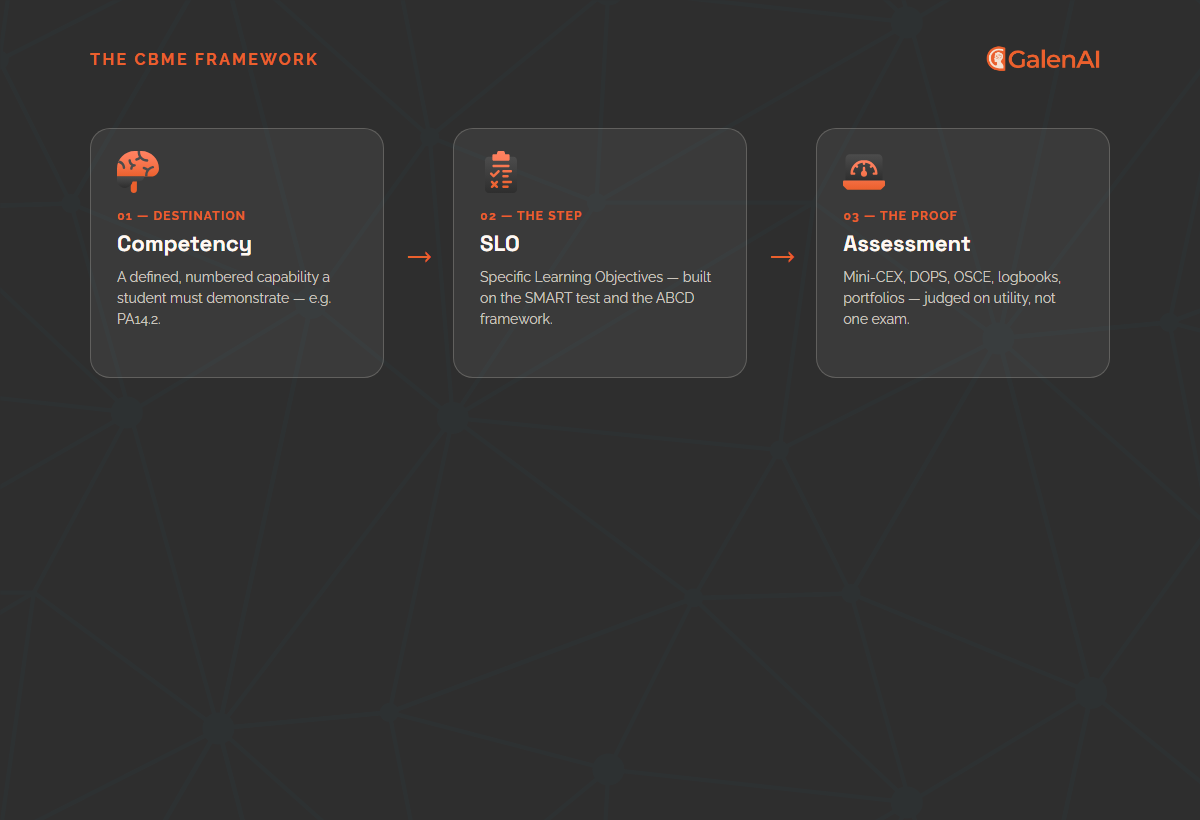
- Competency — a specific, defined capability: the knowledge, skill, or attitude needed to perform a task effectively. Competencies are numbered and published subject-wise by the NMC. Example (Pathology): PA14.2 — Describe the aetiology, investigations and differential diagnosis of microcytic hypochromic anaemia.
- Competence — the broader degree of proficiency a person holds in a field; not one skill, but the overall capability.
- Competent — describes the person: someone who actually holds the requisite knowledge, skill, and judgment to perform the role, sometimes with legal/ethical weight attached (a court or a regulator can ask whether a doctor was "competent" in a given situation).
A subject's competency list is the actual source document faculty write lesson plans and exam questions from — it's not background policy, it's the syllabus.
Specific Learning Objectives (SLOs) — the real unit of teaching
A competency is the destination. An SLO is the step — a statement of what a learner should be able to do at the end of one specific teaching session that they couldn't do before. Every properly written SLO is checked against two frameworks:
The SMART test
- Specific — narrowly scoped, not vague
- Measurable — assessable through a defined tool
- Achievable — realistic within the course structure
- Relevant — tied to the actual competency
- Time-bound — attached to a defined point (end of a module, end of a session)
The ABCD framework
Every SLO should be traceable to four components:
- Audience — who is the learner? (e.g. "Phase II MBBS students")
- Behaviour — what should they be able to do?
- Condition — under what conditions, or with what tool? (e.g. "using a microscope," "given a lab report")
- Degree — how well, and by when?
Worked example
Take the Pathology competency above — PA14.2: describe the aetiology, investigations, and differential diagnosis of microcytic hypochromic anaemia. Broken into SLOs, by the end of the session a Phase II learner should be able to:
- Define microcytic hypochromic anaemia and the physiological basis of red cell size and haemoglobin content. (cognitive)
- Enumerate the common aetiologies. (cognitive)
- Discuss iron metabolism's role in iron-deficiency anaemia. (cognitive)
- Outline the principles of laboratory investigation. (cognitive)
- Interpret lab results from a patient report, as correctly as possible. (psychomotor)
- Evaluate a peripheral blood smear for characteristic features. (psychomotor)
- Communicate to a patient why investigating and treating anaemia matters. (affective)
- Collaborate with haematology specialists on management. (affective)
Notice the spread across three domains — cognitive (knowledge), psychomotor (skill), affective (attitude). A well-built competency isn't just "know the facts" — it's built to produce a doctor who can reason, do, and behave correctly, and each domain gets tested differently.
Why this matters if you're a student: when a question or OSCE station feels unusually specific, it's not arbitrary — it was very likely reverse-engineered from an SLO exactly like the one above. Knowing the ABCD behind a question tells you exactly what "correct" looks like to the examiner.
The 7 roles of an Indian Medical Graduate
CBME doesn't just define subject knowledge — it defines what kind of professional the degree is meant to produce. The NMC originally specified five roles: Clinician, Communicator, Professional, Leader, and Lifelong Learner (plus member of the health care team and system). A gazette notification dated 1 August 2023 added two more: Critical Thinker and Researcher — a detail most explainers of CBME miss entirely, because it postdates the version of the framework most people learned.
Two of these roles — Professional and Communicator — can't be taught implicitly through subject lectures alone. That's precisely why the NMC built a dedicated module for them.
AETCOM — the module most people can't fully explain
AETCOM (Attitude, Ethics and Communication) is a longitudinal module running from Phase I through Phase IV MBBS, introduced specifically to make the Professional and Communicator roles explicit and assessable rather than assumed. It covers three domains:
- Right attitude and professionalism — empathy, compassion, patient-centred care.
- Ethics and decision-making — applying autonomy, beneficence, non-maleficence, and justice to real clinical dilemmas.
- Communication skills — clear, empathetic, jargon-free patient communication and shared decision-making.
Who teaches it was genuinely contested for years — early guesses ranged from "only the Medical Education Unit" to "whichever department feels responsible" (Community Medicine and Anatomy, via the "cadaver as first teacher" idea, were both floated). The NMC resolved this by explicitly distributing AETCOM competencies department-wise, phase-wise, per the CBME guidelines dated 1 August 2023 and refined in the CBME 2024 guidelines — every department now knows exactly which AETCOM competencies it owns and in which paper they're assessed.
- Confirm your department's AETCOM competencies (per the Aug 2023 distribution) are actually mapped to a paper/session — not assumed to be "someone else's job."
- AETCOM assessment isn't optional decoration: it can include short essays, reflective portfolios, OSCE-based scenarios, and viva voce — with at least one AETCOM question mandated in every subject's assessment.
How students are actually assessed under CBME
CBME's assessment principle is programmatic: many small, varied observations over time, not one high-stakes exam. The toolkit institutions are expected to run includes:
| Tool | What it captures |
|---|---|
| Mini-CEX (Mini-Clinical Examination Exercise) | Direct observation of a real patient encounter — history, exam, diagnosis, plan — rated across interview skill, exam skill, professionalism, and overall competence |
| DOPS (Direct Observation of Procedural Skills) | Structured rating of a procedure: prep, technique, asepsis, and post-procedure steps |
| OSCE (Objective Structured Clinical Examination) | Multiple timed stations, each testing one discrete skill, scored against a checklist — built for reliability across many contexts, not just one |
| OSPE (Objective Structured Practical Examination) | The OSCE's counterpart for lab/basic-science skills (anatomy, biochemistry, pathology) |
| Case-based discussion / Chart-stimulated recall | A structured 20-minute oral exam on a real case, probing the reasoning behind each decision, with mandatory feedback |
| Logbook | A running record of every clinical encounter, procedure, and session a student completes — the primary evidence trail for formative assessment |
| Portfolio | Like a logbook, but with added reflection — what the student learned from each experience, used to plan the next step |
None of these tools is "the best" in isolation. NMC's own framing judges an assessment by its utility — validity × reliability × feasibility × acceptability × educational impact, multiplied together. A single long case feels realistic but has poor validity (one patient, one context); many short OSCE stations sacrifice some realism for much better reliability. That's why CBME leans on a mix, tracked longitudinally in the logbook/portfolio, rather than any single high-stakes test.
Why this matters if you're a student: your logbook and portfolio aren't paperwork to fill in retrospectively before an exam — they're your actual evidence trail. Treat every Mini-CEX, DOPS, and OSCE as a data point that's being collected on you continuously, because it is.
Traditional vs. CBME — the shift in one table
| Variable | Traditional | CBME |
|---|---|---|
| Curriculum driven by | Content | Outcomes |
| Process driven by | Teacher | Learner |
| Responsibility for content | Teacher | Both teacher and learner |
| Assessment style | Mostly subjective | Authentic — mimics real professional tasks |
| Assessment emphasis | Summative | Formative |
| Programme completion | Fixed time | Variable, until competency is demonstrated |
What the NEXT exam means for you
The National Exit Test (NEXT) runs in two stages:
- Stage 1 — during the 54th week of the MBBS course.
- Stage 2 — during the 12th month of the Compulsory Rotating Medical Internship (CRMI).
Full NEXT rollout has been delayed to 2026, with pilot testing and practice papers released in 2025 — so 2025-26 is the window to get familiar with the format before it counts for real.
Action items this term
- Learn to read a competency the way it's actually written — SMART + ABCD — so you know what "correct" means before you're tested on it
- Keep your logbook current and treat every Mini-CEX/DOPS/OSCE as real evidence, not a formality
- Don't treat AETCOM as a soft, skippable subject — it's assessed in every paper, with mandatory questions
- Practise reasoning over recall — case-based discussions and OSCEs test application, not memorisation
- Get familiar with the NEXT two-stage format using 2025 practice papers
- Confirm your department's AETCOM competencies (Aug 2023 distribution, refined in CBME 2024) are actually assigned and assessed, not assumed
- Audit assessment infrastructure: OSCE/OSPE stations, DOPS-capable procedure lists, Mini-CEX training for assessors
- Check that logbook/portfolio review is happening for every student, not a sample — and that it's used formatively, not just filed
- Run a blueprinting exercise per subject: does your assessment mix actually cover the full competency list, weighted appropriately across knowledge/skill/attitude?
- Verify faculty are trained on the SMART/ABCD framework — badly written SLOs upstream produce unfair or unclear assessments downstream
FAQ
What's the difference between a competency and a learning objective? A competency is the overall capability a student must demonstrate (e.g. diagnosing a condition). A Specific Learning Objective (SLO) is one measurable step toward it, written to the SMART criteria and traceable via the ABCD framework (Audience, Behaviour, Condition, Degree).
What is AETCOM and why is it separate from regular subjects? AETCOM (Attitude, Ethics and Communication) is a longitudinal module (Phase I-IV) built specifically to teach and assess the Professional and Communicator roles of an Indian Medical Graduate — roles that don't get taught reliably through subject lectures alone. Competencies are distributed department-wise per NMC's August 2023 and 2024 guidelines, with at least one AETCOM question mandatory in every subject.
How many roles does an Indian Medical Graduate have to fulfil? Seven: Clinician, Communicator, Professional, Leader, Lifelong Learner, and member of the health care team/system — plus Critical Thinker and Researcher, added by gazette notification on 1 August 2023.
What tools are used to assess clinical skills under CBME? A mix, not one exam: Mini-CEX, DOPS, OSCE, OSPE, case-based discussion, logbooks, and portfolios — judged collectively on validity, reliability, feasibility, acceptability, and educational impact.
When is the NEXT exam happening? Two stages — the 54th week of MBBS and the 12th month of the CRMI internship. Full rollout is delayed to 2026, with pilot testing and practice papers released in 2025.
Want to practice the way CBME actually assesses you? Try GalenAI free — case-based clinical reasoning and CBME-mapped Q-banks, not just recall drills.
Sources & References
- 1.NMC — Competency Based Medical Education (CBME) Curriculum 2024, dated 12 September 2024, nmc.org.in
- 2. NMC — Competency-based UG Curriculum for the Indian Medical Graduate, Vol I-III, nmc.org.in
- 3.NMC — AETCOM Book (Attitude, Ethics and Communication), nmc.org.in
- 4."Basic Concepts in Medical Education, As per NMC Basic Course in Medical Education Module for Faculty Members" — Deb Roy A, Chaudhuri A, Ghosh A, et al. (eds. Shah C, Barua P), CBS Publishers, 1st eBook ed. 2025
- 5.NMC Revised CBME Guidelines and Modified MBBS Exam Passing Criteria, pw.live